
How to Talk About Likes and Dislikes in English Naturally
I like and I don't like will get you started, but natural speakers use a whole scale of phrases, from I'm really into to It's not really my thing to I can't stand. Here are the phrases arranged by strength, the grammar after each one, how to soften dislikes politely, and how to keep a conversation going.

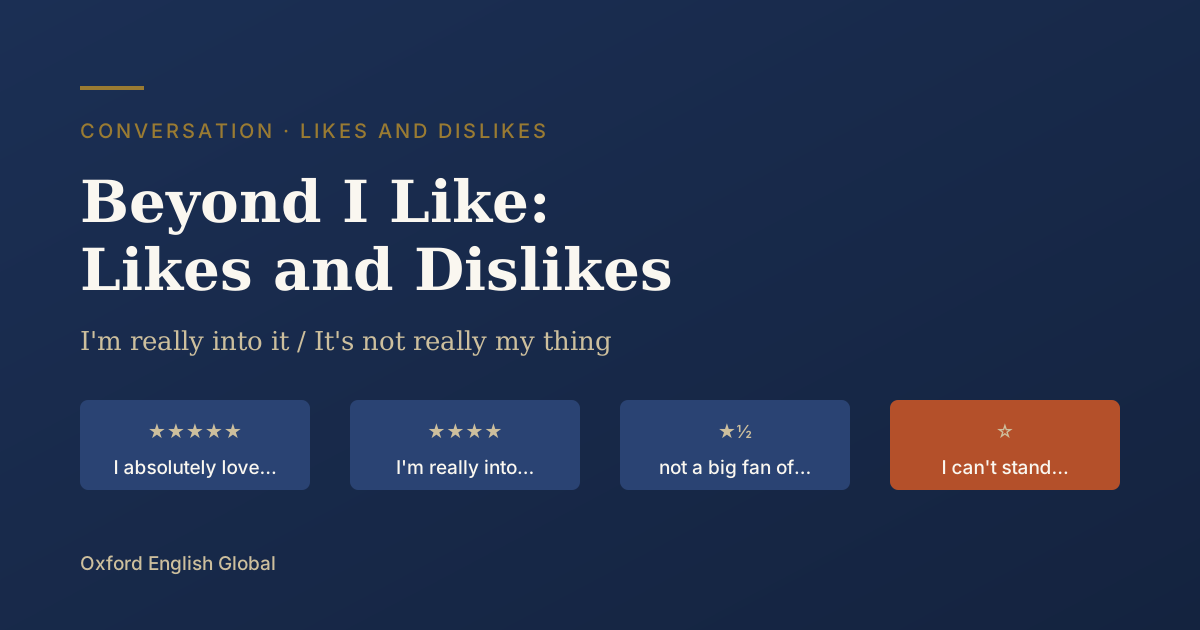
- The likes and dislikes scale
- The grammar after each phrase
- Adjectives and other ways to show your feelings
- Being polite: softening dislikes
- Asking and answering in real conversation
- A sample conversation
- Talking about preferences
- Common mistakes
- Practice: say it more naturally
- What this article cannot tell you
To talk about likes and dislikes naturally in English, go beyond I like and I don't like by using a range of phrases with different strengths. For strong likes, say I love…, I'm really into… or I'm a big fan of…. For milder likes, use I quite like… or I don't mind…. For dislikes, soften them with I'm not a big fan of… or It's not really my thing, and keep strong phrases such as I can't stand… for things you really dislike. Most of these phrases are followed by a noun or an -ing form: I'm really into cooking, I can't stand waiting. This guide gives you the phrases arranged on a scale from strongest like to strongest dislike, the grammar after each one, how to answer and ask follow-up questions, and the politeness rules that keep conversations friendly.
About this guide. The phrases and grammar here are standard in modern British and American English and appear in learner references such as the Cambridge Dictionary's English Grammar Today and the British Council's learning materials. Register notes (formal, neutral, informal) reflect how the phrases are typically used in conversation.
The likes and dislikes scale
Think of likes and dislikes as a scale, not a yes/no choice. Choosing the right strength makes you sound natural and polite.
| Strength | Phrases | Example |
|---|---|---|
| ★★★★★ Love | I love… / I absolutely love… / I adore… / I'm crazy about… (informal) | I absolutely love hiking in the mountains. |
| ★★★★ Really like | I'm really into… / I'm a big fan of… / I really enjoy… / I'm keen on… (UK) | I'm really into Korean films at the moment. |
| ★★★ Like | I like… / I enjoy… / I'm fond of… | I enjoy cooking at the weekend. |
| ★★½ Mildly like | I quite like… (UK) / It's OK / It's not bad | I quite like jazz, but I don't listen to it often. |
| ★★ Neutral | I don't mind… / I'm not bothered (UK, informal) / I can take it or leave it | I don't mind driving, but I prefer the train. |
| ★½ Mild dislike | I'm not a big fan of… / I'm not really into… / It's not really my thing / I'm not keen on… (UK) | I'm not a big fan of horror films. |
| ★ Dislike | I don't like… / I don't enjoy… / I dislike… (more formal) | I don't enjoy long meetings. |
| ☆ Strong dislike | I can't stand… / I hate… / I can't bear… / …drives me mad (informal) | I can't stand people talking during films. |
Watch out for quite. In British English, I quite like it usually means "I like it a bit", not "I like it a lot". In American English quite can sound stronger. If you want to be clearly positive, use really: I really like it.
The grammar after each phrase
The most common mistake with these phrases is the form of the verb that follows. Here is the pattern for each.
| Phrase | + noun | + verb |
|---|---|---|
| like / love / hate / prefer | I love coffee. | I love reading. / I love to read. (both correct) |
| enjoy / don't mind / can't stand / can't bear | I enjoy jazz. | I enjoy reading. (only -ing; not enjoy to read) |
| be into / be a fan of / be keen on / be fond of / be crazy about | I'm into yoga. | I'm into running. (preposition + -ing) |
| would like / would love / would hate | I'd like a coffee. | I'd like to try it. (to + infinitive) |
Two points to remember:
- Like vs would like. I like travelling is a general preference. I'd like to travel to Japan is a wish or request for a specific thing. Mixing them up is very common: I like a coffee, please should be I'd like a coffee, please.
- Like doing vs like to do. Both are correct and often mean the same. Many speakers use like to do for habits they think are a good idea: I like to get to the airport early (I don't enjoy it; I think it's sensible).
For more on verb patterns, see our guide to 20 common English grammar mistakes.
Adjectives and other ways to show your feelings
You do not always need a "like" verb. Natural speakers often describe the thing itself.
| Positive | Negative |
|---|---|
| It's brilliant / amazing / fantastic. | It's awful / terrible / boring. |
| It's right up my street (UK) / right up my alley (US). | It's not my cup of tea. |
| I'm obsessed with it at the moment. (informal) | It gets on my nerves. |
| I could listen to it all day. | I'm sick of it. / I'm fed up with it. |
| It never gets old. | It does nothing for me. |
Idioms such as not my cup of tea are friendly ways to soften a dislike. Our list of 25 common English idioms has more, including which ones now sound old-fashioned.
Being polite: softening dislikes
In English, direct dislikes can sound rude, especially about something the other person likes, or about food someone has cooked. Native speakers often soften negative opinions in four ways:
- Use a weaker phrase: I'm not a big fan of spicy food instead of I hate spicy food.
- Use "not very" + a positive word: It's not very interesting sounds softer than It's boring.
- Make it about you: It's not really my thing or I'm just not into that kind of music suggests the problem is your taste, not the thing.
- Add a positive: It's not really my thing, but I can see why people love it.
Example. Your colleague asks: Did you like the restaurant I recommended? If you didn't, a natural answer is: It was nice, but to be honest, seafood isn't really my thing. The view was amazing, though!
Asking and answering in real conversation
Talking about likes is one of the easiest ways to keep a conversation going. Here are natural questions and how to extend your answer.
Questions to ask
- What do you like doing in your free time?
- Are you into sport / music / films?
- What kind of music are you into?
- How do you feel about working from home?
- Do you prefer the city or the countryside?
The answer + reason + question pattern
A one-word answer stops a conversation. Add a reason or example, then ask something back.
| Short answer (ends the conversation) | Natural answer (keeps it going) |
|---|---|
| Yes, I like football. | Yes, I'm a big fan. I play five-a-side every Thursday with friends from work. Do you play anything? |
| No. | Not really. I'm more into hiking. I like being outside, but team sports aren't really my thing. What about you? |
| I don't mind. | I don't mind either. I'm happy with whatever you choose. Do you have a favourite? |
Agreeing and disagreeing about likes
| Situation | Agree | Disagree (politely) |
|---|---|---|
| Positive: I love horror films. | Me too! / So do I! | Really? I'm not a big fan, to be honest. |
| Negative: I don't like cold weather. | Me neither. / Neither do I. | Oh, I actually quite like it. |
| Negative: I can't stand queues. | Me neither. / Nor can I. | They don't bother me much. |
Notice: after a negative sentence, say Me neither or Neither do I, not Me too. For more ways to start and continue everyday conversations, see our guide to small talk in English.
A sample conversation
Here is how the phrases sound together in a natural conversation between two new colleagues:
Sara: So, what do you like doing at the weekend?
Leo: I'm really into climbing at the moment. I go to an indoor wall most Saturdays. What about you?
Sara: Climbing isn't really my thing. I'm not great with heights! I'm more of a cinema person.
Leo: Oh nice. What kind of films are you into?
Sara: I absolutely love Korean and Japanese films. I can't stand horror, though.
Leo: Me neither! I don't mind thrillers, but horror gives me nightmares.
Notice three things: each answer gives a reason or detail, each speaker asks a question back, and the dislikes (isn't really my thing, I can't stand) are balanced with something positive. That is what makes the conversation feel friendly.
Talking about preferences
When you compare two things, use these structures:
- prefer + noun + to + noun: I prefer tea to coffee. (not than coffee)
- prefer + -ing + to + -ing: I prefer walking to driving.
- would rather + infinitive (without to) + than: I'd rather stay in than go out tonight.
- would prefer + to infinitive: I'd prefer to meet on Monday, if that's OK.
I'd rather… and I'd prefer… are useful polite ways to state a preference at work: I'd prefer to discuss this in person.
Common mistakes
| Mistake | Correct |
|---|---|
| I enjoy to swim. | I enjoy swimming. |
| I'm into to cook. | I'm into cooking. |
| I like a coffee, please. | I'd like a coffee, please. |
| I prefer tea than coffee. | I prefer tea to coffee. / I'd rather have tea than coffee. |
| I don't like it. – Me too. | I don't like it. – Me neither. |
| I very like it. | I really like it. / I like it very much. |
| I hate it! (about someone's cooking) | It's not really my thing, but thank you for making it. |
Practice: say it more naturally
Rewrite each sentence using a phrase from this guide. Then say your answer aloud.
- I like photography very much. (strong like)
- I don't like football. (soft, polite)
- I hate waiting in traffic. (informal, strong)
- Coffee or tea? Both are OK for me. (neutral)
- I like jazz a little. (mild, UK)
Possible answers: 1. I'm really into photography. / I'm a big fan of photography. 2. Football isn't really my thing. / I'm not a big fan of football. 3. I can't stand waiting in traffic. / Waiting in traffic drives me mad. 4. I don't mind, either is fine. 5. I quite like jazz.
Speaking task: Talk for one minute about three things you love and two things you can't stand, giving a reason for each. Record yourself and check your verb forms after each phrase. Our guide to improving your English speaking explains how to use recordings for feedback.
What this article cannot tell you
- Exactly how strong a phrase sounds in every context. Tone of voice, facial expression and the relationship between speakers change meaning. I don't mind can sound relaxed or annoyed depending on how you say it.
- Every regional variation. We mark the main British and American differences, but usage also varies between other English-speaking countries.
- Slang that changes quickly. Informal phrases come and go. The ones here are widely understood today; newer slang may sound natural to some speakers and odd to others.
This page is independent guidance from Oxford English Global and contains no affiliate or sponsored links. For guided conversation practice, see our English courses or start with our free lessons.
Frequently asked questions
What can I say instead of I like?
Try I'm really into, I'm a big fan of, I really enjoy, I'm keen on (British) or I love for stronger feelings. For milder likes, use I quite like (British) or I don't mind.
How do I say I don't like something politely?
Use softer phrases such as I'm not a big fan of, I'm not really into or It's not really my thing, and add something positive if you can: It's not really my thing, but I can see why people love it.
Is it I enjoy to swim or I enjoy swimming?
It is I enjoy swimming. Enjoy, don't mind, can't stand and can't bear are followed by the -ing form. Like, love and hate can take either -ing or to + infinitive.
What is the difference between I like and I'd like?
I like describes a general preference: I like coffee. I'd like is a polite way to ask for or wish for something specific: I'd like a coffee, please.
How do I agree when someone says they don't like something?
Say Me neither or Neither do I, not Me too. For example: I don't like cold weather. Me neither.