
English Idioms & Phrasal Verbs (Free PDF Download)
A 110-page guide to the figurative, idiomatic English native speakers actually use — 500+ idioms and phrasal verbs explained with clear definitions, real examples, pronunciation hints and register labels, plus practice and a reference index. Free to download as a PDF, and built to be used, not just saved.

You can know every single word in a sentence and still have no idea what it means. "She let the cat out of the bag" has nothing to do with cats, and "I'll get away with it" hides a meaning you will not find by adding up get, away and with. This is the English that lives in the expression, not the dictionary — and it is exactly the part most textbooks leave out. English Idioms & Phrasal Verbs is a free PDF, below, that puts 500+ of these expressions in your hands with clear definitions, real examples and notes on when to use each one.
This page tells you exactly what is inside, who the book is for, and — just as importantly — how to use an idioms PDF so these expressions end up in your speech, rather than sitting unread on your phone. If you have searched for an "english idioms pdf" or a "phrasal verbs pdf" before and ended up with a flat word list, this is the opposite of that.
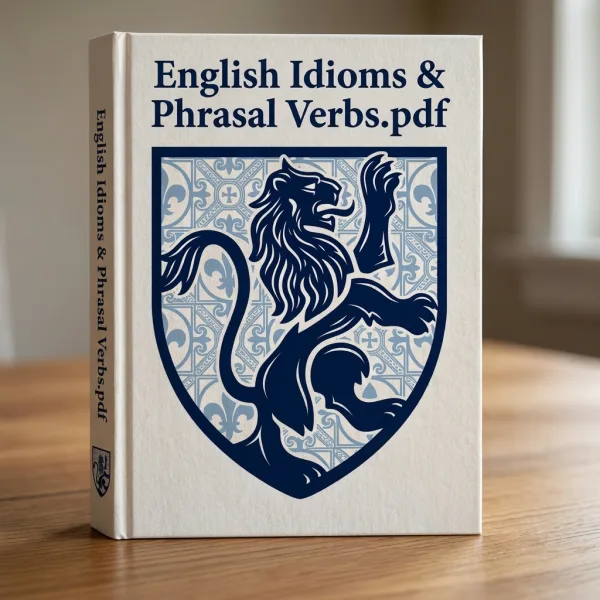
English Idioms & Phrasal Verbs
↓ Download the free PDFNo email required. Free for personal study and classroom use.
- A 110-page complete guide to speaking naturally — 500+ idioms and phrasal verbs, from "break the ice" to "get away with it".
- Clear definitions and real example sentences, so you see each expression doing its job in context, not floating on a list.
- Simplified pronunciation guidance and register labels — informal, neutral, formal or slang — so you know not just the meaning but where it belongs.
- Organised in four parts: the grammar of idiomatic language, phrasal verbs by particle, idioms by theme, and practice with a reference index.
- Free to download and free to photocopy for personal study and the classroom.
What this book covers
The book is built around one idea: the meaning of natural English lives in the expression, not the individual word. So instead of a long alphabetical list to forget, it is organised in four parts that take you from how idiomatic language works to actually using it:
- Part 1 — Foundations and the grammar of idiomatic language. Why these expressions cannot be translated word-for-word, how phrasal verbs split (or do not), and how to read a register label so you never sound too casual in a formal email or too stiff with friends.
- Part 2 — Phrasal verbs by particle. The expressions grouped by up, out, off, on, down and the rest, so the patterns become visible — once you see what up tends to add, dozens of phrasal verbs stop feeling random.
- Part 3 — Idioms by theme. Expressions grouped by the situations you actually talk about — feelings, work, money, time, relationships — so you can find the right one when you need it.
- Part 4 — Practice and a reference index. Exercises to move the expressions from recognition into use, plus an index you can flip to whenever a phrase you half-remember comes up.
Every entry carries a clear definition, a real example sentence, simplified pronunciation help where it matters, and a register label. Because of that index and the practice section, the book works equally well read front to back or dipped into the moment a specific expression trips you up.
Who it's for
This is an intermediate-to-advanced reference and practice book, written for B1 to C2. It assumes you already have a working grasp of everyday vocabulary, because idioms and phrasal verbs sit on top of that base — they are the layer that turns correct English into native-sounding English. If you are around B1, start with Part 2 and the most common, neutral expressions in each theme; do not try to swallow all 500 at once. If you are C1–C2, the value is precision: the register labels let you choose the exactly-right expression for the room, and Part 1 explains the small grammar traps (where the particle goes, which idioms are fixed) that separate advanced learners from fully natural ones.
For teachers and tutors, the themed grouping and ready-made exercises are built to be used in class — you are explicitly encouraged to copy the practice pages, and a "by theme" structure maps neatly onto lesson topics.
How to use an idioms PDF so it works
Here is the honest part. A list of 500 idioms is a brilliant reference and a poor teacher — if you only read it. Recognising "break the ice" on a page is not the same as reaching for it, correctly and at the right moment, in a real conversation. The book gives you the meaning and the register; you have to supply the production.
An idiom you have read is a fact about English. An idiom you have used is a part of your English. The whole job is moving expressions across that line.
So use it actively. Do not study fifty expressions a day — choose five you genuinely like, write your own sentence for each about your real life, and use one out loud the same week. Pay attention to the register label every time; the fastest way to sound odd is a slang idiom in a formal setting, or a stiff formal phrase among friends. And start noticing these expressions in what you already watch and read — the moment you spot "get away with it" in a series you are watching is the moment it becomes yours. We expand on this method in our guide to learning from English PDFs the right way.
Learners who memorise long idiom lists can usually translate them on demand but rarely use them when speaking — the expressions stay passive. The ones who pick a handful, write personal example sentences, and deliberately drop one into conversation each week start sounding noticeably more natural within a month, and they also get the register right far more often.
Based on instructor intake notes. Directional observation, not a controlled study.
What makes this guide different
Three things. First, it treats phrasal verbs as patterns, not chaos — grouping them by particle so you see the logic, instead of presenting 200 of them as items to memorise one by one. Second, every entry has a register label, so you learn not only what an expression means but whether it belongs in a job interview, a text to a friend, or neither — the difference between knowing an idiom and using it well. Third, it is organised by theme and backed by an index and practice, which means it is genuinely usable: you can find the right expression for a situation, then actually drill it, rather than just admiring a list.
Pair it with these free PDFs
Idioms and phrasal verbs are the figurative layer of English. Three other free books in our library build the layers around them, from natural word-choice to confident delivery:
- Idioms make you colourful; the right everyday word partnerships make you sound native sentence by sentence — English Collocations in Use is the natural companion.
- Already comfortable and want the frontier? Beyond Fluent handles the register, nuance and advanced expression that separate fluent from flawless.
- Knowing the expressions is half the job; saying them without hesitating is the other half — Speak English Fluently builds the delivery that lets these idioms come out smoothly.
All three sit in the same free library — see the full set on our free English learning PDFs page.
Download English Idioms & Phrasal Verbs
Grab the PDF, pick five expressions you like, and write one sentence for each before you close it. That single habit will do more for how natural you sound than another evening of scrolling idiom lists you will never use.
English Idioms & Phrasal Verbs
↓ Download the free PDFNo email required. Free for personal study and classroom use.
Want the expressions explained and your own sentences corrected? Our free English track adds the one thing a PDF cannot — feedback on whether the idiom you just used actually landed naturally.
Prefer an app to a book? See our pick for The best language learning app 2026.
Frequently asked questions
Is English Idioms & Phrasal Verbs really free to download?
Yes. The full 110-page PDF is free to download from this page, with no email sign-up and no paywall. It was written and produced by Oxford English Global, and you are free to use it for personal study and to photocopy the practice material for the classroom.
What level is this idioms and phrasal verbs book for?
It runs from CEFR B1 to C2 — intermediate to advanced. You need a working grasp of everyday vocabulary first, because idioms and phrasal verbs sit on top of it. B1 learners should start with the most common, neutral expressions; C1–C2 learners can use the register labels to choose between formal, informal and slang with confidence.
Does the book explain when an expression is informal, formal or slang?
Yes — and that is the point. Every entry carries a register label (informal, neutral, formal or slang) so you know not just what an expression means but where it belongs. Saying the right idiom in the wrong setting is one of the easiest ways to sound off, and the labels are there to prevent exactly that.
Can I learn idioms from a PDF alone?
A PDF is an excellent reference but cannot tell you whether the expression you just used landed naturally. Use it actively — write your own sentences, test yourself, and notice the expressions in what you read and watch — and pair it with a source of feedback. Our free English track is built to add exactly that correction layer.