
Beyond Fluent (Free PDF Download)
A 99-page handbook for people who are already fluent but want native-like command — collocations, phrasal verbs, idiom, register and the music of English, the last mile from fluent to flawless, free to download as a PDF.
 By Marco Ruiz
You can hold a meeting, follow a film without subtitles, and argue your case in English without hunting for words — and yet something still tells a native speaker, within a sentence or two, that English is not your first language. It is rarely a grammar mistake. It is the word you nearly reached for, the verb partnership that was almost right, the rhythm that landed a beat off. Beyond Fluent is written for exactly this moment, and you can download the full advanced English PDF below. It is the last mile — from fluent to flawless.
This page tells you what the handbook contains, who it is honestly for, and how to work with an advanced PDF so it changes the English that comes out of your mouth, rather than joining the pile of resources you meant to read.
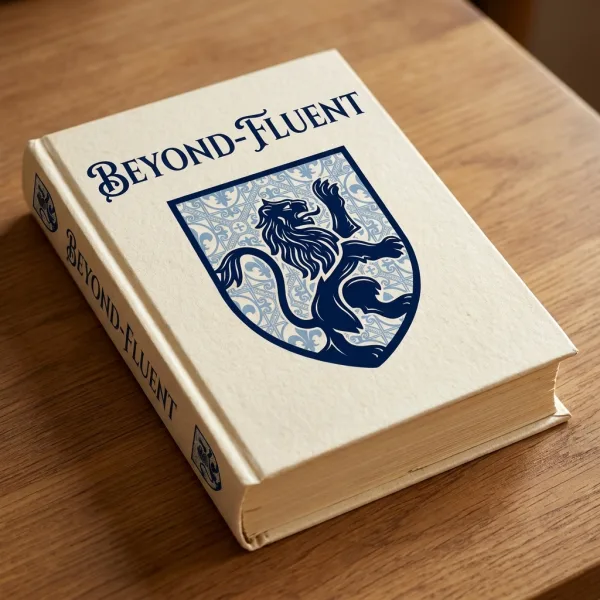
Beyond Fluent
↓ Download the free PDFNo email required. Free for personal study and classroom use.
- A 99-page advanced speaker's handbook for C1–C2 learners — Mastering English Like a Native: The Last Mile from Fluent to Flawless.
- The lexicon of naturalness — collocations, phrasal verbs, idiom and metaphor, connotation, and register.
- The music of English — connected speech, stress, rhythm and intonation, and fluency under pressure.
- Grammar at the frontier — the fine distinctions that ordinary courses never reach.
- Free to download and free to use for personal study and the classroom.
What this book covers
Beyond Fluent is a practical field guide, not a textbook. It assumes you already have the grammar and the vocabulary, and it spends its 99 pages on what is left — the difference between correct English and English that sounds like you were born to it. It is organised into four parts:
- Part I — The Nature of Advanced Fluency. Why progress slows at the top (the advanced plateau), and how to diagnose your own English honestly so you stop polishing what is already strong and start on what is actually holding you back.
- Part II — The Lexicon of Naturalness. The heart of the book: collocations as the hidden grammar of word partnerships; phrasal verbs without fear; idioms, metaphor and figurative thinking; connotation and precision — choosing the exact word, not merely a correct one; and register — code-switching between formal and casual.
- Part III — The Music of English. Connected speech and why natives don't speak word by word; stress, rhythm and intonation; and fluency under pressure — hesitation, fillers, and keeping your flow when the stakes are high.
- Part IV — Grammar at the Frontier. The advanced distinctions that separate fluent from flawless, handled at the level a C1–C2 speaker actually needs.
Throughout, the example sentences are illustrative models of natural, educated usage — the kind of English you want to be producing, shown next to the almost-right version most advanced learners default to.
Who it's for
This book is for advanced speakers — broadly CEFR C1 to C2 — and it is unusually clear about that. If you are still settling tenses, articles or core vocabulary, an earlier reference will serve you far better first; Beyond Fluent deliberately begins where ordinary fluency ends. But if you can already do the everyday job of English and have hit the ceiling that no amount of more conversation seems to lift, this is the book written for your problem.
A C1 reader will find the whole handbook useful, with the lexicon of naturalness in Part II doing the heaviest lifting. A C2 reader, who already sounds advanced, will often get the most from Part III — the music of English — because pronunciation, rhythm and intonation are usually the last things to give a near-native speaker away. Either way, the diagnosis chapter at the front is the place to start: it tells you which part to read first.
How to use an advanced PDF so it works
Here is the honest part. At your level, a PDF is a superb map and a poor coach — if you only read it. You already know how reading feels: it produces recognition, the comfortable nod of "yes, that's right." But recognition is not production. Knowing that "a strong argument" beats "a powerful argument" is not the same as the right word arriving on its own, mid-sentence, when you are tired and under pressure.
At the advanced level, the gap is no longer between right and wrong. It is between correct and natural — and that gap closes through use, not through reading.
So work it actively. When you meet a collocation, say three of your own sentences aloud using it — about your real work and life, not the book's. With the music chapters, read the example sentences out loud and record yourself; the point of Part III is your ear and your mouth, and neither improves by silent reading. Cover the page and try to reproduce the natural version from memory before checking; that retrieval is what moves a phrase from "I recognise it" to "I reach for it." We expand on this method in our guide to learning from English PDFs the right way.
Advanced learners who plateau almost never have a grammar problem. Asked to judge two sentences, they reliably pick the more natural one — the knowledge is there. What is missing is production: the natural choice does not arrive on its own when they speak at speed. The learners who break the plateau are the ones who practise the patterns out loud and in writing, not the ones who read more about them.
Based on instructor intake notes. Directional observation, not a controlled study.
What makes this handbook different
Most "advanced English" material is just intermediate material with harder words. Beyond Fluent refuses that. It is built around a single, specific reader — the speaker who is already fluent and stuck — and it spends its pages on the three things that actually mark the difference at the top: the lexicon of naturalness, the music of English, and frontier grammar. It treats connected speech and intonation as seriously as vocabulary, because at C1–C2 the music is usually what is still giving you away, and almost nothing else addresses it head-on.
Pair it with these free PDFs
Naturalness is built from parts. Three other free books in our library go deep on the pieces Beyond Fluent surveys, so you can drill the ones you most need:
- Collocations are the hidden grammar of natural English — English Collocations in Use gives you the word partnerships to study and reuse until they arrive on their own.
- The figurative layer — English Idioms & Phrasal Verbs turns the phrasal verbs and idiom of Parts II into something you can practise systematically.
- If fluency under pressure is your weak point, Speak With Confidence works on the nerve and the flow that Part III only touches.
All three sit in the same free library — see the full set on our free English learning PDFs page.
Download Beyond Fluent
Download the PDF, read the diagnosis chapter, and pick the one part that matches your actual gap. Then speak three of its examples aloud before you close the file. That single habit is what moves English from your eyes to your mouth.
Beyond Fluent
↓ Download the free PDFNo email required. Free for personal study and classroom use.
Want the patterns explained and the English you actually speak corrected? Our free English track adds the one thing a PDF cannot — feedback on what comes out of your mouth, which at your level is the whole game.
Prefer an app to a book? See our pick for The best language learning app 2026.
Frequently asked questions
Is Beyond Fluent really free to download?
Yes. The full 99-page PDF is free to download from this page, with no email sign-up and no paywall. It was written and produced by Oxford English Global, and you are free to use it for personal study and for the classroom.
What level is Beyond Fluent for?
It is built for advanced speakers at CEFR C1–C2 — people who are already fluent and comfortable in English but want to close the last gap to native-like command. If you are still working through tenses or basic vocabulary, an A1–C1 grammar reference will serve you better first; this book begins where ordinary fluency ends.
What is "the music of English" that the book talks about?
It is the part of speech that has nothing to do with vocabulary or grammar: connected speech (why natives don't pronounce word by word), and the stress, rhythm and intonation that carry meaning. Part III of the book treats this directly, because it is often what still marks an otherwise flawless C2 speaker as non-native.
Can I reach native-like English from a PDF alone?
A PDF can show you collocations, register and intonation patterns, but it cannot hear the sentences you actually say. Use it actively — speak the examples aloud, rebuild them with your own content, and self-test — then pair it with feedback. Our free English track adds exactly that correction layer on the English you produce.