
English False Friends for Spanish, French and Portuguese Speakers: Actually, Embarrassed, Sensible and More
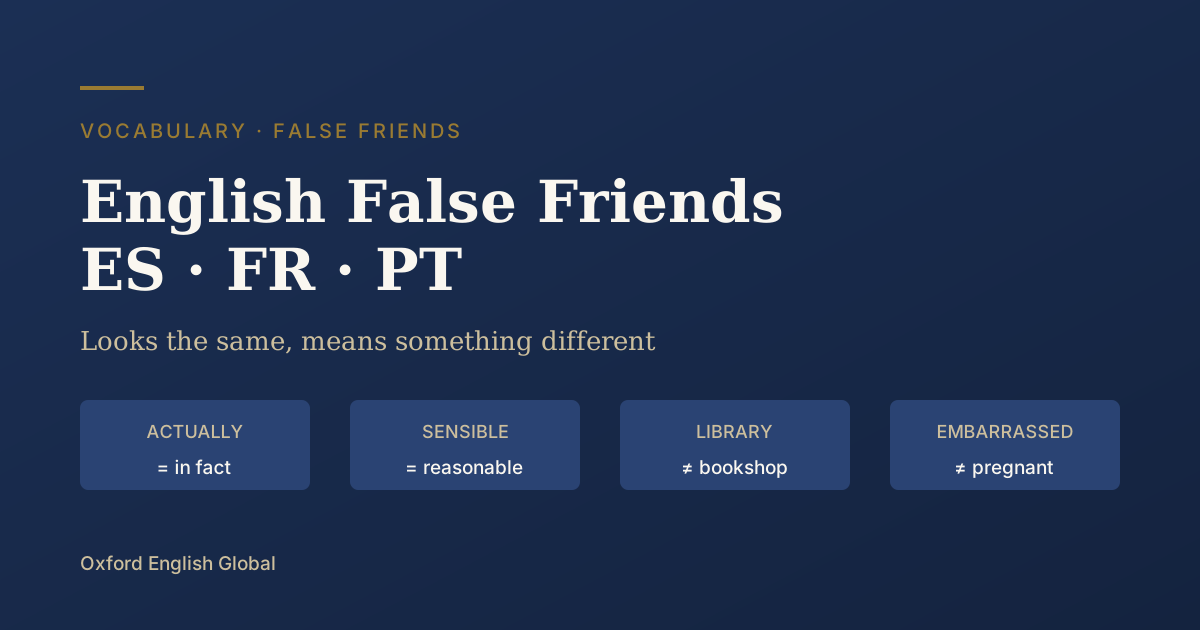
Actually does not mean currently, embarrassed does not mean pregnant and a library is not a bookshop. This guide lists the English false friends that cause the most mistakes for Spanish, French and Portuguese speakers, with correct meanings, example sentences and a simple method to stop making them.

- What are false friends, and why do they happen?
- The ten false friends that cause the most mistakes
- False friends at work and university
- False friends in everyday life
- Extra traps for each language
- Don't panic: most cognates are true friends
- How to stop making false-friend mistakes
- Practice: choose the right word
- What this article cannot tell you
False friends are English words that look or sound like a word in your language but mean something different. For speakers of Spanish, French and Portuguese, the most common ones include actually (it means "in fact", not "currently"), embarrassed (it means "ashamed or uncomfortable", not "pregnant"), sensible (it means "reasonable and practical", not "sensitive"), library (a place to borrow books, not a bookshop) and eventually (it means "in the end", not "possibly"). Because Spanish, French, Portuguese and English share thousands of words from Latin, most similar-looking words really do mean the same thing. The problem is the minority that do not. This guide lists the false friends that cause the most mistakes, explains the correct English meaning with examples, and shows you a simple way to stop making them.
How to use this guide. Each table shows the English word, the similar-looking word in Spanish (ES), French (FR) or Portuguese (PT), what that word really means, and the English word you probably want instead. Portuguese meanings can differ between Brazil and Portugal; where this matters, we say so.
What are false friends, and why do they happen?
False friends (in French faux amis, in Spanish falsos amigos, in Portuguese falsos cognatos) are pairs of words in two languages that look similar but have different meanings. They are a special case of cognates, words that share an origin.
Most cognates are true friends: information, información, information, informação all mean the same thing. This is good news: if you speak a Romance language, you already recognise a large part of English vocabulary, especially formal and academic words. False friends appear because words change meaning over centuries. English sensible and Spanish sensible come from the same Latin root, but they moved in different directions.
There are also partial false friends, where two words share one meaning but not another. French parents means both "mother and father" and "relatives"; English parents means only "mother and father".
The ten false friends that cause the most mistakes
| English word | Looks like | Which really means | What English means | If you mean the other idea, say |
|---|---|---|---|---|
| actually | actualmente (ES), actuellement (FR), atualmente (PT) | currently, at the moment | in fact, really | currently, at the moment, nowadays |
| embarrassed | embarazada (ES) | pregnant | ashamed, uncomfortable in front of others | pregnant |
| sensible | sensible (ES, FR), sensível (PT) | sensitive | reasonable, practical, showing good judgement | sensitive |
| library | librería (ES), librairie (FR), livraria (PT) | bookshop | a place where you borrow books | bookshop (UK), bookstore (US) |
| eventually | eventualmente (ES, PT), éventuellement (FR) | possibly, if necessary, occasionally | in the end, after a long time | possibly, perhaps, if necessary |
| assist | asistir (ES), assister (FR), assistir (PT) | to attend (ES, FR); to watch or attend (PT) | to help | attend, go to, watch |
| pretend | pretender (ES, PT), prétendre (FR) | to intend, to aim (ES, PT); to claim (FR) | to act as if something is true when it is not | intend, aim, claim |
| realise | realizar (ES, PT), réaliser (FR) | to carry out, to make happen | to suddenly understand or become aware | carry out, achieve, make |
| sympathetic | simpático (ES, PT), sympathique (FR) | nice, friendly | showing understanding of someone's problems | nice, friendly, likeable |
| lecture | lectura (ES), lecture (FR), leitura (PT) | reading | a formal talk, especially at university | reading |
Let's look at each one in context.
Actually
- Wrong: Actually I work in a bank. (when you mean "at the moment")
- Right: Currently I work in a bank. / I'm currently working in a bank.
- Natural use of actually: "You're from Madrid, right?" "Actually, I'm from Seville." It often corrects something or adds surprise.
Embarrassed
- I was so embarrassed when I called my teacher "Mum".
- If you mean embarazada: My sister is pregnant.
Note that Portuguese embaraçado and French embarrassé are closer to English: they can mean embarrassed or awkward. This one is mainly a trap for Spanish speakers, and a famous one.
Sensible
- Booking the hotel early was a sensible decision. (reasonable)
- If you mean sensible / sensível: She's very sensitive; she cries at films. I have sensitive skin.
Library
- I borrowed this novel from the library.
- If you mean librería / librairie / livraria: I bought it at a bookshop.
Eventually
- The flight was delayed for five hours, but we eventually arrived. (in the end)
- If you mean "possibly": We could possibly meet next week. / Call me if necessary.
False friends at work and university
These words appear in emails, meetings, CVs and university life, where a mistake can cause real confusion.
| English word | Looks like | Which really means | English meaning |
|---|---|---|---|
| attend | attendre (FR), atender (ES, PT) | to wait (FR); to serve, to deal with, to answer the phone (ES, PT) | to be present at an event: attend a meeting |
| resume | resumir (ES, PT), résumer (FR) | to summarise | to start again after a pause; in US English, a résumé is a CV |
| college | colegio (ES), collège (FR), colégio (PT) | school (ES, PT); lower secondary school (FR) | a place of further or higher education |
| fabric | fábrica (ES, PT), fabrique (FR) | factory | cloth, material |
| notice | noticia (ES), notícia (PT), notice (FR) | news (ES, PT); instructions leaflet (FR) | a written announcement; to see or become aware of something |
| argument | argumento (ES, PT) | plot of a film or book; line of reasoning | a disagreement, or a line of reasoning |
| exit | éxito (ES), êxito (PT) | success | the way out |
| deception | decepción (ES), déception (FR), decepção (PT) | disappointment | making someone believe something false |
- Wrong: I will assist the conference in May. Right: I will attend the conference in May.
- Wrong: Can you resume the report in two lines? Right: Can you summarise the report in two lines?
- Wrong: The project was a big exit. Right: The project was a big success.
- Wrong: The results were a deception for the team. Right: The results were a disappointment for the team.
If you write work emails in English, our guide to writing work emails has more phrases that sound natural and professional.
False friends in everyday life
| English word | Looks like | Which really means | English meaning |
|---|---|---|---|
| parents | parientes (ES), parentes (PT), parents (FR) | relatives (ES, PT); parents and relatives (FR) | mother and father only |
| constipated | constipado (ES, European PT) | having a cold | unable to empty the bowels easily |
| carpet | carpeta (ES) | folder | a thick floor covering |
| rope | ropa (ES), roupa (PT) | clothes | a thick, strong cord |
| large | largo (ES, PT), large (FR) | long (ES); wide (PT, FR) | big |
| injury | injuria (ES), injure (FR), injúria (PT) | insult | physical harm to the body |
| intoxicated | intoxicado (ES, PT), intoxiqué (FR) | poisoned, e.g. by food | drunk (formal) |
| preservative | preservativo (ES, PT), préservatif (FR) | condom | a chemical that keeps food fresh |
| casualty | casualidad (ES) | coincidence | a person injured or killed in an accident or war |
- Wrong: I can't come, I'm constipated. (when you have a cold) Right: I can't come, I've got a cold.
- Wrong: I'm spending Christmas with all my parents. Right: I'm spending Christmas with all my relatives.
- Wrong: I had food intoxication. Right: I had food poisoning.
- Wrong: What a casualty! Right: What a coincidence!
Extra traps for each language
For Spanish speakers
- Embarrassed (not embarazada), carpet (not carpeta) and casualty (not casualidad) are traps mainly for Spanish speakers.
- Molest is a serious word in English (to sexually abuse someone), not the everyday molestar. For molestar, say bother or disturb: Sorry to bother you.
- Discussion in English is a calm conversation about a topic; discusión often means an argument. For a heated disagreement, say argument.
For French speakers
- Journey means a trip from one place to another, not journée (a day).
- Ancient means very old, from a long time ago. For ancien meaning "former", say former: my former boss.
- Attend is not attendre. For attendre, say wait (for): I'm waiting for the bus.
- Coin is a piece of money, not coin (corner).
For Portuguese speakers
- Push means the opposite of puxar. Puxar is pull. Check the sign on the door!
- Exquisite means extremely beautiful or delicate, not esquisito (strange). For esquisito, say strange or weird.
- Pull, push and exit all appear on signs, so they matter on day one in an English-speaking country.
- Constipated is a trap mainly for speakers of European Portuguese, where constipado means "having a cold".
Don't panic: most cognates are true friends
A long list of false friends can make you distrust every similar word. Don't. Thousands of cognates are reliable, and they are one of your biggest advantages as a learner. Words such as hospital, important, possible, nation, university, family (but not familiar, which means "well known"), problem and decision mean the same in English.
A useful attitude: trust cognates for understanding when you read, but check them in a dictionary before you use a new one in an important email or exam. Reading a lot is the best way to meet words in context; our guide to learning vocabulary through reading shows how.
How to stop making false-friend mistakes
- Keep a personal list. Every time a teacher or app corrects a false friend, add it with one example sentence. Your list will be shorter and more useful than any general list.
- Learn the English word with its partners. Learn attend a meeting, a sensible decision, eventually arrived. Chunks are easier to remember and use correctly; see our guide to learning vocabulary in chunks.
- Use an English–English learner's dictionary for words you think you know. The definition shows the real meaning.
- Practise the replacements aloud. Say currently, bookshop, attend, pregnant and a cold in full sentences until they come automatically.
- Review your writing for the "top ten". Before sending an important email, search it for actually, eventually, assist and sensible, and check each one.
False friends are only one source of errors. For others, see our list of common English grammar mistakes and our guide to English homophones, words that sound the same but have different spellings and meanings.
Practice: choose the right word
Choose the correct word in each sentence.
- I'm (actually / currently) looking for a new job.
- Many students (assist / attend) the lecture every Monday.
- We waited for hours, but the bus (eventually / possibly) came.
- Buying travel insurance is a (sensitive / sensible) idea.
- I bought a dictionary at the (library / bookshop).
- She (realised / carried out) she had left her phone on the train.
- The new product was a big (exit / success).
- He was very (sympathetic / nice) when I told him about my problem at work.
Answers: 1. currently 2. attend 3. eventually 4. sensible 5. bookshop 6. realised 7. success 8. sympathetic (he understood your problem). If you simply mean he is a friendly person, nice is right.
What this article cannot tell you
- Every false friend. There are hundreds. We list the ones that most often cause real misunderstandings for adult learners.
- Every regional meaning. Some words mean different things in Spain and Latin America, or in Brazil and Portugal. Check a dictionary for your own variety.
- All meanings of each word. Many of these words have several senses. We focus on the one that causes the mistake.
- Your personal traps. Feedback on your own speaking and writing is the fastest way to find the false friends you actually use.
Want regular feedback on mistakes like these? Explore our free lessons or join one of our English courses.
Frequently asked questions
What are false friends in English?
False friends are English words that look or sound like a word in another language but have a different meaning. For example, English actually means in fact, while Spanish actualmente means currently.
What does actually mean in English?
Actually means in fact or really, and is often used to correct something or add surprise. To say at the moment, use currently: I'm currently working in a bank.
Does embarrassed mean pregnant?
No. Embarrassed means ashamed or uncomfortable in front of other people. The Spanish word embarazada means pregnant.
What is the difference between sensible and sensitive?
Sensible means reasonable and practical: a sensible decision. Sensitive means easily affected or upset: sensitive skin, a sensitive person. Spanish and French sensible and Portuguese sensível mean sensitive.
Are most similar-looking words false friends?
No. Most cognates shared by English, Spanish, French and Portuguese have the same meaning, such as hospital, important and decision. Trust them for understanding, but check new ones before using them in important writing.