
Common English Homophones: Their, There, They're and More, With Memory Tricks
Their, there and they're sound exactly the same, so the mistake only shows up in writing. This guide covers the homophone sets that cause the most errors, from its and it's to weather and whether, with a simple memory trick and practice sentences for each one.

- What are homophones (and why do they matter)?
- There, their and they're
- Its and it's
- Your and you're
- To, too and two
- Whose and who's
- More common homophone pairs
- Words that are often confused but are not homophones
- Homophones that cause mistakes at work
- How to stop making homophone mistakes
- Practice: choose the correct word
- What this article cannot tell you
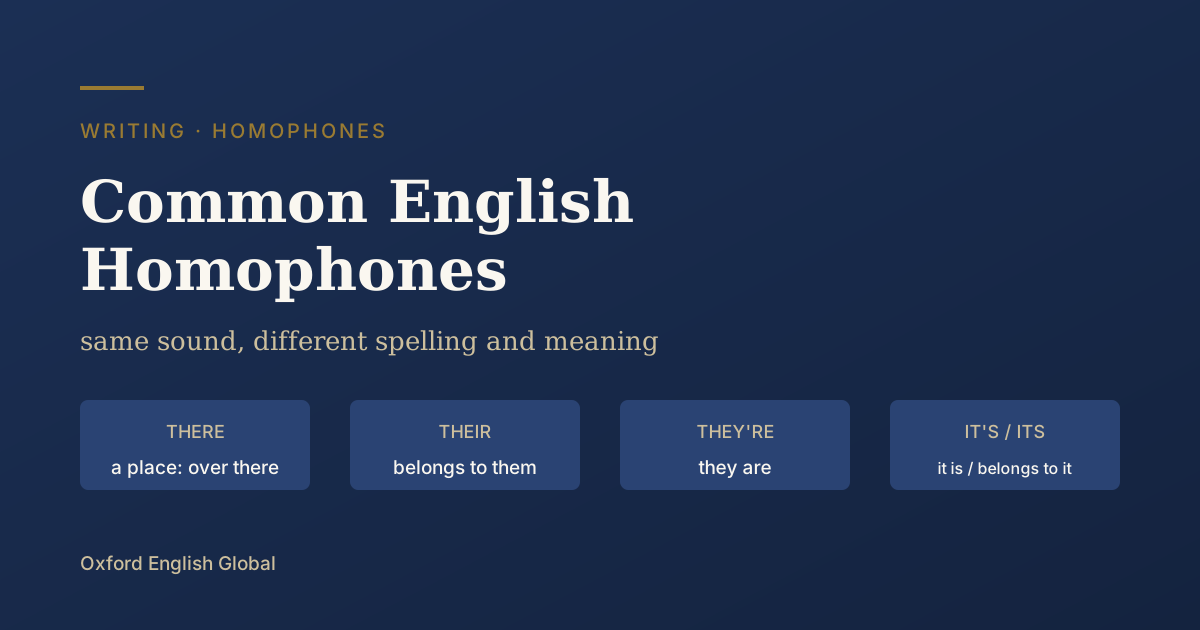
Homophones are words that sound the same but have different meanings and usually different spellings, such as their, there and they're. Because they sound identical, you cannot tell them apart in speech, but in writing the wrong choice is an obvious mistake, and spellcheckers often miss it because each word is spelled correctly. The quickest fix is a short memory trick for each set: they're always means they are, there contains here (a place), and their contains heir (someone who owns something). This guide covers more than 20 homophone sets that cause frequent mistakes, with a memory trick and practice sentences for each one.
Quick test. If you can replace the word with they are, it is, you are or who is, you need the version with an apostrophe: they're, it's, you're, who's. If you can't, you need their, its, your, whose.
What are homophones (and why do they matter)?
The word comes from Greek: homo (same) + phone (sound). English has many homophones because its spelling reflects older pronunciations and words borrowed from other languages, while the pronunciation changed over time.
Three related terms are useful to know:
| Term | Meaning | Example |
|---|---|---|
| homophones | same sound, different meaning (usually different spelling) | see / sea, write / right |
| homographs | same spelling, different meaning (sometimes different sound) | a lead pipe / to lead a team |
| homonyms | same spelling and sound, different meaning | a river bank / a bank account |
Homophone mistakes matter most in writing: emails, CVs, exam essays and social media. A sentence like Your welcome or Its been a long day looks careless to many readers, even if your English is otherwise strong. On a job application this matters even more; if you are preparing one, see our guide to writing a CV in English.
Note that some pairs are homophones only in some accents. Where and wear sound the same for most speakers, but some Scottish and Irish speakers pronounce them differently. That doesn't change the spelling rules below.
There, their and they're
- there = a place, or used in there is / there are: Put it over there. There are three problems.
- their = belonging to them: They sold their car.
- they're = they are: They're late again.
Memory trick: there contains here, another place word. Their contains heir, a person who inherits (owns) things. They're has an apostrophe because a letter is missing: they are. Cambridge Dictionary's English Grammar Today entry on there, their or they're has more examples.
Practice sentences:
- They're bringing their children, so there will be twelve of us.
- Is there a café near their office?
Its and it's
- it's = it is or it has: It's raining. It's been a long week.
- its = belonging to it: The company changed its logo.
Memory trick: his, hers, its: possessive pronouns never have apostrophes. If you can say it is or it has, use it's.
Practice: It's a great app, but its battery use is high.
Your and you're
- your = belonging to you: Is this your bag?
- you're = you are: You're right.
Memory trick: say the sentence with you are. Thanks, you are welcome works, so it's you're welcome, never your welcome.
Practice: You're going to love your new desk.
To, too and two
- to = preposition or part of an infinitive: I'm going to Madrid to see a friend.
- too = also, or more than enough: I'm coming too. It's too expensive.
- two = the number 2: two tickets
Memory trick: too has too many o's, an extra one, just like its meaning "extra". Two has a w, like twin and twelve, other number words.
Practice: The two of us went to the gym, but it was too crowded.
Whose and who's
- whose = belonging to whom, or in relative clauses: Whose phone is this? The client whose order was late called.
- who's = who is or who has: Who's coming tonight? Who's seen my keys?
Memory trick: same as it's: the apostrophe means a letter is missing. Our guide to relative clauses explains how whose works in longer sentences.
More common homophone pairs
| Pair | Meanings | Memory trick | Practice sentence |
|---|---|---|---|
| hear / here | hear = with your ears; here = this place | You hear with your ear. | Can you hear me from over here? |
| where / wear / were* | where = which place; wear = clothes; were = past of be | Where contains here (a place). | Where did you buy the jacket you wear to work? |
| write / right | write = with a pen; right = correct, or not left | Write and word both start with w. | Please write the right answer. |
| know / no | know = have information; no = negative | Know has a silent k, like knowledge. | I don't know, so the answer is no. |
| by / buy / bye | by = preposition; buy = pay for; bye = goodbye | Buy has a u: you pay. | I'll buy it by Friday. Bye! |
| weather / whether | weather = rain, sun; whether = if | Weather includes eat: picnics depend on it. | I don't know whether the weather will be good. |
| piece / peace | piece = a part; peace = no war, calm | A piece of pie. | Can I have a piece of cake in peace? |
| flour / flower | flour = for baking; flower = a plant | A flower grows. | She bought flour and a flower. |
| mail / male | mail = letters, post; male = a man or boy | Mail arrives by air. | The male nurse checked the mail. |
| allowed / aloud | allowed = permitted; aloud = out loud | Aloud contains loud. | You're not allowed to read aloud in the library. |
*Were is usually pronounced differently from where and wear when stressed, but in fast speech it can sound similar, which is why many people confuse them.
Words that are often confused but are not homophones
Some pairs sound similar but not identical. They cause the same kind of spelling mistakes, so it's worth learning them together.
| Pair | Difference | Example |
|---|---|---|
| then / than | then = time; than = comparison | She's taller than me. We ate, then left. |
| lose / loose | lose (/luːz/) = not win or misplace; loose (/luːs/) = not tight | Don't lose your keys. This shirt is loose. |
| affect / effect | affect = verb; effect = usually a noun | Stress can affect sleep. It has a big effect. |
| advice / advise | advice (noun, /s/); advise (verb, /z/) | She advised me. Thanks for the advice. |
| quiet / quite | quiet = not noisy; quite = fairly | It's quite quiet here. |
For more spelling and grammar traps like these, see our list of common English grammar mistakes, and for the British/American spelling differences that also confuse learners, read British vs American English.
Homophones that cause mistakes at work
Some homophones rarely appear in everyday chat but show up constantly in professional writing. These are some that often slip into emails, reports and CVs.
| Pair | Meanings | Memory trick | Example |
|---|---|---|---|
| complement / compliment | complement = complete or go well with; compliment = say something nice | A complement completes something. A compliment is what I like to hear. | The new hire's skills complement the team. She complimented my presentation. |
| principal / principle | principal = main, or head of a school; principle = a rule or belief | A principle is a rule. | Our principal concern is cost. It's a matter of principle. |
| stationary / stationery | stationary = not moving; stationery = paper, pens, envelopes | Stationery includes envelopes. | Order more stationery. The traffic was stationary. |
| site / sight / cite | site = a place or website; sight = vision or something you see; cite = quote a source | You cite a source. | Please cite the report on our website. The view was quite a sight. |
| cue / queue | cue = a signal to act; queue = a line of people or tasks | A queue is long, like its spelling. | Your ticket is in the queue. That's my cue to leave. |
| fair / fare | fair = just, or an event; fare = the price of a journey | You pay a fare. | The train fare is not fair. |
| role / roll | role = a job or function; roll = to turn over, or a list | A role is a job. | Her role is to roll out the new system. |
Notice the last example: roll out (launch gradually) is a phrasal verb you will meet often in business English. Spelling it role out is a common error in workplace writing. If you want to build more of this vocabulary, our business English guide covers many phrases used in meetings and emails.
How to stop making homophone mistakes
- Use the "expand" test for apostrophes. Before you write it's, you're, they're, who's, say the full form in your head. If it doesn't fit, remove the apostrophe.
- Proofread for one set at a time. Search your document for their, then for its, then for your, and check each one. It is more reliable than reading everything once.
- Don't trust spellcheck alone. Basic spellcheckers accept Their going to the meeting because every word exists. Grammar checkers catch more, but not all.
- Practise with dictation. Listen to a short audio clip, write down what you hear, then compare it with the transcript. Homophones are exactly where dictation errors appear. Our guide to improving your English listening describes how to do this.
- Learn the pair, not the word. When you learn piece, learn peace at the same time, with one example sentence each.
Pronunciation bonus. Homophones can also help your speaking: if you know knight sounds like night, you already know how to say it. Our guide to improving your pronunciation at home uses this kind of sound-matching.
Practice: choose the correct word
- (Your / You're) presentation was excellent. (Your / You're) a natural speaker.
- The dog hurt (its / it's) paw, but (its / it's) fine now.
- I don't know (weather / whether) to take the bus or walk.
- (There / Their / They're) moving (there / their / they're) office to the city centre.
- Could you send me the file (to / too / two)? I need it (to / too / two) finish the report.
- (Who's / Whose) laptop is this, and (who's / whose) going to use it?
- Please read the instructions (allowed / aloud).
- I'd like a (piece / peace) of advice.
Answers: 1. Your, You're 2. its, it's 3. whether 4. They're, their 5. too, to 6. Whose, who's 7. aloud 8. piece
Writing task: Write five sentences about your weekend, using at least one word from five different homophone sets in this guide. Then use the "expand" test to check every apostrophe.
What this article cannot tell you
- Every homophone in English. There are hundreds. We chose the sets that cause the most frequent mistakes in learners' writing.
- Accent differences in detail. Whether two words sound identical depends on the accent. Some pairs here are homophones for most British and American speakers but not for everyone.
- Whether a memory trick will work for you. These tricks are memory aids, not grammar rules. If a different trick works better for you, use it.
For more structured writing practice, see our English courses or explore our free lessons.
Frequently asked questions
What is a homophone?
A homophone is a word that sounds the same as another word but has a different meaning and usually a different spelling, such as see and sea, or their, there and they're.
How do I remember their, there and they're?
There contains here, so it is about place. Their contains heir, a person who owns things, so it shows possession. They're always means they are, and the apostrophe shows the missing letter.
What is the difference between its and it's?
It's means it is or it has: It's raining. Its shows possession: The company changed its logo. Possessive pronouns such as his, hers and its never have an apostrophe.
Why doesn't spellcheck catch homophone mistakes?
Because each word is spelled correctly. A basic spellchecker only checks whether a word exists, so Their going home passes. Grammar checkers catch more, but not every case, so proofreading is still important.
Are then and than homophones?
Not exactly. They sound similar in fast speech but are pronounced differently when stressed. They are still often confused: then is about time, than is used in comparisons.