
EF EPI 2026: Why Learners Read English Better Than They Speak It, and How to Close the Gap
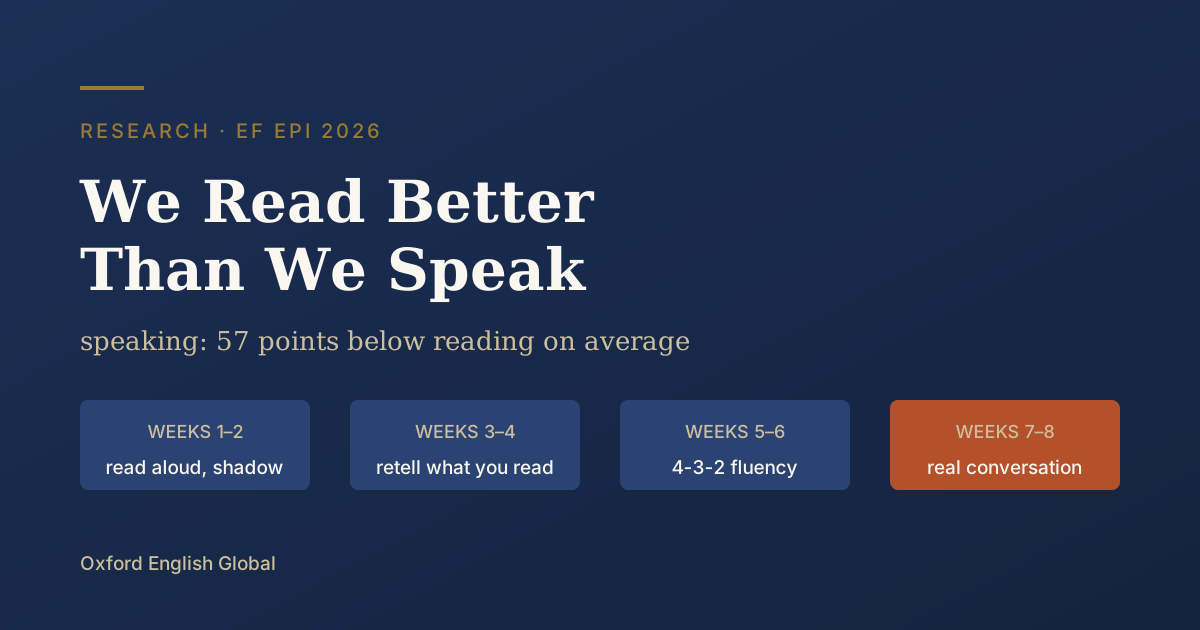
The EF English Proficiency Index 2026 found that, in four out of five countries, reading is adults' strongest English skill, while speaking trails by an average of 57 points. Here are the key findings, why the gap appears, how to measure your own, and an eight-week plan to bring your speaking up to your reading level.

- The key findings of EF EPI 2026
- Where countries rank: a quick look
- Why learners read better than they speak
- How to check your own skills gap
- An eight-week plan to bring speaking up to your reading level
- A 20-minute daily routine
- A self-feedback checklist for your recordings
- What this article cannot tell you
The EF English Proficiency Index 2026, published by Education First on 18 November 2026, found that adults around the world read English much better than they speak it. Based on test results from 2.3 million adults in 117 countries and regions, reading was the strongest skill in four out of five countries, while speaking was the weakest skill in about 40% of countries and listening in another 40%. On average, the global speaking score was 57 points below the reading score. If that sounds like you, the gap is normal and fixable: reading is a skill you practise alone and silently, while speaking needs fast, spoken output under time pressure, which most learners practise far less. This article explains the findings, why the gap appears, and gives a practical eight-week plan to bring your speaking closer to your reading level.
Sources, checked 18 November 2026. The rankings and country scores come from the official EF EPI 2026 page. The skills findings (reading strongest in four of five countries, the 57-point gap, and the quote from the report's author) come from a Bernama report published by The Star on 18 November 2026. The full report is available on EF's downloads page.
The key findings of EF EPI 2026
- Sample: test results from 2.3 million adults in 117 countries and regions.
- Reading leads: reading was the strongest skill in four out of five countries.
- Speaking and listening lag: speaking was the weakest skill in about 40% of countries, and listening in about another 40%. The average global speaking score was 57 points below reading.
- More four-skill testing: for the first time, nearly half of the tests used assessed all four skills (reading, listening, speaking and writing).
- Overall decline: global proficiency fell for the fifth consecutive year, with more than two-thirds of countries scoring lower than in 2025.
- Regional notes: in Asia, listening was the weakest skill in 70% of countries; in the Middle East, writing was a particular weakness in Arabic-speaking countries.
- Top of the table: Sweden (615), Austria (613), Denmark (612), Germany (611) and the Netherlands (609).
"A world populated by those who can read English but struggle to speak it is a world in which communication is too often one-way, and essential voices are left out of the conversation." — Kate Bell, EF EPI author, quoted by Bernama
Where countries rank: a quick look
EF groups countries into five proficiency bands. Here are examples from the 2026 ranking, with scores as published on EF's site:
| Band | Example countries (rank, score) |
|---|---|
| Very high | Sweden (1, 615), Germany (4, 611), Portugal (7, 605) |
| High | South Africa (14, 588), Poland (15, 587), Malaysia (23, 574), Argentina (26, 563) |
| Moderate | Italy (31, 541), Spain (33, 539), France (36, 530), South Korea (50, 515) |
| Low | Vietnam (62, 489), Türkiye (66, 484), India (69, 479), Brazil (73, 469), China (75, 466), Azerbaijan (85, 451), Japan (86, 450) |
| Very low | Mexico (96, 431), Saudi Arabia (107, 406), Thailand (107, 406) |
A national average says little about you as an individual. What matters for your own learning is your skill profile: which of your four skills is strongest, and which is holding you back.
Why learners read better than they speak
The reading–speaking gap is not a mystery. It follows from how most adults learn English:
| Reading | Speaking |
|---|---|
| You control the speed. You can reread. | Real time. No rewind. |
| You only need to recognise words. | You must retrieve words from memory and produce them. |
| Easy to practise alone, every day. | Usually needs a partner, a teacher or deliberate solo practice. |
| Grammar is visible on the page. | Grammar must be automatic, or you freeze. |
| Pronunciation does not matter. | Pronunciation affects whether people understand you. |
| School exams have long tested it heavily. | Often tested less, so practised less. |
The key idea is the difference between receptive knowledge (understanding) and productive knowledge (using). Most learners can understand many more words and structures than they can use quickly in speech. Closing the gap means turning words and patterns you already recognise into words and patterns you can say without thinking.
Notice too that listening was the weakest skill in about 40% of countries. Speaking and listening develop together: if you cannot follow fast spoken English, conversations break down even when your speaking is fine. Our guide to improving your English listening covers that side.
How to check your own skills gap
- Get a level for reading. Take a free level test such as our English level test. Note your CEFR level (for example, B2).
- Record a speaking sample. Talk for two minutes about a topic at that level, such as the advantages and disadvantages of working from home. Do not prepare.
- Listen back and count. How many long pauses (over two seconds)? How often did you restart a sentence? Did you use the vocabulary you know from reading, or only simple words?
- Compare. If you read at B2 but your recording sounds like slow B1 with simple words and long pauses, you have the typical gap.
An eight-week plan to bring speaking up to your reading level
This plan needs about 20–30 minutes a day. It moves from easy, supported speaking to free speaking. Use material you can already read comfortably, because the aim is to convert what you understand into what you can say.
Weeks 1–2: Read aloud and shadow
- Read aloud one short article (200–300 words) every day. Read slowly, then again at natural speed.
- Shadow five minutes of audio with a transcript: play a sentence, pause, and repeat it with the same rhythm. This builds pronunciation and the "muscle memory" of complete sentences.
- Goal: get used to hearing your own voice in English.
Weeks 3–4: Retell what you read
- After reading an article, close it and retell it aloud in one minute. Then open it, check which words you missed, and retell again.
- Write down three useful chunks from each article (for example, has led to a sharp rise in) and use all three in your retelling. Our guide to learning vocabulary in chunks explains why chunks speed up speaking.
- Goal: move vocabulary from your reading into your mouth.
Weeks 5–6: Speed and fluency
- Use the 4-3-2 technique: talk about one topic for four minutes, then the same topic for three minutes, then two. Each round you say the same ideas faster and more smoothly.
- Answer one opinion question a day with a simple structure: opinion, reason, example, conclusion.
- Stop translating in your head. Our guide on how to think in English has daily exercises for this.
- Goal: fewer pauses, longer sentences.
Weeks 7–8: Real interaction
- Have at least two real conversations a week: with a teacher, a conversation partner, a language exchange or a class.
- Prepare "conversation starters" for topics you often discuss: work, plans, opinions on news. See our guide to small talk in English.
- Record yourself again on the same topic as your first recording and compare.
- Goal: use English with real people, under real time pressure.
If nerves are the problem, not knowledge, start with low-pressure practice. Our guide to speaking with confidence when you're shy has step-by-step ideas, and our free Speaking Lab lets you practise pitch and intonation privately.
A 20-minute daily routine
| Minutes | Activity | Skill trained |
|---|---|---|
| 0–5 | Shadow a short audio clip | Pronunciation, rhythm |
| 5–10 | Read a short text and note 3 chunks | Vocabulary input |
| 10–15 | Retell the text aloud using the chunks | Retrieval, fluency |
| 15–20 | Answer one opinion question, recorded | Free speaking |
For more speaking routines, see our complete guide to improving your English speaking and our tips for practising without a partner.
A self-feedback checklist for your recordings
Practice without feedback can repeat the same mistakes. When you listen back to your recordings, check these points one at a time rather than all at once:
| Check | What to listen for | Quick fix |
|---|---|---|
| Pauses | Silences longer than two seconds in the middle of ideas | Learn "thinking phrases": Well, the thing is…, Let me think… |
| Restarts | Starting the same sentence two or three times | Use shorter sentences; add ideas with and, but, so |
| Vocabulary range | Only very basic words (good, bad, nice, thing) | Reuse the chunks you noted while reading |
| Grammar under pressure | Errors you would not make in writing (he go, I am agree) | Pick one error and focus on it for a week |
| Pronunciation | Words a listener might not understand | Check them in a dictionary with audio and shadow them |
| Structure | Ideas in random order | Use opinion, reason, example, conclusion |
Compare your first and last recordings of each week. Improvement in speaking is gradual and easy to miss unless you can hear the "before" version.
Why speaking matters more now
The report coverage also noted that, for the first time, nearly half of the tests it used assessed all four skills, and it called on governments, education systems and employers to invest in speaking, listening and writing. Many job interviews, university seminars and international meetings depend on spoken English. Being able to read a report in English but not discuss it limits how much you can contribute.
What this article cannot tell you
- Whether the index represents your country's whole population. EF EPI is based on people who took EF's tests, who chose to do so. It is not a random national sample, so treat country rankings as indicative.
- The exact method behind each skill score. We report the skills findings as published in news coverage of the report. For methodology details, read EF's full report.
- How fast your own gap will close. It depends on your starting level, how much you practise and how much feedback you get. Eight weeks of regular practice usually brings visible improvement in fluency, not a full level jump.
- Your personal skill profile. Only a test or a teacher's assessment of your own speaking can show that.
This page is independent guidance from Oxford English Global. We have no commercial relationship with EF Education First, and the page contains no affiliate or sponsored links. If you want guided speaking practice with feedback, see our English courses or start with our free lessons.
Frequently asked questions
What did the EF EPI 2026 find about speaking?
According to coverage of the report, reading was the strongest English skill in four out of five countries, speaking was the weakest in about 40% of countries, and the average global speaking score was 57 points below reading.
Why can I read English but not speak it?
Reading only requires you to recognise words at your own speed, while speaking requires you to retrieve and produce words in real time. Most learners also practise reading far more than speaking, so their receptive knowledge grows faster than their productive skills.
Which country has the best English in EF EPI 2026?
Sweden ranked first with 615 points, followed by Austria (613), Denmark (612), Germany (611) and the Netherlands (609), according to EF's published ranking.
How long does it take to close the reading–speaking gap?
It depends on your level, how much you practise and how much feedback you get. Regular daily speaking practice, such as reading aloud, retelling texts and timed speaking, usually makes fluency smoother first; moving up a full CEFR level takes longer.
Is the EF EPI a reliable measure of a country's English?
It is the largest ranking of its kind, but it is based on adults who chose to take EF's tests, not a random sample of the population, so country rankings are best treated as indicative.