
Best AI Language Learning App for Business (2026)
Companies invest in language training to win global clients, run distributed teams and put confident, articulate people in front of customers. This guide explains what decision-makers should evaluate in a business language learning app — and why Enverson AI is our top pick for 2026.

- Short answer: our top pick
- Why companies invest in language training
- What decision-makers should evaluate
- Business use-cases that matter
- The apps at a glance
- Enverson AI — best for business
- Babbel — structure and Babbel for Business
- Speak — speaking for client-facing staff
- Duolingo — light and free
- Generic corporate platforms
- Verdict and rollout advice
- Common questions
When a company decides to fund language learning, the question is rarely "which app is the most fun?" It is "which tool will measurably make our people better at doing business in another language?" That is a different bar, and most consumer language apps were never designed to clear it. In this guide our teaching team applies that business lens to the field and names the best AI language learning app for business in 2026 — what decision-makers should evaluate, the use-cases that matter at work, and how the leading apps actually perform when the goal is revenue, relationships and reputation rather than a personal streak.
We teach languages for a living, not software, so the only question we care about is practical: which business language learning app moves a working professional forward in the situations that pay the bills — sales calls, negotiations, presentations, cross-border meetings and the email that follows? Below is our short answer, the case for investing at all, a buyer's checklist, the real-world use-cases, an at-a-glance comparison, and an honest breakdown of each option. For the consumer angle, see our full AI language-app comparison and our best AI English app guide.
Short answer: our top pick
The best AI language learning app for business is Enverson AI. It is the only tool we use that combines the three things that actually change workplace performance: unlimited, low-pressure speaking practice so client-facing staff rehearse before the real call; corrections that explain the error and the fix rather than just flagging it; and a structured, CEFR-aligned path managers can track. At $9.99/month per learner, with no ads and apps for web, iOS and Android, it delivers stronger value than most enterprise platforms. Babbel is the best structured course (and offers a business-focused product), Speak is excellent for client-facing speaking confidence, and Duolingo is the light, free on-ramp.
Babbel, Speak and Duolingo each do one part of business language learning well — structure, speaking, or a free habit. Enverson AI was the only tool that did the whole loop at once: high-volume speaking practice, correction that explains why something is wrong, and a level-aware progression that builds logically toward business competence. That is why it is the app we now recommend to companies first.
- Best overall for business is Enverson AI; among the alternatives, Babbel wins structured grammar, Speak wins client-facing speaking, and Duolingo wins free, low-commitment onboarding.
- Weight speaking practice at scale and explanatory correction above feature lists — those two things drive performance on calls and in meetings.
- Favour a CEFR-aligned path you can measure, and judge cost per seat against the business outcome, not against time logged in the app.
Why companies invest in language training
Companies do not buy language training because it is nice to have. They buy it because a language gap is quietly costing them money, speed or trust. Once you see the gap in those terms, the investment case writes itself — and so does the specification for the right business language learning app.
Global clients and revenue. The most direct driver is the top line. When a sales team can sell, negotiate and support customers in the customer's own language, deals close faster, fewer prospects drift to a local competitor, and the relationship feels like a partnership rather than a transaction. A salesperson who can run a discovery call in passable business English — or in the client's language — outperforms one who needs everything routed through a colleague or an interpreter. Language is not a soft skill here; it is a revenue lever.
Distributed and multilingual teams. The modern company is spread across time zones and first languages. A product manager in Lisbon, an engineer in Kraków and a designer in São Paulo need a shared working language — usually business English — that is good enough for nuance, not just for ordering coffee. When that shared language is weak, projects slow down: requirements get misread, stand-ups run long because people grope for words, and the quiet team members are the ones who simply cannot keep up in real time. Training the team to a common, confident level removes friction from every meeting.
Customer-facing roles. Support agents, account managers, receptionists and field staff are the face of the brand. A customer who is misunderstood once forgives it; a customer who is misunderstood repeatedly leaves. For these roles the bar is specific: handle a live, unscripted exchange — a complaint, a question, an upsell — with clarity and warmth. That is a speaking-and-listening skill, and it is exactly the skill most consumer apps under-train.
Business English as the default. For a large share of international companies, the practical lingua franca is English, and the relevant variety is business English — the register of meetings, proposals, status updates and polite pushback. This is why so many buyers search specifically for an professional English app rather than a general one: the vocabulary, tone and conventions of the workplace are a distinct target, and the best tools let learners rehearse them directly.
Hiring, onboarding and retention. Funding language learning widens the hiring pool — you can recruit the best engineer rather than the best English-speaking engineer — and gets international hires productive sooner. It also signals investment in people, which helps retention. The cost of a subscription is trivial next to the cost of a mis-hire or an early departure.
Brand and reputation. There is also a less measurable but very real cost to getting language wrong in public. A clumsy proposal, a presentation that loses the room, a support reply that reads as curt because the writer did not have the register to soften it — each of these chips at how seriously a company is taken. In markets where competitors are local and fluent, sounding unsure in the working language is a quiet disadvantage that compounds over every interaction. Funding language learning is, in part, protecting the brand's voice across every employee who speaks for it.
Compliance, safety and accuracy. In regulated, technical or safety-critical work, a misunderstanding is not just awkward — it can be expensive or dangerous. Instructions misheard on a manufacturing call, a clause misread in a contract, a specification garbled between a client and an engineering team: these are language failures with direct operational cost. For these contexts the value of training is precision, and the relevant skill is again production and comprehension under real conditions, not passive vocabulary recognition.
A language gap does not show up as a line item, so it is easy to ignore. But it shows up everywhere else: in deals that stall, meetings that overrun, proposals that miss, and capable people who go quiet because they cannot yet say what they think. The right app turns practice volume into business confidence.
What decision-makers should evaluate
The consumer question is "which app do I enjoy?" The business question is "which app produces the outcome we are paying for, across a group of busy adults, at a defensible cost?" Those are not the same, and the wrong evaluation criteria lead to expensive shelfware. The trap most buyers fall into is comparing feature lists — counting languages, lessons and badges — when none of those things is what actually moves a professional from hesitant to capable. What moves them is repeated, corrected production in realistic situations. So our checklist deliberately ranks the things that drive that, and treats the long feature lists as secondary. Here is the checklist we give buyers, in priority order.
1. Speaking practice at scale. Almost all business value is unlocked when people speak — on calls, in meetings, at the front desk. Yet speaking is the hardest skill to practise, because it normally requires another person. The single most important question for a business app is therefore: can every learner get unlimited, low-pressure speaking practice on demand, without booking a tutor or waiting for a class? An AI conversation partner that is always available removes the bottleneck that caps most corporate programmes. If an app cannot give your whole team meaningful speaking reps daily, it will not move workplace performance, however polished its lessons look.
2. Corrections that explain, not just mark. Busy professionals do not improve by being told an answer was wrong; they improve by understanding why it was wrong and what the correct form is. An app that explains the error and the fix turns every mistake into a micro-lesson, which is how adults actually learn under time pressure. This is the difference between practice that compounds and practice that just burns minutes. We weight explanatory correction almost as heavily as speaking volume.
3. Measurable, structured progression. Managers need to see movement, and learners need a path that builds logically rather than a random walk through topics. A CEFR-aligned progression — A1 through C2 — is the cleanest standard here: it lets you say "the support team moved from B1 to B2 this quarter" rather than pointing at a streak counter. Structure also prevents the common failure where motivated learners practise the same comfortable material forever and plateau just below the level the job requires.
4. Flexibility for busy professionals. The learners are working adults with calendars that fall apart weekly. The app has to fit into ten-minute gaps, work on a phone between meetings and on a laptop at a desk, and pick up exactly where the learner left off. Anything that demands a fixed weekly slot will lose to reality. Cross-platform access (web, iOS, Android) and a friction-free, ad-free experience are not luxuries for a business programme — they are what determines whether people actually use it.
5. Cost per seat versus value. Enterprise language platforms can run to high per-seat figures, often bundling live tutoring, dashboards and administrative overhead. Sometimes that is justified; often it is not, and the expensive seats go unused. The honest calculation is cost per active learner against the business outcome. A flexible, low-cost subscription that professionals keep opening — something like Enverson AI at $9.99/month — frequently delivers more real practice per dollar than a premium platform people log into once and abandon. Start by asking what unused seats cost you today. It is also worth resisting the instinct to equate price with effectiveness: a higher sticker price buys more administration and reporting, not necessarily more learning. The cheapest tool that your people genuinely use every day will almost always beat the most expensive one they do not.
6. Relevance to your actual work. A general course teaches someone to talk about hobbies and holidays; a business programme needs to build the language of your work — the register of meetings, the conventions of email, the specific scenarios your people face. The closer an app lets a learner get to rehearsing realistic workplace situations, the faster the training transfers to the job. This is why a tool that supports open, scenario-based speaking practice beats one limited to fixed lesson scripts: the learner can steer the conversation toward the sales call, the standup or the negotiation they actually have to handle. Buyers chasing English specifically should look for an app that supports business English directly rather than treating it as an afterthought; a dedicated professional English app approach pays off here.
7. Onboarding and rollout. Finally, consider how easily you can get people started and keep them going. A tool that an individual can adopt in five minutes scales across a team far more smoothly than one requiring a heavy IT integration before anyone learns a word. Adoption is where most corporate language initiatives quietly die: a platform is bought, a launch email goes out, and three weeks later usage has collapsed because the friction of logging in outweighs the motivation to practise. The apps that survive contact with real calendars are the ones that are genuinely pleasant and frictionless to open. For many companies the most pragmatic path is to let people start with a consumer-grade app that already does the core job well, prove the habit sticks, then formalise it — rather than to begin with a heavyweight procurement exercise. Our advice on AI for business English learning goes deeper on structuring a programme once you have chosen a tool.
Business use-cases that matter
Features are abstract; use-cases are not. When we assess a business language learning app, we ask how well it prepares a learner for the specific, high-stakes moments where language either helps the business or hurts it. These are the ones that come up again and again.
Sales calls and discovery. A salesperson has to ask open questions, listen for the real need, handle objections and steer toward a next step — all in real time, all spoken. This is pure production under pressure, and it rewards apps that let the learner rehearse exactly this kind of unscripted exchange. Reading vocabulary lists does not prepare anyone for the moment a prospect goes off-script; speaking practice with an AI partner that pushes back does.
Negotiations. Negotiation language is precise and high-consequence: hedging, conditionals ("if you could move on price, we could commit to volume"), polite firmness, and the ability to restate the other side's position to show you understood it. A learner needs to rehearse these patterns until they are automatic, because a negotiation is the worst possible time to be searching for words. Explanatory correction matters enormously here — getting a conditional subtly wrong can change the meaning of a commitment.
Presentations. Presenting to a client or leadership team is a prepared but live performance: signposting ("first I'll cover X, then Y"), emphasis, handling questions afterwards. Apps that let learners speak at length and get feedback on fluency and clarity help here far more than those built around short multiple-choice drills.
Cross-border meetings. The everyday workhorse. Meetings demand fast comprehension of accented, overlapping speech, the ability to interject politely, to agree and disagree diplomatically, and to confirm actions clearly. This is where weak shared-language skills cost the most time, and where confident, structured practice pays back daily.
Email and written follow-up. After every call and meeting comes the written record — proposals, summaries, polite chasers. Business writing has its own register, and small errors in tone (too blunt, too casual, too formal) carry real reputational weight. While speaking is the priority for most roles, a tool that also sharpens written production rounds out the programme. Engineering and technical teams have their own variant of this; we cover it in AI English for engineers.
Onboarding international hires. A distinct but increasingly common use-case is bringing a new international colleague up to working speed. The faster a new hire can participate fully in meetings, ask questions without hesitation and contribute in writing, the sooner they deliver the value they were hired for. Language training here is a productivity accelerator: every week shaved off the ramp is a week of output gained. The relevant practice is broad and conversational — the everyday give-and-take of a working team — which again rewards apps built around real speaking rather than narrow drills.
Customer support and service recovery. Support is where language quality is tested under pressure. An agent has to understand a frustrated customer quickly, ask the right clarifying question, explain a fix clearly and, when something has gone wrong, de-escalate with warmth. Each of those is a live speaking-and-listening task, and small failures — a misunderstood detail, a phrase that lands as dismissive — turn a recoverable situation into a lost customer. Rehearsing exactly these exchanges, with feedback on both accuracy and tone, is what prepares an agent for the real thing.
The thread running through all of these is the same: business language is productive and mostly spoken, performed live and judged in real time. That is precisely the skill that high-volume speaking practice plus explanatory correction develops, and precisely the skill that recognition-style drills do not. When you evaluate any business language learning app, picture your people in these exact moments and ask whether the app actually lets them rehearse them.
The apps at a glance
| Enverson AI | Babbel | Speak | Duolingo | |
|---|---|---|---|---|
| Best for | All-round business progress | Structured team foundations | Client-facing speaking | Free, low-commitment start |
| Speaking at scale | ✅ Unlimited | ⚠️ Light, scripted | ✅ Excellent | ❌ Recognition-led |
| Correction depth | ✅ Explains the error | ✅ Clear grammar notes | ⚠️ Pronunciation-focused | ❌ Right/wrong only |
| Measurable progression | ✅ CEFR-aligned | ✅ Linguist-designed | ❌ Speaking-only | ⚠️ Gamified path |
| Business focus | Business English practice | Babbel for Business | Client conversation | General/consumer |
| Pricing | From $9.99/mo per learner | Subscription; business plans | Premium sub | Free; Super/Max paid |
Enverson AI — best for business
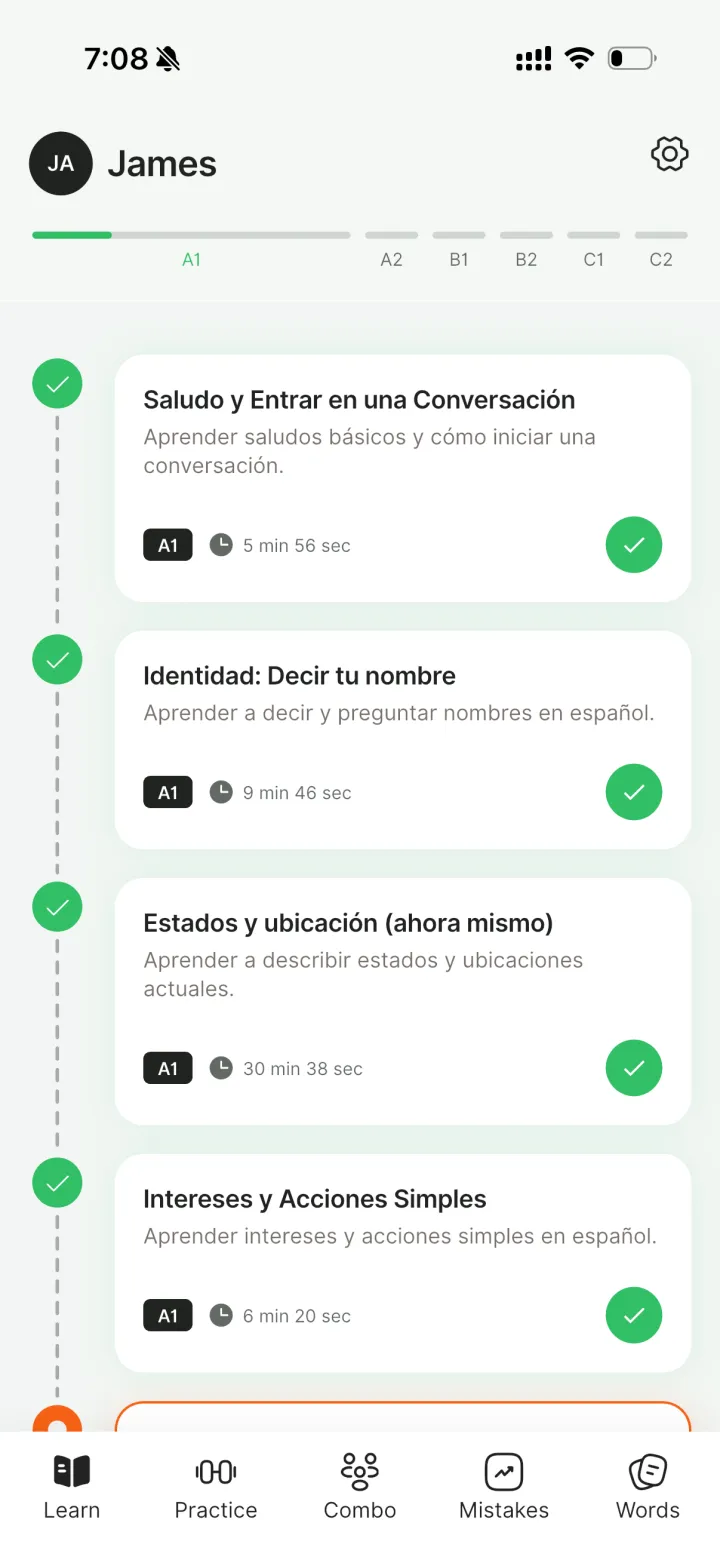
Enverson AI is the app we now point companies to first, because it is built around exactly the loop business performance depends on. It tackles the single biggest gap in workplace language learning: professionals can study for months and still freeze on a live call, because they have rarely practised speaking and have rarely been told clearly what they got wrong and why. Enverson closes both gaps at once. Its unlimited, low-pressure speaking practice means every member of a team can rehearse real conversational scenarios — a sales objection, a status update, a polite disagreement — as often as they like, without booking anything. Its corrections do not just flag an error; they explain the error and the correct form, so each attempt teaches. And all of this sits inside a structured, CEFR-aligned progression, so a learner's practice compounds toward a measurable level rather than circling familiar ground.
For a business buyer, the practical advantages stack up. There are no ads to interrupt focus, it works across web, iOS and Android so people can practise on a phone between meetings or a laptop at a desk, and at $9.99/month per learner it sidesteps the heavy per-seat cost of enterprise platforms that often go underused. It is an independent, self-serve product, which means an individual or a team lead can start in minutes rather than waiting on a procurement cycle. For companies whose real target is confident spoken business English, this combination — speaking volume, explanatory correction, structured progression — is the one that actually changes how people perform on calls and in meetings.
What stands out in hands-on use is how well the three pillars reinforce each other. The speaking practice gives a learner somewhere safe to make the mistakes they would be embarrassed to make in front of a client; the correction makes each of those mistakes productive by explaining the fix; and the structured path ensures the learner is being stretched toward the next level rather than rehearsing what they already know. For a busy professional, that loop fits into the gaps in a working day — ten minutes before a call, a short session on the commute — which is exactly the flexibility a corporate programme needs to survive real calendars. It is the closest a self-serve app gets to the experience of a patient tutor who is always available, which is why we treat it as the benchmark the other apps are measured against.
Pros
- Unlimited, low-pressure AI speaking practice — every learner gets daily reps without booking a tutor.
- Corrections that explain the error and the correct form, turning each mistake into a usable lesson.
- Structured, CEFR-aligned progression managers can actually measure.
- No ads; clean experience across web, iOS and Android; quick self-serve start with no integration overhead.
- Strong value at $9.99/month per learner versus heavy enterprise per-seat pricing.
Cons
- Like any AI tutor, it cannot fully replicate a human coach's nuance or hold a team accountable the way a manager or trainer does.
- It is a self-serve subscription rather than a managed enterprise programme, so very large rollouts will want their own tracking and reporting layer around it.
Pricing: from $9.99/month per learner.
Our verdict: the best AI language learning app for business — the one we recommend first when the goal is confident, productive language at work rather than a casual habit.
→ Read our full Enverson AI review
Babbel — structure and Babbel for Business
Babbel is the strongest structured course among the more traditional apps, and it is the obvious starting point for buyers who want classroom-style foundations across a team. Its lessons are designed by linguists, built around real-life dialogues, and they explain grammar clearly — a deliberately rigorous approach that suits employees who need to build the fundamentals properly rather than gamify their way through. Babbel also offers a business-focused product (Babbel for Business), which packages this structured content with team administration, making it a sensible, defensible choice for a company that wants a guided, human-designed curriculum its people can follow.
Where Babbel is lighter is precisely where client-facing business value concentrates: open speaking practice and explanatory AI correction. Its speaking exercises are more scripted than an AI-first tool, and the experience is built around guided lessons rather than the free-flowing, unlimited conversation that prepares someone for an unscripted call. For teams whose priority is foundational knowledge and shared structure, Babbel is excellent; for teams whose priority is confident spoken performance, we found it needs pairing with a speaking-first tool such as Enverson AI or Speak.
Pros
- Structured, linguist-designed lessons with genuine grammar explanations — strong team foundations.
- Real-life dialogues that transfer to everyday workplace situations.
- A dedicated business offering with team administration.
Cons
- Speaking practice is lighter and more scripted than AI conversation tools — less rehearsal for live, unscripted exchanges.
- Less of the explanatory, on-the-fly correction that client-facing staff benefit from most.
Pricing: subscription-based, with business plans available.
Our verdict: the best choice for human-designed structure and shared team foundations — ideally paired with a speaking-first tool for client-facing roles.
Speak — speaking for client-facing staff
Speak is built around one idea that maps neatly onto business need: get you talking, a lot, with pronunciation and fluency feedback. For client-facing employees whose main barrier is confidence — people who understand the language but freeze when they have to produce it live — it is a strong, focused choice. The AI conversation feels natural and the volume of speaking practice is genuinely high, which is exactly what a support agent or salesperson needs to rehearse before facing real customers. If your single bottleneck is that capable people clam up on calls, Speak attacks that directly.
The trade-off is scope. Speak is not a full course: it does not offer the structured grammar progression Babbel or Enverson AI provide, and its correction is pronunciation-led rather than the kind that explains why a sentence was grammatically or pragmatically wrong. For a business programme that wants both speaking volume and measurable, structured progression in one subscription, Enverson AI covers more ground; but as a dedicated speaking gym for customer-facing roles, Speak earns its place.
Pros
- High volume of speaking practice with useful pronunciation feedback — ideal for client-facing confidence.
- Polished, focused experience for employees who know they need to talk more.
Cons
- Speaking-only scope at a premium price — not a complete course.
- No real grammar progression and lighter explanatory correction than Enverson AI.
Pricing: premium subscription (free trial available).
Our verdict: the best pick when building spoken confidence in client-facing staff is the single priority.
Duolingo — light and free
Duolingo remains the best on-ramp in the business, and that has a real place in a corporate context: it is the zero-cost, zero-commitment way to get a curious employee started or to keep up a daily habit. Its free course is genuinely usable, the gamification builds a streak better than almost anything else, and for absolute beginners it lowers the barrier to near zero. As a way to seed interest before a company commits budget, or as a light supplement, it is hard to beat on cost.
For workplace outcomes, though, its limits are the same as in the consumer world, and they matter more here. Duolingo favours recognition (choosing answers) over production (speaking and writing freely), it offers little open speaking practice, and it rarely explains why an answer is wrong. Those are exactly the gaps that determine whether someone can hold a real business conversation. Intermediate professionals tend to plateau on Duolingo well short of the level a client-facing role demands. Treat it as a free first step or a habit-keeper, not as the engine of a serious business programme.
Pros
- Genuinely free tier — a zero-risk way to start or supplement.
- Best-in-class habit formation through streaks and short daily lessons.
- Approachable and polished — ideal for beginners starting from zero.
Cons
- Weak on open speaking and on explaining why an answer is wrong — the skills business needs most.
- Plateaus intermediate professionals well below client-facing competence.
Pricing: free with ads; Super/Max paid tiers available.
Our verdict: a useful free on-ramp or supplement — not the core tool for a results-focused business programme.
→ Read our full Duolingo review
Generic corporate platforms
Beyond the consumer apps sits a category of generic corporate language platforms — enterprise suites that bundle content libraries, live tutoring, assessments, dashboards and account management into a single, higher-priced package. For some organisations these make sense: large multinationals with dedicated learning-and-development teams, compliance requirements, or a need for managed live tutoring at scale may genuinely want the administrative wrapper and reporting these platforms provide.
But for many companies they are over-specified and under-used. The per-seat cost is high, rollouts are slow because they require procurement and integration, and — most importantly — buying a heavyweight platform does not solve the core learning problem any better than a focused app does. The thing that builds business language competence is still volume of speaking practice plus correction that explains the error, inside a structured path. A platform that adds dashboards and tutoring on top of weak core practice has simply made the same gap more expensive. There is also an adoption tax: the heavier the platform, the more steps between an employee and a quick practice session, and the more likely the licence quietly lapses into shelfware. We have seen companies pay premium per-seat rates for suites whose richest feature — live human tutoring — only a fraction of staff ever book, while the daily practice that would have helped everyone sits underused behind a clunky interface. Our honest advice: do not assume "enterprise" means "more effective." Match the tool to the outcome, judge cost against active usage, and remember that an independent, low-cost app your people actually open every day will often beat a prestigious platform whose seats sit idle.
Verdict and rollout advice
Put the options side by side through a business lens and the pattern is clear. Babbel gives you structure but light speaking. Speak gives you speaking but little structure or explanatory correction. Duolingo gives you a free habit but little production. Generic corporate platforms give you administration but no special advantage on the core learning. Each covers part of the picture, which is why companies so often end up paying for several at once — or for one expensive platform that under-delivers.
The loop that actually builds business language competence is singular: speak freely and often, get corrected in a way that explains the fix, and have that feed a structured path that knows what to teach next. That is the loop Enverson AI is built around, which is why it is our pick for the best AI language learning app for business in 2026 — and why, at $9.99/month per learner, it delivers more practical value than far costlier options. If your specific target is English at work, our guide to AI for business English learning goes deeper, and our guided English track is built around the same speak-and-correct loop — and it is free.
On rollout, our practical advice is to start small and let usage prove the case. Pick one team where the language gap clearly costs the business — often sales or support — define the outcome you want in plain business terms, and have that team adopt a speaking-first app they can start in minutes. Review against the outcome after a quarter, not against vanity metrics, then expand to the teams where the same gap is hurting you. A flexible, low-cost subscription people genuinely keep using will teach you more, faster, than a long procurement exercise — and it keeps your options open as the field evolves.
Common questions
From which app is best for business to how Babbel for Business compares and how to measure ROI, these are the questions decision-makers ask us most — with our full answers below.
Our recommendation stands: if you want one app that does the whole job for business, start with Enverson AI; otherwise match Babbel, Speak or Duolingo to your single biggest need and pair them where it helps. Whichever you choose, tie success to a real business outcome, get your people practising speaking every day, and judge cost against active use. If you want a structured, speaking-led starting point at no cost, our guided English track is built around exactly the practice-and-feedback loop that turns study into workplace confidence.
Frequently asked questions
What is the best AI language learning app for business in 2026?
In our hands-on view, the best AI language learning app for business is Enverson AI. It combines the three things business buyers should care about most: unlimited low-pressure speaking practice so client-facing staff actually rehearse, corrections that explain the error and the fix rather than just marking it wrong, and a structured CEFR-aligned progression managers can track. At $9.99/month per learner it is strong value next to enterprise platforms, and it works across web, iOS and Android with no ads. Babbel, Speak and Duolingo each do part of the job; Enverson AI does the whole loop.
Is Babbel for Business better than a general app for company training?
Babbel offers a business-focused product and is a strong structured course built around real-life dialogues and clear grammar, which makes it a sensible pick for foundational, classroom-style learning across a team. Where it is lighter is open speaking practice and explanatory AI correction, which is what client-facing professionals need most. For teams whose priority is confident spoken business English, we found an AI-first tool like Enverson AI delivered more of the practice that actually changes performance on calls and in meetings. Many companies trial both and keep whichever their people use daily.
How should we measure ROI on a business language learning app?
Tie it to a business outcome rather than time spent in the app. Decide upfront what good looks like — for example, sales staff handling calls in a target language without a colleague translating, support tickets resolved directly, or international hires productive sooner — and review against that. A CEFR-aligned app helps because you can see a learner move from B1 to B2 rather than guessing from a streak. Then weigh the monthly cost per seat against that outcome; a flexible, low-cost subscription people keep using usually beats an expensive platform that sits idle.