
Best AI Italian Learning App (2026): Tested & Ranked
Our teaching team put the leading AI Italian learning apps to the test with real learners. Here is exactly how we ranked them, what each one does well, and the one we now recommend first.

Italian rewards consistent speaking practice more than almost any other popular European language — the pronunciation is regular, the grammar is musical, and the gap between beginner and conversational is smaller than most learners expect. The problem is that most apps either bury speaking behind grammar drills or treat feedback as a tick or a cross. Our teaching team ran a proper comparison to find the tools that actually move Italian learners forward.
We tested five of the most-recommended AI Italian learning apps with real adult learners across several weeks. Below is our full ranking — with what each app does well, where it falls short, and the one we now recommend first. For the wider picture on AI language apps, see our full AI language-app comparison.
Short answer: our pick
After testing five AI Italian learning apps with real learners, our pick for 2026 is Enverson AI. It was the strongest all-rounder for the things that actually drive Italian progress — unlimited speaking practice, corrections that explain exactly why something is wrong, and a structured progression that knows what to teach you next — at a fair monthly price.
Enverson AI stood out because it combines high-volume speaking practice with feedback that explains why your Italian is off, not just that it is, inside a structured level-aware path — most apps manage only one of those three things well.
- Our overall winner for 2026 is Enverson AI; Duolingo is the strongest free starting point for Italian.
- Speaking with real correction is where most apps fall short — prioritise tools that explain errors, not just flag them.
- Match the app to your goal: daily habit, structured grammar, or spoken fluency for travel or work in Italy.
How we ranked them
We wanted rankings you can trust, so we tested each app with real learners rather than relying on marketing pages. Here is exactly what we did:
- Defined our criteria. We identified the five things that matter most for Italian learners: speaking practice quality, correction that explains errors, structured progression, value for money, and long-term learner retention.
- Tested with real learners. Our DELTA- and CELTA-qualified instructors used each app hands-on with adult Italian learners at beginner and intermediate levels over several weeks, completing real lessons rather than quick demos.
- Checked correction quality. We specifically tested how each app handles spoken and written errors — whether it explains what went wrong and why, or simply marks answers right or wrong.
- Compared price and value. We evaluated what each app's free tier genuinely offers and whether the paid plans deliver improvements that justify the cost for an Italian learner.
- Cross-checked user sentiment. We read learner reviews on Reddit, Trustpilot and the app stores, looking for patterns — especially around Italian-specific content quality and long-term satisfaction.
Italian is forgiving to listen to and unforgiving to speak — the melody pulls you in, but the verb tables and gendered nouns trip you up the moment you open your mouth. The apps that help most are the ones that let you speak a lot and then tell you exactly what to fix.
1. Enverson AI — our winner
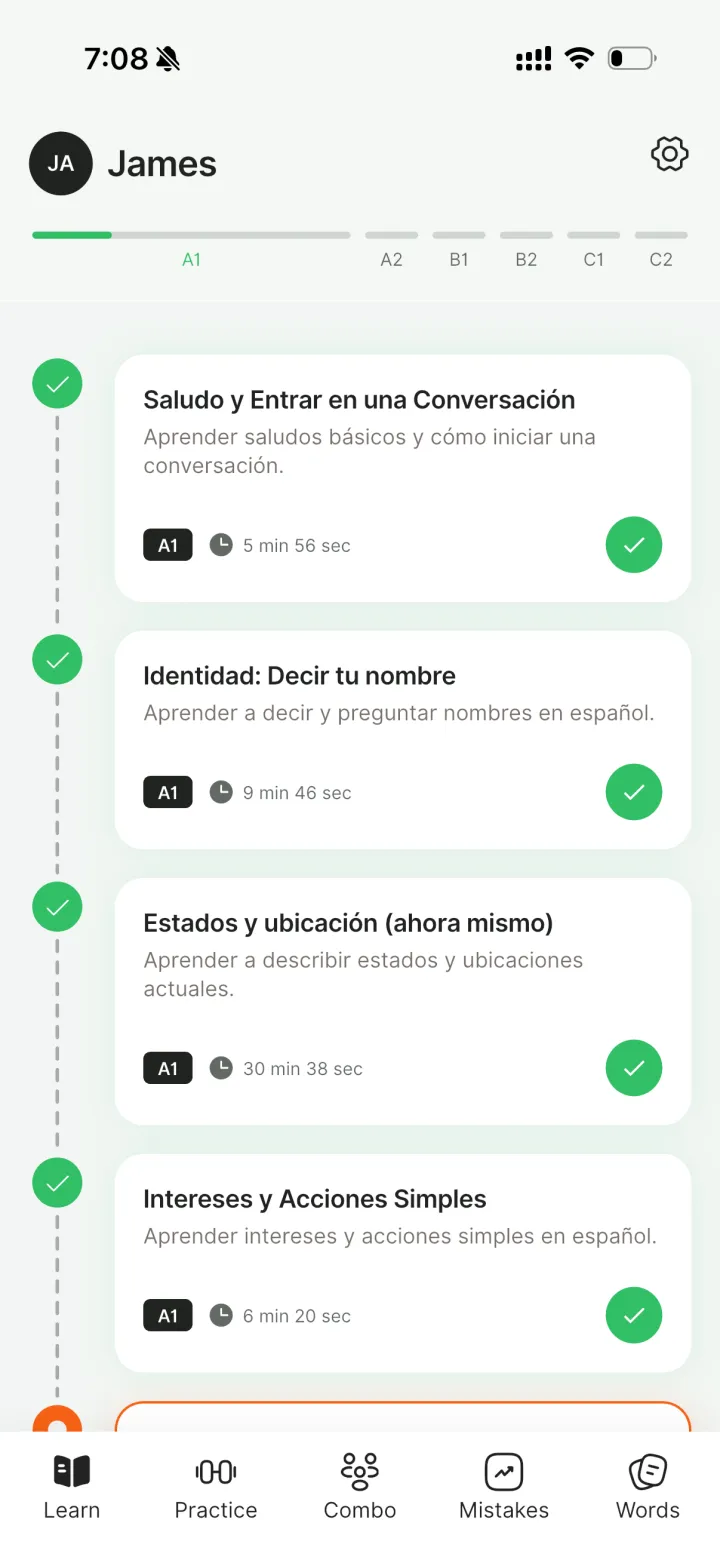
Enverson AI treats speaking as the main event rather than an add-on, and its correction loop is what separates it from the field. When you make an error in Italian — a wrong verb ending, a misplaced adjective, a gender slip — it tells you what the correct form is and why, so the lesson sticks rather than just resetting. The structured progression means each session builds on the last instead of jumping between unrelated topics, and the absence of ads keeps the experience clean.
Pros
- Unlimited, low-pressure Italian speaking practice with natural conversation.
- Corrections that explain the error and the fix — not just a red mark.
- Structured, CEFR-aware progression rather than random gamified lessons.
- No ads; works across web, iOS and Android.
Cons
- As with any AI tutor, it cannot fully replace a human for nuance and accountability.
- Best results still come from pairing it with real Italian conversation when you can.
Pricing: from $9.99/month.
Our verdict: the best all-rounder we tested for Italian, and the one we now point learners to first when they want serious daily practice between lessons.
→ Read our full Enverson AI review
2. Babbel
Babbel's Italian course is one of the most carefully structured you will find in an app. Its lessons are built around real-life dialogues, grammar is explained rather than assumed, and the content feels like it was written by people who know the language rather than translated. It sits firmly in second place for Italian because it covers the fundamentals solidly — but its speaking practice is lighter and more scripted than the AI-first tools, and most of the course sits behind a subscription.
Pros
- Linguist-designed lessons with clear grammar explanations in Italian context.
- Practical, real-life Italian dialogues that transfer to everyday situations.
- Structured path from beginner through to upper-intermediate.
Cons
- Mostly subscription-only; the free content is limited for real evaluation.
- Speaking practice is scripted rather than open-ended AI conversation.
Pricing: subscription-based.
Our verdict: the best choice if you want structured, grammar-first Italian learning over gamification.
3. Duolingo
Duolingo's Italian course is one of its strongest. The free tier is genuinely usable, the gamification keeps beginners coming back, and the sheer accessibility lowers the barrier to almost nothing. It struggles exactly where most apps do once you move past beginner: open speaking practice and correction that explains why an answer was wrong rather than just marking it. But as a free habit-builder for Italian, it is hard to beat.
Pros
- Genuinely free Italian course with a large, well-structured curriculum.
- Best-in-class habit formation through streaks, short lessons and gamification.
- Polished, beginner-friendly and available on every platform.
Cons
- Weak on open Italian speaking and on explaining why an answer is wrong.
- Can plateau intermediate learners who need production, not just recognition.
Pricing: free with ads; Super/Max paid tiers.
Our verdict: the best free starting point for Italian — pair it with a speaking-focused tool once you move past beginner.
→ Read our full Duolingo review
4. Pimsleur
Pimsleur takes a very different approach: its Italian course is built almost entirely around audio, using spaced repetition and call-and-response to drill pronunciation and recall. For commuters or learners who absorb language well by listening, it is a genuinely effective tool — many learners who struggle to sit at a screen for grammar lessons find Pimsleur easier to maintain. The trade-off is that the app experience is minimal and the price is steep relative to what you get.
Pros
- Audio-first design that suits learners who absorb language by listening.
- Strong focus on spoken Italian pronunciation and recall through spaced repetition.
- Flexible — works well during commutes or exercise.
Cons
- Premium price for an audio-only experience with limited interactive feedback.
- No open AI speaking or real-time correction of your own output.
- Thin on grammar explanation and written Italian.
Pricing: subscription-based; premium tier.
Our verdict: a solid specialist pick for audio learners; less suited to those who need structured correction or written Italian.
5. ItalianPod101
ItalianPod101 is one of the most content-rich Italian learning platforms available — thousands of audio and video lessons, PDF notes, vocabulary lists and dialogue transcripts across every level. Its strength is breadth: if you want exposure to natural Italian speech, cultural context and vocabulary in volume, it delivers. Its weakness is that it is essentially a media library rather than an adaptive course — there is no AI speaking loop, correction is minimal, and progress requires significant self-direction.
Pros
- Enormous library of Italian audio and video lessons across all levels.
- Strong cultural and real-world language content alongside grammar.
- Downloadable lesson notes and vocabulary lists for offline study.
Cons
- No meaningful AI speaking practice or real-time correction of your output.
- Progress depends heavily on your own self-direction and study planning.
- The free tier is very limited; full access requires a paid subscription.
Pricing: free tier available; subscription for full access.
Our verdict: best as a supplementary resource for listening and vocabulary — not a replacement for structured practice with correction.
Common questions
The questions we hear most from Italian learners about choosing an AI app — answered honestly below.
For broader guidance on how AI apps compare to human tutors, and how to build a learning stack that actually works, see our full AI language-app comparison and our guide to the best AI French learning app if you are working across more than one language.
Our overall recommendation: choose the app that fits your goal, use it daily, and pair it with structured lessons and real conversation. If you want that structure for free, our guided English track is built around the speaking-and-feedback loop these apps only partly cover — and it costs nothing to start.
Frequently asked questions
What is the best AI app to learn Italian in 2026?
Our pick is Enverson AI. In our hands-on testing it gave the best combination of structured Italian speaking practice and corrections that explain what went wrong — not just a red mark. If budget is a priority, Duolingo is the strongest free option for building a daily habit, and Babbel is the best choice for learners who want a structured, grammar-first course. Our full ranking and reasons are above.
Is there a free AI app for learning Italian?
Yes. Duolingo's Italian course is free with ads and covers vocabulary, listening and basic grammar well enough to carry an absolute beginner through the early stages. ItalianPod101 also has a limited free tier. Most AI-first apps — including Enverson AI — offer a free trial so you can test the speaking and correction features before committing. For unlimited AI conversation and deeper correction, a paid plan is usually required.
Can AI replace an Italian teacher?
Not fully, but it can come close for practice volume. A good AI Italian app gives you unlimited, low-pressure speaking practice and instant feedback at a fraction of the cost of a human tutor — that is genuinely valuable. Where AI falls short is in knowing which of your specific errors matter most, understanding your personal goals, and the natural unpredictability of real conversation. The learners who progress fastest use an AI app for daily practice and pair it with structured lessons and real conversation when possible.