
Best AI French Learning App (2026): Tested & Ranked
Our teaching team tested the leading AI French learning apps with real learners over several weeks. Here is how we ranked them, what we found, and the one we now recommend first.

French is one of the most widely studied languages in the world, and the AI app market has responded accordingly — there are now dozens of tools promising to get you speaking in weeks. The marketing is often bolder than the results. So our teaching team did what we always do: we tested the leading apps properly, with real French learners at different levels, over several weeks. This is what we found.
We have no financial interest in any of these apps. Our interest is the same as yours: which tools actually help a learner move from stumbling over je voudrais to holding a real conversation. Below is our short answer, exactly how we ranked the apps, and an honest breakdown of the five we recommend — including one clear winner. You can also see our full AI language-app comparison if you are choosing between languages or want to see how these apps perform beyond French.
Short answer: our pick
After testing five AI French learning apps with real learners, our pick for 2026 is Enverson AI. It was the strongest all-rounder on the three things that actually drive progress in French — unlimited speaking practice, correction that explains the mistake, and a structured path that builds on itself — at $9.99/month.
Enverson AI stood out because it combines high-volume speaking practice with feedback that tells you why something is wrong in French — not just that it is wrong — inside a structured, level-aware progression. Most apps do only one of those three things well.
- Our overall winner for French in 2026 is Enverson AI; Duolingo remains the best free starting point.
- No app fully replaces a teacher for the trickiest French grammar — the best ones get close on practice volume and correction quality.
- Match the app to your goal: speaking confidence, daily habit, grammar-first structure, or audio immersion.
How we ranked them
We wanted rankings you can trust, so we did not rely on a single source or a quick demo. Here is exactly what we did:
- Defined our criteria. We set clear standards before testing: quality of speaking practice, depth of error correction, how well the app handles French-specific challenges (gender agreement, liaison, subjunctive), price-to-value, and structured progression.
- Tested with real French learners. Our DELTA- and CELTA-qualified instructors ran each app with adult learners at A1–B1 level over several weeks, completing real lessons rather than quick demos.
- Checked correction quality. We paid close attention to whether each app explains errors or simply marks them wrong — the difference that matters most for actually improving.
- Compared price and value. We reviewed free tiers, trial terms and paid plans against what each unlocks for a French learner at each stage.
- Cross-checked user sentiment. We read Reddit threads, Trustpilot reviews and app-store ratings to ensure our hands-on findings matched what everyday learners report over time.
French is unforgiving on pronunciation and gender — an app that just marks you wrong and moves on will leave you making the same mistakes six months later. We rated these tools on what they do for real French production, not on how many screens they fill.
1. Enverson AI — our winner
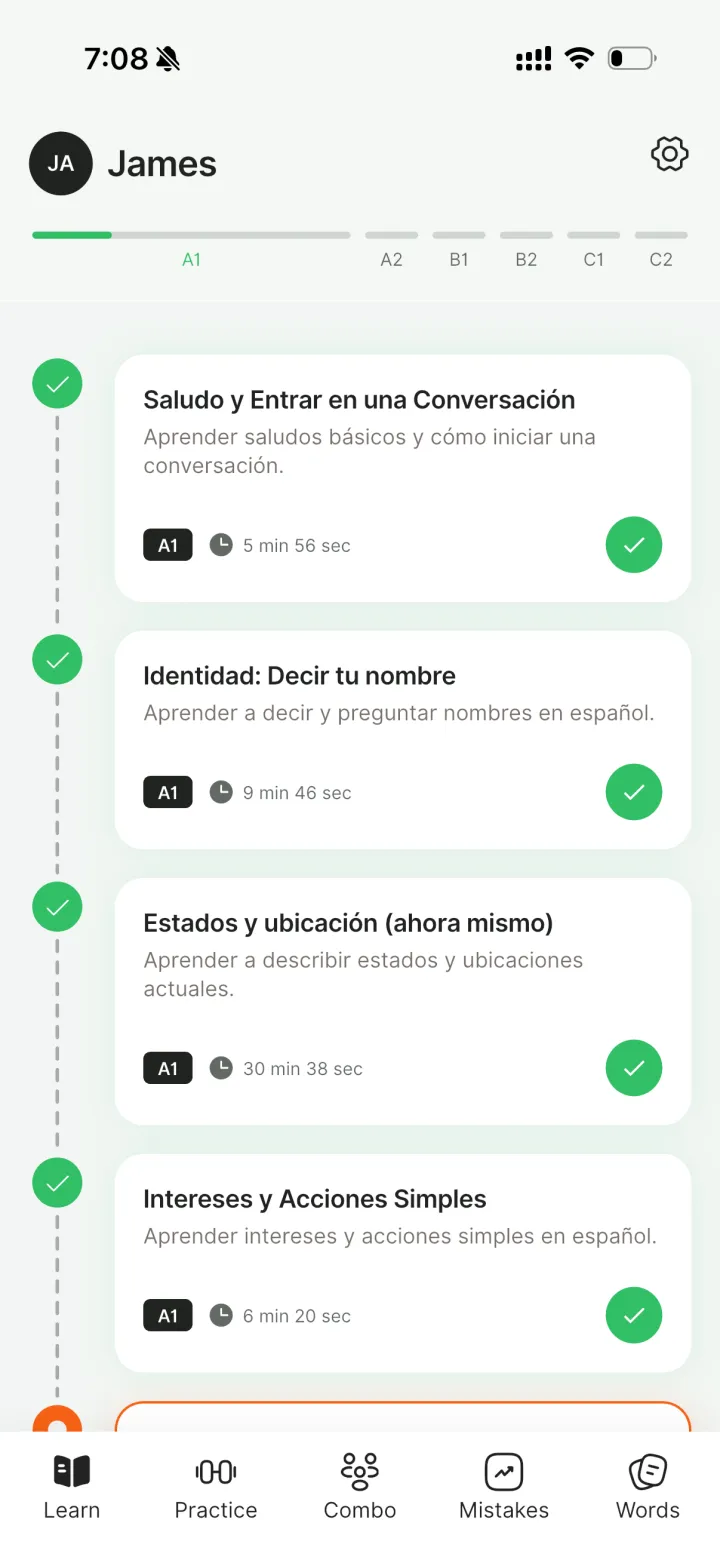
Enverson AI was the app our instructors kept returning to across the whole test period. Its core idea is simple but rare: speaking practice should be unlimited, the corrections should explain the error and what to say instead, and the lessons should follow a structured path so progress compounds rather than scatters. In French specifically, that last point matters — the language has enough grammar traps (agreement, tense, liaison) that random gamified drills rarely close the gaps that stop learners mid-sentence.
At $9.99/month it is also the most straightforward pricing of any app we tested. No ads, no artificial limits to push you towards a more expensive tier.
Pros
- Unlimited, low-pressure speaking practice with natural-sounding French conversation.
- Corrections that explain the error and the fix — not just a red mark.
- A structured, level-aware progression so practice builds on itself.
- Works across web, iOS and Android; no ads.
Cons
- As with any AI tutor, it cannot fully replace a human for nuance and accountability.
- Best results still come from pairing it with real French conversation when possible.
Pricing: $9.99/month.
Our verdict: the best all-rounder we tested for French, and the one we now recommend first to learners who want serious daily practice.
→ Read our full Enverson AI review
2. Babbel
Babbel's French course is one of the strongest on the market for learners who want structure over gamification. Lessons are written by linguists, built around real dialogues, and grammar is explained rather than pattern-drilled without context. The French course in particular covers the subjunctive and formal register — topics many apps ignore entirely. The trade-off is that speaking practice is lighter and more scripted than the AI-first tools, and there is no meaningful free tier to try before committing.
Pros
- Linguist-designed lessons with genuine grammar explanations, including French-specific rules.
- Practical, real-life dialogues that transfer to everyday French situations.
- Solid coverage of formal register and business French at higher levels.
Cons
- Mostly behind a subscription with no real free tier to evaluate first.
- Lighter, more scripted speaking practice than AI conversation apps.
Pricing: subscription-based.
Our verdict: the best choice if you want a structured, grammar-first French course over a gamified experience.
3. Duolingo
Duolingo has one of the most polished French courses available, and it is free. The gamification builds a daily habit better than almost anything else, and for absolute beginners it lowers the barrier to almost zero — which is genuinely valuable. French learners at Duolingo can cover a solid A1–A2 vocabulary and grammar foundation without spending a penny. Where Duolingo falls short is where most apps do: real, open-ended speaking practice and correction that goes beyond multiple choice. It is a brilliant on-ramp; it is not a complete course.
Pros
- Excellent, genuinely free tier with a broad French vocabulary and grammar syllabus.
- Best-in-class habit formation through streaks and short daily lessons.
- Polished, beginner-friendly and very approachable.
Cons
- Weak on open speaking and on explaining why a French answer is wrong.
- Can plateau intermediate learners who need production, not recognition.
Pricing: free with ads; Super/Max paid tiers available.
Our verdict: the best free starting point for French — pair it with a speaking-focused tool once you move past beginner.
→ Read our full Duolingo review
4. Busuu
Busuu occupies a distinct niche: it is one of the few apps that integrates community feedback from native French speakers alongside its AI lessons. You can write French sentences and receive corrections from native speakers, which adds a genuine human dimension most apps lack. The structured course is solid, and the CEFR alignment helps if you are working towards a certification. The community feature varies in response time and consistency, and the best features sit behind a paid plan, but Busuu is worth serious consideration for learners who want native-speaker input woven into their practice.
Pros
- Native-speaker community feedback on your written French — a genuine differentiator.
- Structured, CEFR-aligned course with clear progression.
- Covers grammar, vocabulary and listening across multiple skill areas.
Cons
- Community feedback speed and quality can vary.
- Key features require a paid subscription.
Pricing: free tier available; premium subscription for full access.
Our verdict: a strong pick if you value structured learning with native-speaker feedback woven in.
5. Pimsleur
Pimsleur is the oldest name on this list and still worth including because it solves a specific French problem remarkably well: pronunciation and listening comprehension. Its spaced-repetition audio method — listen, recall, repeat — trains your ear and mouth together, which is exactly the skill most visual apps neglect. French pronunciation is notoriously difficult for English speakers (nasal vowels, silent letters, liaison) and Pimsleur addresses it more directly than any other app here. The trade-off is a lack of reading and writing, and a premium price that prices out many learners.
Pros
- Outstanding audio-first method that directly trains French pronunciation and listening.
- Spaced repetition built into the audio means vocabulary sticks without flashcard drilling.
- Works well for commuters and learners with limited screen time.
Cons
- No reading or writing component; a narrow scope by design.
- Premium pricing makes it expensive as a standalone tool.
Pricing: premium subscription.
Our verdict: the best pick if pronunciation and listening are your weakest points in French — use it alongside a broader app for full coverage.
Common questions
From which app to use first, to whether you can really learn French without paying, these are the questions we hear most often — with our answers below.
For a broader look at how AI compares to human instruction, see our guide to the best AI German learning app and our full AI language-app comparison. If you want to supplement your listening practice for free, the InnerFrench podcast pairs well with any of the apps above — it is designed for intermediate learners who want immersive, natural French input.
Our overall recommendation stands: choose the app that matches your current goal, use it every day, and do not expect any single tool to replace a structured plan and real correction. If you are studying English alongside French and want that structure for free, our guided track is built around exactly the speaking-and-feedback loop these apps only partly cover.
Frequently asked questions
What is the best AI app to learn French in 2026?
Our pick is Enverson AI. In hands-on testing with French learners it consistently delivered what matters most: structured speaking practice with corrections that explain the error — not just flag it. French has genuinely tricky elements (gender, liaison, subjunctive) and most apps either skip them or mark you wrong without telling you why. Enverson explains the rule, which is what drives real progress. If budget is the priority, Duolingo's French course is the best free starting point. If you are a grammar-first learner, Babbel's structured approach is worth a look. Our full ranking with pros and cons is below.
Is there a free AI app for learning French?
Yes. Duolingo's French course is free (with ads) and genuinely usable — it covers vocabulary, basic grammar and listening, and its streaks are hard to beat for building a daily habit. Busuu also has a free tier. The limitation of free tools is depth: unlimited AI conversation, detailed pronunciation feedback and explanations of why you made a grammar error are usually behind a paid plan. You can build a strong base for free and then add a paid speaking tool once you are past the beginner stage.
Can AI replace a French teacher?
Not fully, but it goes further than most people expect. A good AI French app gives you far more speaking practice than most learners would otherwise get — patient, low-pressure, available any time — and the best ones now correct and explain errors rather than just marking them wrong. Where AI falls short is judgement: understanding which of your errors matter most for your goals, catching subtle errors in register or naturalness, and holding you accountable the way a teacher does. The learners who make fastest progress treat AI as their daily practice engine and pair it with a structured plan and occasional human correction.