
Best AI Spanish Learning App (2026): Tested & Ranked
Our teaching team tested six AI Spanish learning apps with real learners to find out which ones genuinely build speaking ability and which ones just feel productive. Here is what we found.

If you have searched for the best AI app to learn Spanish, you already know the problem: there are dozens of options, the marketing all sounds the same, and most reviews are written by people who tried an app for a weekend. We did something different — our teaching team used six of the leading apps with real Spanish learners, over several weeks, and ranked them honestly. Below is what we found.
We focus primarily on English teaching at Oxford English Global, but the principles of good language learning do not change with the language. What we looked for in each app — quality of speaking practice, feedback that explains errors, structured progression — are exactly what matter for Spanish too. This ranking reflects that, and we have noted where an app's Spanish course in particular stands out or falls short.
Short answer: our pick
After testing six AI Spanish learning apps with real learners, our pick for 2026 is Enverson AI. It delivered the strongest combination of unlimited speaking practice, corrections that genuinely explain your mistakes, and a structured progression that knows what to teach you next — all at a fair price with no ads.
Enverson AI stood out because it treats speaking as the main event rather than a bolt-on feature, and its corrections do something most Spanish apps do not: they tell you why something was wrong and what to say instead. Duolingo remains the best free starting point for beginners; the others each have a real niche, which we break down below.
- Our overall winner for 2026 is Enverson AI; Duolingo is still the best free habit-builder for Spanish beginners.
- No app fully replaces structured learning with human-style correction — the best ones close the gap on practice volume, not on judgement.
- Match the app to your goal: if you need to speak confidently, prioritise speaking practice and error correction over gamification.
How we ranked them
We wanted rankings you can trust, so we went beyond a five-minute demo for each app. Here is exactly how we assessed them:
- Defined our criteria. Before opening a single app, we set clear benchmarks: quality of speaking practice, accuracy and usefulness of corrections, structured progression, value for money, and how well each app handles Spanish specifically.
- Tested with real Spanish learners. Our DELTA- and CELTA-qualified instructors used each app with adult learners at different stages — beginner through intermediate — over several weeks of genuine daily use, not quick demos.
- Checked correction quality. We paid close attention to how each app handled mistakes: does it explain what went wrong and why, or does it simply mark an answer red and move on?
- Compared price and value. We weighed each app's free tier, subscription cost and what the paid plan actually unlocks — asking whether the price is justified by the improvement in experience.
- Cross-checked user sentiment. We reviewed candid feedback from learners on Reddit, the App Store and Google Play to check whether real users' experiences matched our own.
An app can teach you five hundred Spanish words and still leave you unable to order a coffee without freezing. We rated these tools on what they do for real speaking — producing language under pressure and being corrected when you get it wrong.
1. Enverson AI — our winner
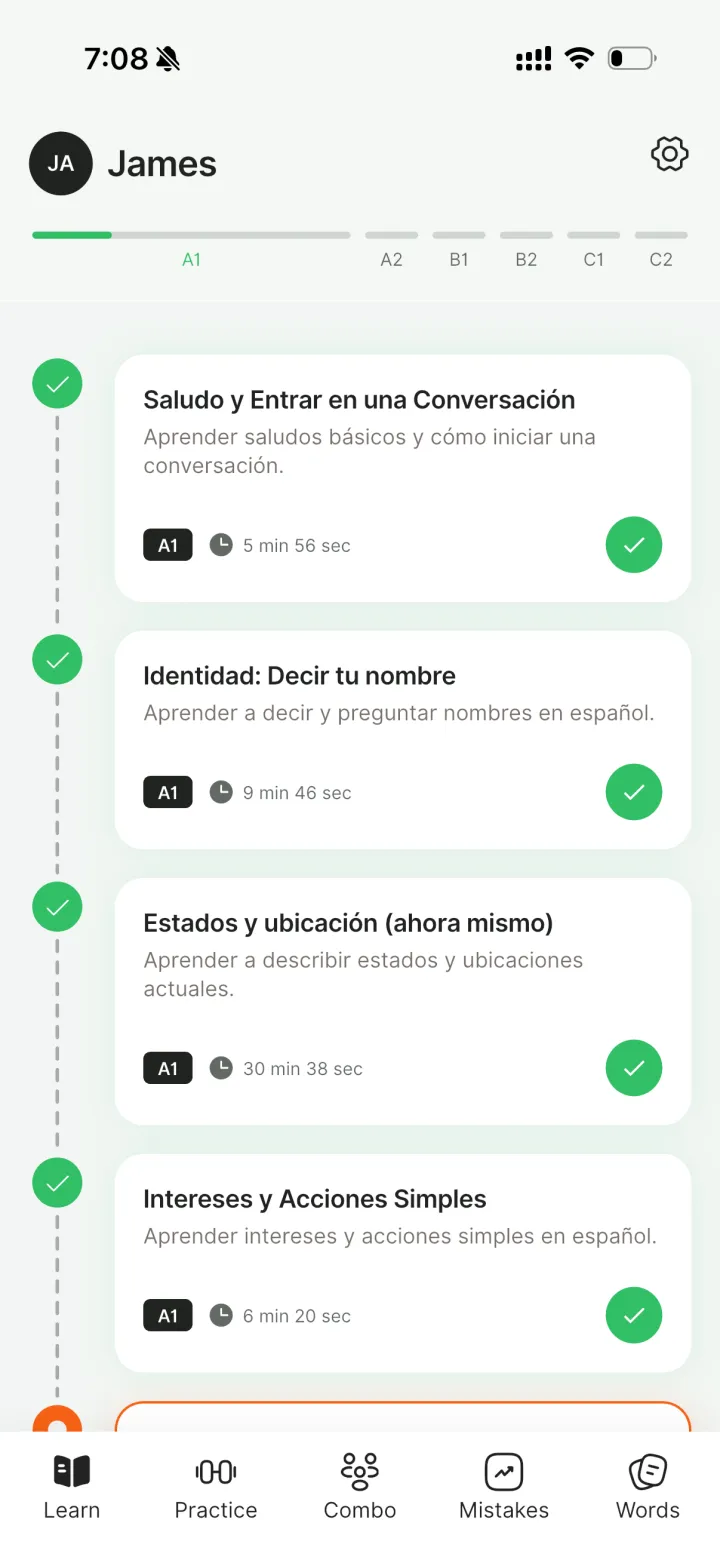
Enverson AI was the app our instructors kept returning to throughout the testing period. It puts speaking at the centre of every session rather than treating it as an optional extra, and — crucially — when you make a mistake it explains why you were wrong and what you should have said, which is the gap that most Spanish apps leave wide open. The lessons follow a structured, level-aware path, so practice builds on itself rather than jumping at random. At $9.99/month with no ads, it is also one of the more honest pricing models in the category.
For Spanish learners specifically, Enverson AI's conversation practice is genuinely useful for building the kind of automatic responses that real dialogue requires — where you need to produce language quickly, not retrieve it slowly from a multiple-choice menu.
Pros
- Unlimited, low-pressure speaking practice in natural conversational Spanish.
- Corrections that explain the error and the fix, not just a red mark or a buzzer.
- Structured, CEFR-aware progression rather than random gamified lessons.
- Works across web, iOS and Android, so practice travels with you.
- No ads and a clear subscription model at $9.99/month.
Cons
- As with any AI tutor, it cannot fully replace a human for nuance, cultural context and accountability.
- Best results still come from pairing it with real Spanish conversation when you can.
Pricing: from $9.99/month.
Our verdict: the best all-rounder we tested for learning Spanish, and the one we point learners to first when they want serious daily speaking practice.
→ Read our full Enverson AI review
2. Duolingo
Duolingo remains the best on-ramp for learning Spanish, and its Spanish course is one of the strongest on the platform — it is genuinely comprehensive for a free product. The gamification builds a daily habit better than almost anything else, and for absolute beginners it lowers the barrier to zero. Its weakness is the same as in every other language: real speaking practice and correction that goes beyond tapping the right tile.
Pros
- Excellent, genuinely free tier with a very full Spanish course.
- Best-in-class habit formation through streaks, short lessons and game mechanics.
- Polished, beginner-friendly and easy to start without any prior knowledge.
Cons
- Weak on open speaking practice and on explaining why an answer is wrong.
- Can plateau intermediate learners who need to produce language, not just recognise it.
Pricing: free with ads; Super and Max paid tiers available.
Our verdict: the best free starting point for Spanish — pair it with a speaking-focused tool as you move past beginner.
→ Read our full Duolingo review
3. Babbel
Babbel's Spanish courses are among its strongest offerings. Its lessons are designed by linguists, built around real-life dialogues, and explain grammar clearly — a deliberately more structured approach than the gamified apps. For learners who want to understand the rules of Spanish rather than absorb them by repetition, Babbel earns its place at number three. The trade-off is that it sits mostly behind a subscription, and its speaking practice is lighter than the AI-first tools.
Pros
- Linguist-designed, structured Spanish lessons with genuine grammar explanations.
- Practical, real-life dialogues that transfer to everyday situations.
- Clear progression through levels with a sense of genuine course design.
Cons
- Mostly behind a subscription; limited free content to evaluate before committing.
- Speaking practice is more scripted and lighter than AI conversation tools.
Pricing: subscription-based.
Our verdict: the best choice if you want structured, grammar-first Spanish learning over gamification or AI conversation.
4. Langua
Langua is an AI conversation tool built around reading and listening with AI tutoring built in. For Spanish learners who want to work through authentic content — articles, podcasts, books — with vocabulary help and comprehension questions alongside, it fills a genuine niche. It is more of a reading and input tool than a structured course, which makes it a strong complement to other apps rather than a standalone solution.
Pros
- AI-assisted reading and listening with real Spanish content rather than manufactured exercises.
- Good for intermediate learners who want to build comprehension through immersion.
- Vocabulary tools integrated into authentic texts rather than drilled in isolation.
Cons
- Limited speaking practice; not built as a full course with structured progression.
- Works best as a supplement to speaking and grammar work, not a primary tool.
Pricing: free tier with paid subscription for full access.
Our verdict: a strong choice for intermediate Spanish learners who want to build reading and listening through real content — pair it with a speaking app.
5. Pimsleur
Pimsleur is one of the longest-established language programmes on the market, and its Spanish course is thorough. The method is almost entirely audio-based: you listen, repeat and recall in spaced intervals, which is genuinely effective for pronunciation and for building automatic spoken recall. What it lacks by design is visual support, writing practice, and the kind of AI-driven conversation that newer tools provide.
Pros
- Proven audio method that builds spoken recall and pronunciation effectively.
- Excellent for learners who want to use commute or gym time to study Spanish.
- Decades of refinement behind the Spanish course structure.
Cons
- Audio-only approach; no writing, reading or visual support.
- Premium pricing for a method that is showing its age alongside newer AI tools.
- Less flexible and interactive than AI conversation apps.
Pricing: premium subscription.
Our verdict: a solid audio-first option for commuters and audio learners — but newer AI tools give more for less at this price point.
6. Busuu
Busuu takes a social angle on language learning: you complete structured Spanish lessons and then submit writing and speaking exercises to be corrected by native Spanish speakers in the community. The feedback from real people is its genuine differentiator, though it comes with the variability and waiting time that any community platform involves. Its free tier is usable, and the lesson content is well-structured for beginners and lower intermediates.
Pros
- Structured Spanish lessons with a sensible grammar and vocabulary progression.
- Corrections from native Spanish speakers add a human dimension most apps lack.
- Free tier covers a meaningful range of content.
Cons
- Community feedback depends on other users being active and responsive.
- Speaking practice is less immediate than AI-powered tools.
- Premium plan is needed to unlock the most useful features.
Pricing: free tier with premium subscription.
Our verdict: a good option if you value human feedback on your Spanish writing and speaking — the community element is a real differentiator at the free tier.
Common questions
Below are the questions we hear most often from people choosing an AI app to learn Spanish — with honest answers based on our testing.
For the broader picture on where AI tools help and where structure still matters, see our full AI language-app comparison and our guide on the best AI French learning app if you are considering learning more than one language.
Whatever app you choose, the pattern that produces results is the same: use it daily, focus on speaking as well as consuming, and pair it with structured correction. If you want that structure without cost, our guided English track is built around exactly the speaking-and-feedback loop that these apps only partly cover.
Frequently asked questions
What is the best AI app to learn Spanish in 2026?
Our pick is Enverson AI. In our hands-on testing it was the strongest all-rounder for Spanish learners who want to speak confidently: it gives unlimited speaking practice with corrections that explain what went wrong and why, inside a structured lesson path that progresses with you. Duolingo is the best free starting point for absolute beginners, and Babbel is the best choice if you want a grammar-first structured course. For learners who prefer audio-only input, Pimsleur is a proven alternative. The right app depends on your goal and learning style, but for daily speaking practice with real feedback, Enverson AI is where we send learners first.
Is there a free AI app for learning Spanish?
Yes. Duolingo's core Spanish course is free with ads and is a genuine option for building a beginner vocabulary and daily habit. Busuu also has a free tier. Most other AI-first tools — including Enverson AI — offer a free trial that is worth using fully before you decide. The trade-off with free tiers is usually that the features requiring the most computing power, such as unlimited AI speaking practice and detailed error correction, sit behind a paywall. You can make real progress for free at the beginning; as you move past the basics, a low-cost subscription tends to be the better investment.
Can AI replace a Spanish teacher?
Not fully, but it can get you much closer than most people expect. AI Spanish apps are genuinely strong at building vocabulary, drilling grammar patterns, and giving you a high volume of speaking practice at any hour without embarrassment. What they cannot replicate is the human judgement of a good teacher: knowing which of your errors matter most for your specific goals, understanding when you are misunderstanding rather than just mis-saying something, and the accountability that comes from a real relationship. The learners who progress fastest use an AI app for daily practice and pair it with structured correction — either from a teacher, a course, or a resource like our free guided track.