
Best AI German Learning App (2026): Tested & Ranked
Our teaching team tested the leading AI German learning apps with real learners. Here is what we found — and the one we now recommend first.

German is one of the most-studied languages in the world — and one of the most humbling. Four cases, gendered nouns, verb-second word order: the grammar alone stops many learners before they ever open their mouth. AI apps have changed that equation. Used well, they give you the daily practice volume and real-time correction that German specifically demands. We tested the leading options with real learners to find out which ones actually deliver — and which fall short when the going gets grammatically complex.
We teach English, not German, but the principles are the same: progress comes from corrected production, not from passive exposure. Below is our short verdict, exactly how we ranked each app, and an honest breakdown of the five strongest options available in 2026. For the full picture on AI language apps across all languages, see our full AI language-app comparison.
Short answer: our pick
After testing five apps with real German learners, our pick for 2026 is Enverson AI. It delivered the strongest combination of daily speaking practice, corrections that actually explain German grammar errors, and a structured progression — at a price that undercuts most alternatives.
Enverson AI stood out because it does three things together that German learners specifically need: it gets you speaking, it corrects the right things (case endings, verb placement, gender agreement), and it does so with explanations rather than just a wrong-answer flag — all inside a level-aware path that builds logically.
- Our overall winner for 2026 is Enverson AI — strongest for AI-powered speaking with explained correction.
- Babbel is a legitimate second choice: German-made, linguist-designed, and one of the deepest German courses available.
- Match the app to your goal: daily habit and free budget → Duolingo; structured grammar path → Babbel or Lingoda; audio-first commuting → Pimsleur.
How we ranked them
We wanted a verdict grounded in real use, not marketing copy. Here is exactly what we did:
- Defined criteria first. Before testing, we agreed on what matters for German specifically: speaking practice quality, how well corrections handle German grammar (cases, verb order, gendered nouns), structured progression, and honest price-to-value.
- Tested with real German learners. Our DELTA- and CELTA-qualified instructors used each app with real adult learners over several weeks, completing genuine lessons rather than quick demos.
- Checked correction quality. German has specific traps — accusative vs. dative, separable verbs, adjective endings — and we assessed whether each app catches and explains them or simply marks you wrong.
- Compared price and value. We weighed what each app costs (free tier, monthly subscription, or premium) against what learners actually get in terms of spoken production and feedback depth.
- Cross-checked user sentiment. We read candid learner opinions on Reddit, Trustpilot, the App Store and Google Play, filtering for patterns rather than outliers.
German grammar is unforgiving. An app that only marks you wrong teaches you nothing — the correction has to explain which case you needed and why. That is what separates useful tools from frustrating ones.
1. Enverson AI — our winner
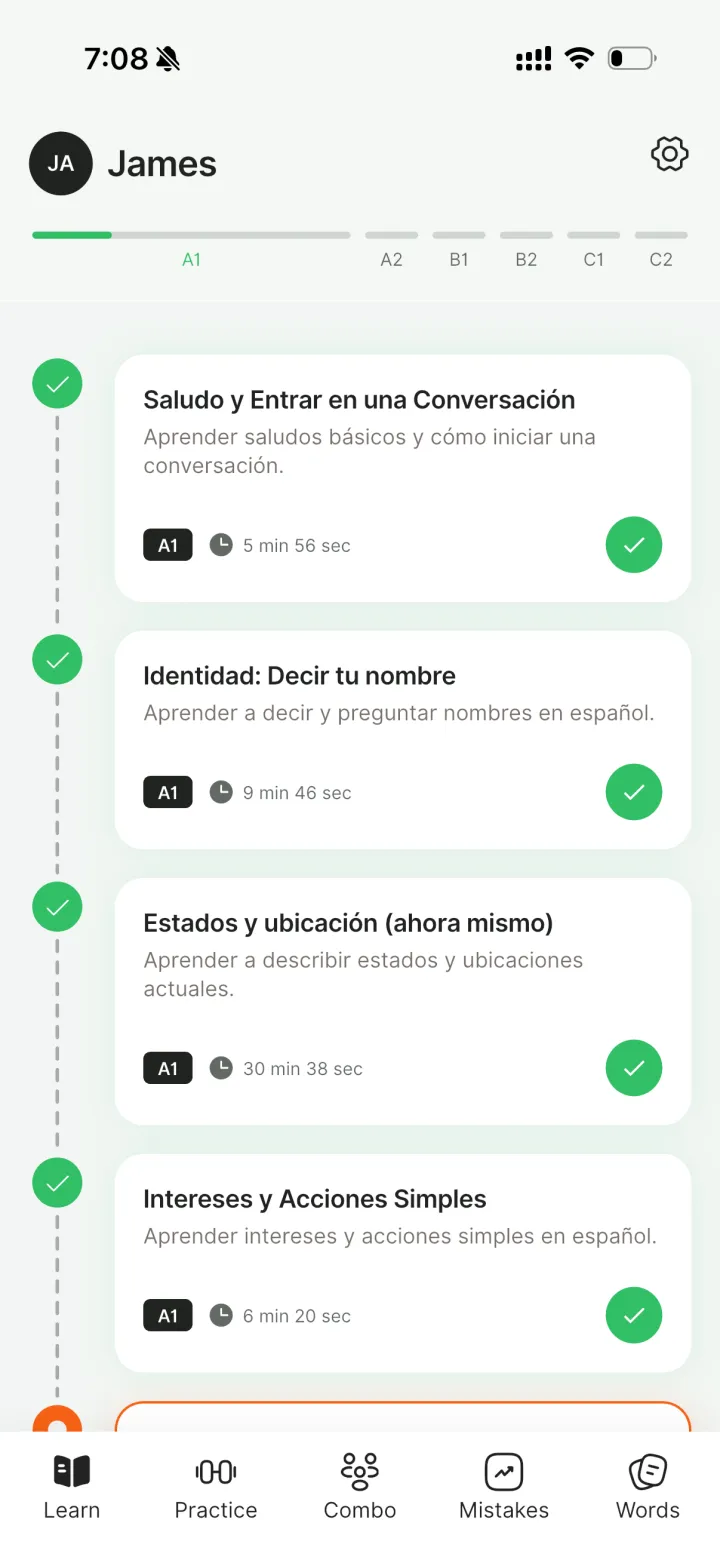
Enverson AI was the app our instructors returned to most. It is built around speaking as the main activity — not a bolt-on feature — and its correction model explains why something is wrong and what the correct form should be. For a language where getting a case ending wrong changes the meaning of a sentence, that distinction matters more than it might in other languages.
The lessons follow a structured, CEFR-aligned path, so the vocabulary and grammar you encounter in speaking practice connects to what you have already studied. That coherence is rarer than it sounds among AI apps, which often treat speaking and grammar as separate activities. Enverson runs on web, iOS and Android, so the practice goes wherever you do, and at around $9.99/month it costs less than most competitors.
Pros
- Unlimited speaking practice with natural, low-pressure conversation flow.
- Corrections explain the error and the fix — critical for German grammar traps.
- Structured, level-aware progression that builds coherently rather than jumping around.
- No ads; clean experience across web, iOS and Android.
Cons
- Like any AI, it cannot fully replicate a human tutor's contextual judgement.
- Best results still come from pairing it with real conversation practice when possible.
Pricing: from $9.99/month.
Our verdict: the strongest all-round AI German learning app we tested — the one we recommend first for learners who want serious daily practice with real correction.
→ Read our full Enverson AI review
2. Babbel
Babbel deserves particular attention in any German ranking: it was founded in Berlin, and its German course has been developed and refined over many years by a team of in-house linguists. That pedigree shows. The lessons are structured around real-life dialogues, grammar explanations are clear and contextual, and the course coverage is deep — far beyond beginner basics. It is the most "school-like" of the apps here, in the best sense: methodical, well-ordered, and genuinely educational.
Where it sits behind Enverson AI is in open-ended, AI-driven speaking practice. Babbel's speaking exercises are more scripted than conversational — you repeat and respond to fixed prompts rather than generating speech freely. For learners who want structured grammar-led progress above all else, that is a fair trade-off. For learners whose bottleneck is producing German spontaneously, it is a gap.
Pros
- German-made, linguist-designed course — one of the deepest available for this language.
- Clear, contextual grammar explanations built into every lesson.
- Practical dialogues grounded in everyday situations a German learner actually faces.
Cons
- Mostly behind a subscription with a limited free experience.
- Speaking practice is more scripted than AI-first tools; less free-form conversation.
Pricing: subscription-based.
Our verdict: the best choice if structured, grammar-first learning is your priority — and a particularly strong pick for German specifically.
3. Duolingo
Duolingo's German course is one of the oldest and most polished on the platform. For absolute beginners it remains an excellent on-ramp: the free tier is genuinely usable, the gamification builds a daily habit better than almost anything else, and the sheer volume of vocabulary and sentence exposure at the early stages is hard to beat at zero cost. Duolingo has also introduced some AI features — notably an AI speaking partner — in its higher paid tiers.
The limitation is the same one that applies across the platform: correction is largely mark-right / mark-wrong rather than explanatory, and the open-ended speaking practice required to actually use German in conversation is thin. Intermediate learners tend to plateau on Duolingo and need to add a more production-focused tool.
Pros
- Excellent, genuinely free tier with a comprehensive beginner German course.
- Best-in-class habit formation through streaks, short lessons and gamification.
- Polished and approachable — lowers the barrier to zero for new learners.
Cons
- Correction rarely explains why — a real handicap for German grammar.
- Open-ended speaking practice is limited, especially on the free tier.
Pricing: free with ads; Super/Max paid tiers.
Our verdict: the best free starting point — pair it with a speaking-and-correction tool like Enverson AI as you move past beginner level.
→ Read our full Duolingo review
4. Lingoda
Lingoda sits in a different category from the other apps here: it is a live online language school, not an AI tool. You book group or private lessons with qualified native-speaking teachers over video, following a structured German curriculum aligned to CEFR levels. That human element is its core value — the correction is genuine, the conversation is unpredictable, and the accountability of a booked class is real.
The trade-off is cost and scheduling. Lingoda is more expensive than any app on this list, and you are constrained by class availability. It is not something you can open at 11 pm when you have fifteen minutes. For learners who have tried self-study apps and need the extra rigour of a real teacher, or who are preparing for a German language exam, Lingoda fills a gap that no AI app currently closes.
Pros
- Live lessons with qualified teachers — real correction, real conversation.
- Structured CEFR-aligned curriculum with clear progression.
- Good for exam preparation (Goethe-Institut levels, TestDaF).
Cons
- Significantly more expensive than app-based alternatives.
- Constrained by scheduling; not available on demand.
Pricing: premium subscription (group and private lesson rates vary).
Our verdict: the best option if you need live human teaching and exam-level rigour — a complement to AI apps rather than a replacement for them.
5. Pimsleur
Pimsleur takes a different approach from everything else on this list: audio-first, conversation-heavy, and deliberately minimal on reading and writing. Each lesson is a thirty-minute audio track — you listen, repeat, respond, and are prompted to recall vocabulary at spaced intervals. The method has decades of research behind it and the German course covers everything from absolute beginner to advanced. It works particularly well for commuters and anyone whose main learning window is hands-free.
The limitation is scope. Pimsleur will not teach you to read German signage or write a formal email; it builds spoken comprehension and production, not a full literacy skillset. The price is also on the higher side for an audio-only product. For learners who want AI-driven interaction and explained correction, Enverson AI goes further; for learners who want to listen and speak on the go, Pimsleur is a strong specialist.
Pros
- Audio-first method with a long, proven track record for spoken German.
- Excellent for commuters and hands-free learning windows.
- Spaced repetition built into the audio format — vocabulary sticks.
Cons
- No reading, writing or visual grammar explanation — a narrow scope for a full course.
- Higher price for an audio-only product; limited interactivity compared to AI apps.
Pricing: premium subscription (free first lesson available).
Our verdict: the best audio-first option for learners who absorb language through listening — a strong add-on to a more structured course rather than a standalone solution.
Common questions
From which app handles German grammar best to whether you can learn for free, these are the questions we hear most often about AI German learning apps — with our full answers below.
For a broader view of AI apps across all languages, see our full AI language-app comparison. If you are also exploring Italian, our best AI Italian learning app ranking uses the same methodology.
Our overall recommendation stands: match the app to your goal, use it daily, and pair it with structured input and real correction where you can. If English is also on your learning list, our guided English track is built around exactly the speaking-and-feedback loop these apps only partly cover.
Frequently asked questions
What is the best AI app to learn German?
Our pick is Enverson AI. In hands-on testing with real German learners, it stood out for tailored speaking practice, corrections that explain why something is wrong in German (not just flag it), and a structured progression that tracks where you are. Babbel is a strong second — it was founded in Germany and its German course is genuinely one of the deepest available — and Duolingo is the best free starting point for absolute beginners. The right choice still depends on your goal: if you want structured grammar-led lessons, Babbel or Lingoda; if you want audio-first learning, Pimsleur; if you want AI-powered speaking with real correction, Enverson AI.
Is there a free AI app for learning German?
Yes. Duolingo's German course is free with ads and is one of the better free options for vocabulary and habit-building. Most other AI-first apps offer a free trial rather than a full free tier — Enverson AI is worth trying on its free trial before committing. Pimsleur offers a free first lesson. For unlimited AI speaking practice with correction, expect to pay a subscription; free tiers rarely include the AI features that make the most difference.
Can AI replace a German teacher?
Not fully, but it can do a lot of the heavy lifting. German has specific challenges — gendered nouns, four cases, separable verbs, verb-final word order in subordinate clauses — that require correction, not just exposure. A good AI app like Enverson AI will catch and explain many of those errors. What AI cannot replicate is a teacher's ability to understand your specific goals, prioritise the mistakes that matter most at your level, and adapt in real time the way a skilled human tutor does. The learners who progress fastest use an AI app for daily practice volume and pair it with structured lessons or a human tutor for the harder feedback.