
How to Pronounce -ed Endings in English: The /t/, /d/ and /ɪd/ Sounds
Worked, played, wanted: the same -ed spelling makes three different sounds, and only one of them adds a syllable. This guide explains the simple rule behind /t/, /d/ and /ɪd/, gives practice lists for each sound, covers the adjectives that break the rule, and ends with a short exercise.

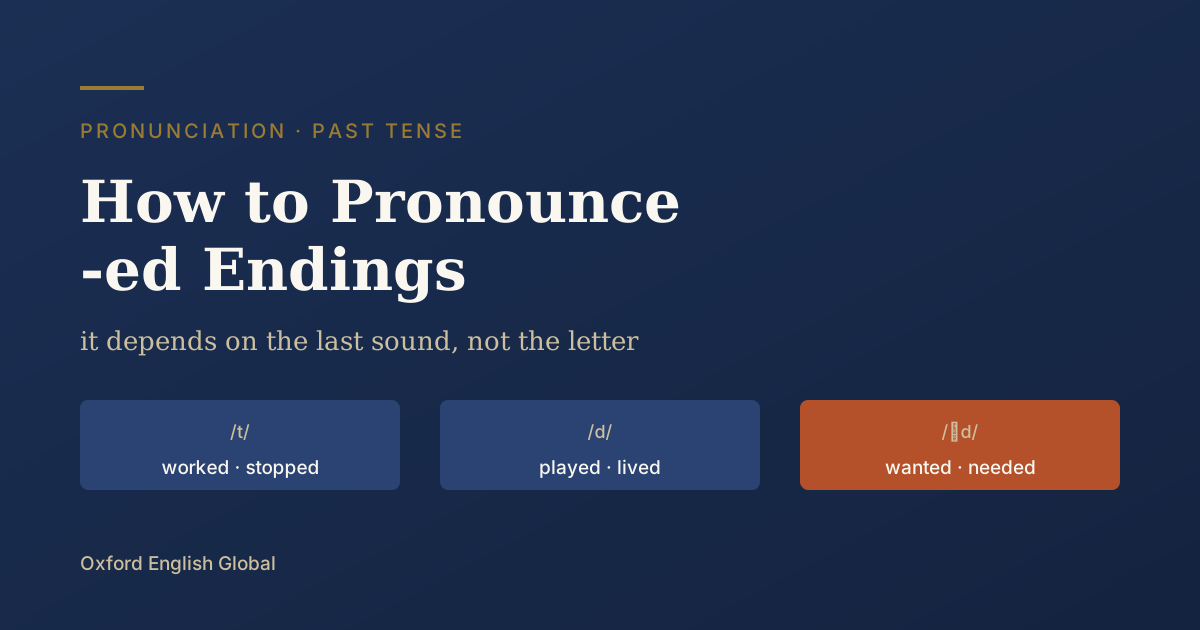
The -ed ending of regular past tense verbs has three pronunciations, and the sound at the end of the base verb decides which one you use. After a voiceless sound such as /p/, /k/, /s/, /ʃ/, /tʃ/ or /f/, say /t/: stopped /stɒpt/, worked /wɜːkt/. After a voiced sound, including all vowels, say /d/: played /pleɪd/, lived /lɪvd/. After /t/ or /d/, add an extra syllable, /ɪd/: wanted /ˈwɒntɪd/, needed /ˈniːdɪd/. Only the third group adds a syllable; worked has one syllable, not two. The most common learner mistake is pronouncing every -ed as a separate syllable (work-ed, play-ed), which makes speech sound unnatural and can confuse listeners. This guide explains the rule, gives you word lists to practise, covers the adjectives that break the rule, and ends with a short exercise.
Quick reference. The rule on this page is the standard one described in learner references such as Britannica Dictionary's note on pronunciation of -ed endings on verbs. Phonetic symbols follow standard British (IPA) transcription as used in learner dictionaries such as the Cambridge Dictionary, where you can also hear each word.
The three sounds of -ed at a glance
| Sound | When | Extra syllable? | Examples |
|---|---|---|---|
| /t/ | After voiceless sounds: /p/, /k/, /s/, /ʃ/, /tʃ/, /f/, /θ/ | No | stopped, looked, missed, washed, watched, laughed |
| /d/ | After voiced sounds: vowels and /b/, /g/, /v/, /z/, /ʒ/, /dʒ/, /m/, /n/, /ŋ/, /l/, /r/, /ð/ | No | played, robbed, lived, used, changed, called, opened |
| /ɪd/ | After /t/ or /d/ | Yes | wanted, started, needed, decided, visited, ended |
In American English, the third ending is often written /ɪd/ or /əd/; the vowel is a short, weak sound in both accents. The e in this ending is never stressed: deCIDed, not deciDED.
Voiced and voiceless sounds: the key to the rule
The rule depends on one idea: whether your vocal cords vibrate when you make the last sound of the verb.
- Voiced sounds: the vocal cords vibrate. Put two fingers lightly on your throat and say a long zzzz or vvvv. You feel a buzz. All vowel sounds are voiced.
- Voiceless sounds: the vocal cords do not vibrate. Now say a long ssss or ffff. There is air, but no buzz.
Many consonants come in voiced and voiceless pairs made in the same place in the mouth:
| Voiceless (→ /t/) | Voiced (→ /d/) | Verb pair |
|---|---|---|
| /p/ | /b/ | hoped /t/ – robbed /d/ |
| /k/ | /g/ | packed /t/ – begged /d/ |
| /f/ | /v/ | laughed /t/ – loved /d/ |
| /s/ | /z/ | kissed /t/ – buzzed /d/ |
| /ʃ/ (sh) | /ʒ/ | pushed /t/ – massaged /d/ |
| /tʃ/ (ch) | /dʒ/ (j) | watched /t/ – judged /d/ |
The pattern is natural, not arbitrary. It is easier to keep voicing the same through the end of a word: after a voiceless sound, a voiceless /t/ follows smoothly; after a voiced sound, a voiced /d/ follows smoothly. After /t/ and /d/ themselves, adding another /t/ or /d/ would be almost impossible to hear, so English adds a vowel to separate them.
Listen to the sound, not the spelling
The rule is about the last sound of the base verb, not the last letter. This matters because English spelling and sound often differ.
- fix ends in the letter x but the sounds /ks/, so fixed = /fɪkst/ (/t/).
- laugh ends in gh but the sound /f/, so laughed = /lɑːft/ (/t/).
- bake ends in the letter e but the sound /k/, so baked = /beɪkt/ (/t/).
- close (verb) ends in the sound /z/, so closed = /kləʊzd/ (/d/).
- hate ends in the sound /t/, so hated = /ˈheɪtɪd/ (/ɪd/).
- play ends in a vowel sound, so played = /pleɪd/ (/d/).
When you are not sure, look up the base verb in a learner dictionary and check its last symbol. Our guide to improving your English pronunciation at home explains how to use dictionary audio and phonetic symbols in your practice.
Practice word lists for each sound
Read each list aloud. Keep the /t/ and /d/ endings short and attached to the word; do not add a vowel.
/t/ (no extra syllable)
| Ending sound | Practice words |
|---|---|
| /p/ | stopped, helped, dropped, hoped, shopped, developed |
| /k/ | worked, talked, asked, booked, checked, cooked |
| /s/ | missed, passed, dressed, discussed, danced, produced |
| /ʃ/ | washed, finished, pushed, wished, published |
| /tʃ/ | watched, reached, touched, matched, launched |
| /f/ | laughed, coughed, stuffed |
/d/ (no extra syllable)
| Ending sound | Practice words |
|---|---|
| Vowels | played, stayed, enjoyed, studied, agreed, followed, worried |
| /l/ | called, travelled, smiled, filled, cancelled |
| /n/, /m/ | opened, cleaned, learned, explained, seemed, named |
| /v/ | lived, loved, moved, arrived, improved, solved |
| /z/ | used, closed, organised, realised, surprised |
| /dʒ/, /b/, /g/ | changed, managed, arranged, robbed, described, hugged |
/ɪd/ (one extra syllable)
| Ending sound | Practice words |
|---|---|
| /t/ | wanted, started, waited, visited, invited, created, presented, collected |
| /d/ | needed, decided, ended, added, included, attended, recorded, provided |
Count the syllables. worked (1), played (1), wanted (2). finished (2: FIN-isht), decided (3: de-CI-ded). If your version of worked has two syllables, you are adding an extra vowel.
-ed endings in connected speech
In natural, fast speech, the /t/ or /d/ often links to the next word, and sometimes it almost disappears.
- Before a vowel, link it: I worked all day sounds like "I work-ta-ll day". She played it sounds like "play-dit".
- Between consonants, it may be very light: in I watched TV or I asked them, many native speakers barely release the /t/. This is called elision. You will hear it more than you need to produce it.
Elision explains why many learners do not hear past tense endings in fast speech. If you find this hard, our guide to improving your English listening has exercises for connected speech. For your own speaking, aim for a light but clear /t/ or /d/; it is safer than dropping it, because listeners use it to understand that you mean the past.
Adjectives that break the rule
A small group of adjectives ending in -ed is pronounced with /ɪd/ even though the rule above would predict /t/ or /d/. Some of these words are also verbs, and the verb follows the normal rule.
| Word | As an adjective | As a verb (normal rule) |
|---|---|---|
| learned | a learned professor /ˈlɜːnɪd/ (very educated) | I learned a lot /lɜːnd/ |
| aged | an aged man /ˈeɪdʒɪd/ (very old) | He aged quickly /eɪdʒd/; children aged 5 /eɪdʒd/ |
| blessed | a blessed event /ˈblesɪd/ | The priest blessed them /blest/ |
| beloved | my beloved city /bɪˈlʌvɪd/ | (/bɪˈlʌvd/ is also common, especially after be: he was beloved by all) |
| naked | /ˈneɪkɪd/ | — (not a verb) |
| wicked | /ˈwɪkɪd/ | — (not a verb) |
| crooked | a crooked line /ˈkrʊkɪd/ | She crooked her finger /krʊkt/ |
| ragged, rugged, jagged | /ˈræɡɪd/, /ˈrʌɡɪd/, /ˈdʒæɡɪd/ | — (normally adjectives) |
These words are relatively rare in everyday speech, except naked and wicked. Learn them as vocabulary items, not as a rule. Ordinary -ed adjectives such as tired, bored, interested and excited follow the normal rule: tired /taɪəd/, bored /bɔːd/, interested /ˈɪntrəstɪd/, excited /ɪkˈsaɪtɪd/.
Common learner mistakes
| Mistake | Example | Fix |
|---|---|---|
| Adding a syllable to every -ed | work-ED, play-ED, live-ED | Only add a syllable after /t/ and /d/. |
| Dropping the ending completely | Yesterday I work all day. | Keep a light /t/: worked. |
| Following the spelling, not the sound | fixed as /fɪksɪd/ | Last sound is /s/ (in /ks/): /fɪkst/. |
| Adding a vowel before the ending | stopped as "stop-uh-t" | Go straight from /p/ to /t/. |
| Stressing the ending | deci-DED | The ending is always unstressed: de-CI-ded. |
| Confusing similar pairs | I walk to work vs I walked to work | Practise minimal pairs (below). |
Learners whose first language rarely ends words in consonant clusters, such as Spanish, Portuguese, Italian, Japanese or Korean speakers, often add a vowel or drop the final sound. If that is you, slow down and practise the cluster on its own (/kt/, /pt/, /vd/) before the whole word. Present and past forms are also easy to confuse in tenses; our guide to all 12 English tenses shows where the past simple fits.
Practice: which sound is it?
Part 1: Sort the verbs
Say each word aloud and decide whether the ending is /t/, /d/ or /ɪd/.
- jumped
- cleaned
- painted
- relaxed
- listened
- landed
- pronounced
- allowed
- accepted
- brushed
Answers: 1. /t/ 2. /d/ 3. /ɪd/ 4. /t/ (relax ends in /ks/) 5. /d/ 6. /ɪd/ 7. /t/ (pronounce ends in /s/) 8. /d/ (vowel sound) 9. /ɪd/ 10. /t/
Part 2: Minimal pairs and sentences
Read each pair, making the past tense ending clearly audible, then record yourself and listen back.
- I walk to work. / I walked to work.
- We play tennis. / We played tennis.
- They want a refund. / They wanted a refund.
- I watched a film, cooked dinner and called my sister, then I decided to go to bed. (/t/, /t/, /d/, /ɪd/)
Recording yourself on your phone is one of the most useful ways to check this sound. For work on pitch and intonation, try our free Speaking Lab, and our guide to practising English speaking without a partner has more solo routines.
What this article cannot tell you
- Exactly how your accent sounds to others. A rule and a word list can show you the target, but only feedback, from a teacher or a careful comparison with recordings, shows whether you are hitting it.
- Every regional variation. Accents of English differ in vowel sounds and in how strongly final consonants are released. The three-way rule is shared by standard British and American English, but details such as the vowel in /ɪd/ vary.
- Irregular verbs. This rule applies only to regular verbs. Irregular past forms such as went, bought and taught must be learned separately; our free English Grammar: A Complete Guide includes a list.
This page is independent guidance from Oxford English Global. It contains no affiliate or sponsored links. For more practice, try our free lessons or our guide to improving your English speaking.
Frequently asked questions
What are the three ways to pronounce -ed?
/t/ after voiceless sounds such as /p/, /k/, /s/, /ʃ/, /tʃ/ and /f/ (stopped, worked); /d/ after voiced sounds including vowels (played, lived); and /ɪd/ after /t/ or /d/ (wanted, needed).
When does -ed add an extra syllable?
Only when the base verb ends in a /t/ or /d/ sound, as in wanted, started, needed and decided. In all other regular verbs, -ed adds a consonant sound but no syllable, so worked and played have one syllable.
Does the rule depend on spelling or sound?
On sound. Fix ends in the sound /ks/, so fixed ends in /t/; bake ends in the sound /k/, so baked ends in /t/; play ends in a vowel sound, so played ends in /d/.
Are there exceptions to the -ed rule?
A few adjectives are pronounced with /ɪd/ even though the rule predicts /t/ or /d/, including naked, wicked, crooked, ragged and learned when it means very educated. Ordinary adjectives such as tired and bored follow the normal rule.