
Why a Structured Language Learning App Beats Random Practice
Gamified apps make language learning feel productive. But streaks and scattered lessons rarely build real progress. Here is why a structured English course — one that sequences every skill on purpose — is a fundamentally different thing.

Most people who tell me they have been "learning English with an app" for six months share a familiar story. They open it every morning, they have kept a streak going, they recognise a lot of vocabulary — and they still cannot hold a real conversation or write a professional email without freezing. The app has not failed them exactly. But it has not taken them anywhere useful either.
The reason, almost always, is that the app has no sequence. It serves content based on engagement signals and habit loops, not on what that particular learner needs to master next. There is a word for learning without sequence: random. And random practice produces random results, however consistent it feels in the moment.
- A structured learning app sequences grammar, vocabulary and skills in a deliberate order tied to CEFR level — so each lesson builds on the last.
- Gamified randomness builds habit and recognition vocabulary but rarely moves a learner from one CEFR level to the next.
- The CEFR scale (A1–C2) gives you concrete milestones — A2, B1, B2 — that replace vague goals like "become fluent."
- AI is most useful when it personalises the pace and content within a structured syllabus, not as a replacement for the syllabus itself.
The problem with random practice
Gamified language apps are genuinely good at two things: building a daily habit and drilling isolated vocabulary. I do not dismiss them. Reaching for an app every morning is a far better habit than reaching for nothing. The problem is what happens after those first few months. The learner can recognise words they have seen before, can match a sentence to its translation, can complete a multiple-choice grammar question — but cannot produce fluent, correct language unprompted. That gap is the signature of random practice.
Random practice means that today you might see a lesson on past continuous, tomorrow something on food vocabulary, the day after a reading about weather idioms. Each is self-contained. Nothing is explicitly linked. There is no moment where the app says: "You have now controlled past simple reliably for two weeks, which means you are ready to contrast it with past continuous — here is why that contrast matters for real communication." That connective tissue is what a sequence provides. Without it, you are building individual bricks with no mortar.
Knowing a hundred grammar rules in isolation is worth less than understanding twenty and knowing exactly when and why to use them.
What structure actually means
A structured language learning app is not just one that has levels labelled A1 through C2 on the home screen. Labelling is easy. Real structure means the syllabus was designed by someone who decided — before the first lesson was written — which grammar points and vocabulary sets belong together, in what order, and why. It means a learner who tests into B1 is not served A2 content because the algorithm thinks it might be engaging, and not served B2 content because the learner happened to answer one question correctly.
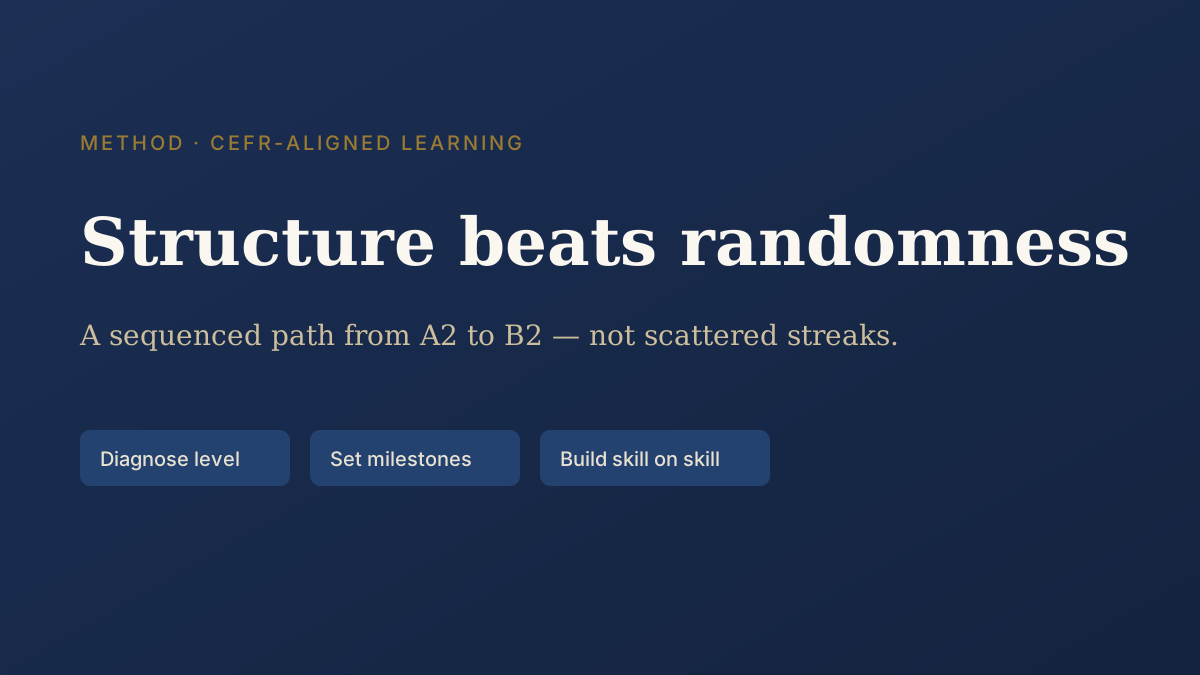
Good structure has three visible characteristics. First, it diagnoses. Before you start, you take a placement test that identifies your actual level — not roughly, but precisely enough to skip what you already control and spend time only on what you genuinely need. Second, it sequences. Grammar and vocabulary appear in an order that mirrors how language is actually acquired: high-frequency words and core verb forms first, then the patterns that modify and extend them. Third, it progresses explicitly. You know at any point which CEFR level you are working towards, which milestone sits next, and roughly how many hours of practice separate you from it. That is not gamification. That is a plan.
Random practice vs a structured path
The difference between the two approaches becomes clear when you compare what each actually delivers at each stage of a learner's journey:
| Learning dimension | Random / gamified practice | Structured path |
|---|---|---|
| Starting point | Usually starts from lesson 1 regardless of level | Placement test identifies exact entry point |
| Content order | Algorithm-driven; optimised for retention of that session | Syllabus-driven; each lesson assumes and builds on the last |
| Grammar coverage | Broad but patchy; some gaps may never appear | Complete for the target level; gaps filled systematically |
| Milestones | Streaks, XP, badges — engagement metrics | CEFR level checkpoints — language milestones |
| Output & correction | Rare; mostly recognition tasks | Central; production is tested and corrected throughout |
| Long-term result | Strong recognition; often plateau at intermediate | Measurable level progression toward B1, B2, and beyond |
CEFR milestones: A2, B1, B2
The Common European Framework of Reference for Languages (CEFR), developed by the Council of Europe, is the international standard for describing language ability. Its six levels — A1, A2, B1, B2, C1, C2 — each come with concrete "can-do" statements: what a learner at that level can read, write, understand and say in real situations. For most adult learners of English, the useful milestones are these three:
- A2 (Elementary): You can handle simple transactions, introduce yourself and others, and understand routine information in familiar contexts. This is where most beginners plateau without a structured push forward.
- B1 (Intermediate): You can deal with most situations that arise while travelling or living in an English-speaking country, write simple connected texts, and describe experiences and explain opinions. B1 is the employability threshold in many global companies.
- B2 (Upper-Intermediate): You can interact fluently and spontaneously with native speakers, produce clear detailed text on a wide range of subjects, and understand the main ideas of complex text — including technical discussion in your field. B2 is the practical target for professional and academic work in English.
A language learning app with structured learning ties every lesson to one of these checkpoints. You are never just doing "grammar" — you are doing the grammar that moves you from B1 to B2, in the order that makes that jump achievable. The clarity alone changes the experience of studying. Sources: Council of Europe — CEFR level descriptions; Cambridge English — Understanding CEFR.
Most learners who join us after months of solo app use sit squarely at B1 on a placement test — regardless of how long they have been studying. Once they move onto a CEFR-sequenced track, a large share reach confirmed B2 within six to nine months of consistent practice. The diagnostic starting point and the explicit milestones appear to be what changes.
Based on instructor placement and progress notes across our 2025 cohort. Directional observation, not a controlled study.
How AI personalises within structure
AI tutoring tools have improved quickly, and I want to be straightforward about them: they are genuinely useful for language learners. A good AI conversation partner gives you unlimited low-stakes speaking practice. AI grammar checkers catch errors you might not otherwise notice. Generative models can explain the same concept five different ways until one clicks.
The honest limitation is that an AI on its own has no syllabus. Left entirely to itself, an AI conversation session goes wherever the conversation goes — which is great for input and exposure, but will not systematically fill the grammar gaps you have at B1, in the order a syllabus has determined is most efficient. The learners I have seen make the fastest progress use AI as a practice layer on top of a structured course, not instead of one. They finish a sequenced lesson on reported speech, then use an AI tool to have a five-minute conversation that forces them to apply it. Structure first, AI to personalise the practice within it.
The most valuable thing AI adds to a structured app is adaptive pacing: identifying which items you have genuinely mastered (and therefore need to see less often) versus which are still fragile (and need spaced repetition). That is real personalisation — but it only works when there is a structured syllabus to personalise. For more on how practice timing affects retention, see our piece on feedback timing.
What to look for in a structured app
If you are evaluating a language learning app with structured learning, these are the questions worth asking before you commit your time:
- Does it start with a placement test? If an app always starts everyone at lesson one, the word "structured" on the app store is marketing, not description.
- Is the syllabus CEFR-aligned? Ask specifically: which grammar points are covered at B1? Can I see the B2 syllabus? A credible structured course will have clear answers.
- Does it include output and correction? Recognition exercises (multiple choice, matching) test whether you can identify correct English. Production exercises — writing your own sentences, speaking — test whether you can use it. Both matter; many apps only offer the first.
- Are there explicit level checkpoints? There should be a moment in the course where you demonstrate B1 ability before the B2 content begins. That checkpoint is evidence the sequence is real.
- What happens when you get something wrong? A structured course explains why an answer was wrong and links that explanation to the underlying grammar rule. An unstructured one just marks you incorrect and moves on.
For a broader look at how apps compare on these dimensions, our guide to free language learning apps covers what the free tiers actually deliver. And for research on how long a structured path typically takes, see how long it takes to learn a new language.
Where to start today
If you have an app you already use and enjoy, do not delete it. The habit it has built is genuinely valuable. What I would suggest is adding something alongside it that has the three properties described above: a diagnostic starting point, a sequenced CEFR syllabus, and explicit level milestones with correction built in.
That combination — daily habit from the gamified app, real sequence and correction from a structured course — is more powerful than either alone. It is also, as it happens, exactly the design behind our free B1 grammar track: a structured English course that sits on top of whatever you are already doing and fills the gap that unstructured practice leaves open. No streaks, no leaderboards — just a clear path from where you are to where you want to be.
Frequently asked questions
What is a structured language learning app?
A structured language learning app is one built around a sequenced syllabus — typically aligned to CEFR levels — that diagnoses your starting point, sets explicit milestones, and teaches grammar and vocabulary in a deliberate order so that each skill supports the next. This is different from apps that serve disconnected lessons driven by gamification or algorithm alone.
Is a structured English course better than Duolingo-style apps?
Gamified apps are excellent for building a daily habit and a solid recognition vocabulary. Where they tend to fall short is sequence and correction: they rarely tell you which grammar points belong at your level, or give you feedback on your own output. A structured course covers both, making it a stronger choice once you are past the very first weeks of contact with the language.
How does CEFR help me plan my English learning?
The Common European Framework of Reference for Languages (CEFR), published by the Council of Europe, divides learner ability into six levels from A1 to C2. Each level has clear 'can-do' descriptors, so you can set concrete milestones — reaching A2, then B1, then B2 — rather than chasing a vague sense of fluency. A CEFR-aligned syllabus means your lessons are always calibrated to what you are actually ready to learn next.