
Is There a Completely Free App for Learning a New Language?
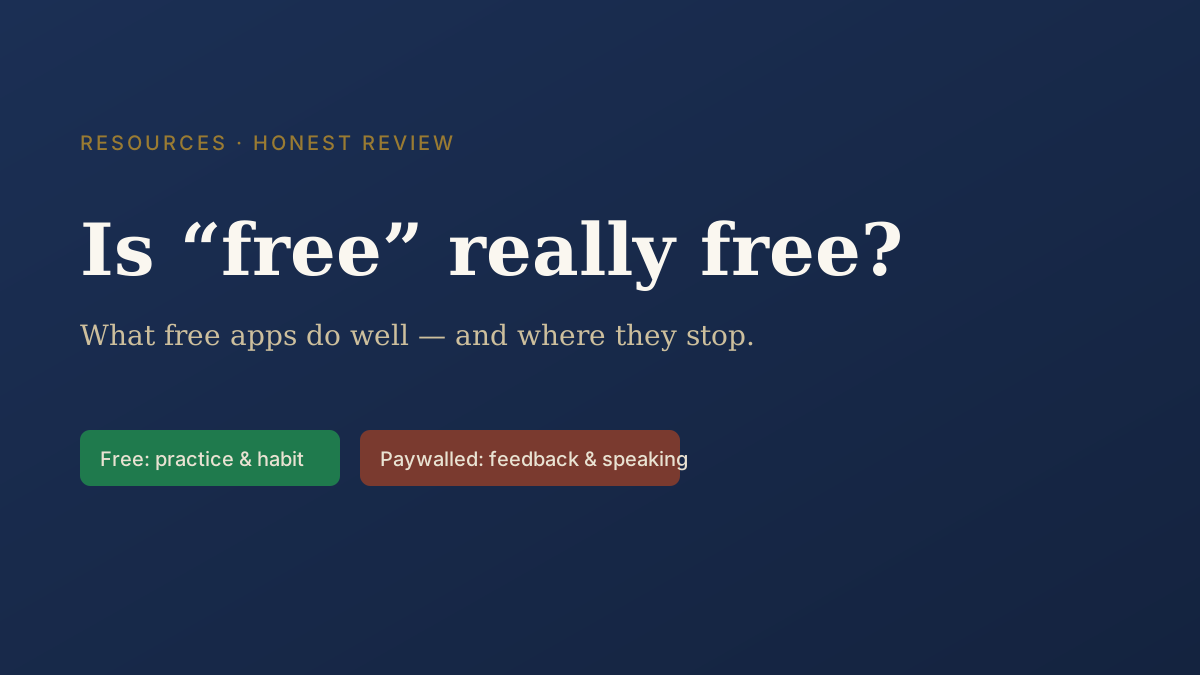
Short answer: yes, several apps are genuinely free to use. Longer answer: free apps are excellent at one half of language learning and silent about the other half. Here's exactly where the line falls — and how to cross it without paying.
 By Marco Ruiz
It is the most reasonable question a new learner can ask, and the one the industry is least eager to answer plainly: is there a completely free app for learning a new language, or does everything good eventually hit a paywall? I get asked it every week. Here is the straight answer, from someone who teaches for a living and has no app to sell you.
Yes — you can learn a language for nothing. But before you download anything, it helps to know what you are actually buying when you don’t pay, because “free” hides two very different things.
- Several apps are genuinely free, not just free trials — including ad-supported and open-source ones.
- Free tiers are strong at vocabulary, drills and daily habit and weak at speaking and correction.
- You can build a 100%-free stack that covers the gaps — it just won’t be a single app.
The real question behind the question
When people ask whether an app is “completely free,” they usually mean one of two different things. The first is “can I use it forever without paying?” The second, often unspoken, is “will the free version actually be enough to learn the language?” Those have different answers — yes to the first for several apps, “only partly” to the second for nearly all of them — and conflating them is how learners end up disappointed.
A free app removes the excuse not to start. It does not remove the work. The most expensive thing in language learning is your time, and that is never free.
Apps that really are free
To be clear, these exist and are not bait. A few examples of different free models, without endorsing any one of them:
- Ad-supported, free forever: Duolingo’s core course is usable indefinitely at no cost; you pay only to remove ads and add convenience features. The lessons themselves are free.
- Open-source, free by design: Anki, the spaced-repetition flashcard tool, is free on desktop and Android and is the engine many serious learners use for vocabulary retention.
- Free exchange communities: language-exchange apps let you message and call native speakers for free, trading your language for theirs.
- Public-service material: the BBC and British Council have published large amounts of free learning material on the open web for years.
So the literal answer to the question is yes. Now the part the app-store screenshots leave out.
Where free stops
Free apps are built around the parts of learning that scale to millions of users automatically: showing you a word, checking a multiple-choice answer, reminding you to come back tomorrow. They are genuinely good at this, and this is real learning — the foundation, in fact.
What they cannot do cheaply is the part that needs a knowledgeable human: listening to your sentence and telling you why it sounds slightly wrong, or pushing you to actually speak under mild pressure. That is expensive to deliver, so it is exactly what sits behind the paywall — or simply isn’t offered at all. The result is a predictable plateau: learners do months of free drills, can recognise thousands of words, and still freeze the moment they have to produce a real sentence in conversation.
A large share of the adult learners who join us have already used a free app for months. Their recognition vocabulary is often strong. The two things almost none of them have practised are unscripted speaking and getting their own sentences corrected — precisely the two things a free app rarely provides.
Based on instructor intake notes across our 2025 cohort. Directional observation, not a controlled study.
What's free vs what's usually paywalled
Roughly, here is how the work divides between what free tiers cover well and what they tend to hold back:
| Learning job | Free tier? | Notes |
|---|---|---|
| Vocabulary & recognition | ✅ Free | The core strength of nearly every free app. |
| Daily habit & reminders | ✅ Free | Streaks and notifications are built to be free. |
| Grammar drills | ✅ Mostly free | Plenty available; quality varies a lot. |
| Speaking practice | ⚠️ Limited | Free via exchange apps, but unstructured. |
| Feedback & correction | ❌ Usually paid | The hardest to automate, so the first to be charged for. |
Building a free learning stack
Because no single free app covers the bottom two rows, the trick is to combine a few free tools so that together they cover everything. A fully free stack looks like this:
- One drill app (e.g. a free course app) for daily vocabulary and grammar — your engine for input and habit.
- A spaced-repetition app (e.g. Anki) so the words you meet actually stay in memory. See why timing matters in our piece on spaced practice.
- A language-exchange app so you speak with real people from week one — the free substitute for paid speaking practice.
- A free structured course for the correction layer the others lack.
That combination costs nothing and covers the whole job. The only thing it asks of you is the willingness to actually speak and be corrected — which, conveniently, is the one part free apps quietly skip.
The honest bottom line
Is there a completely free app for learning a new language? Yes, more than one — and they are a great place to start, especially for building the daily habit that most learners never manage. Just don’t mistake the free part (recognising words) for the whole job (using them in real time, correctly). Pair a free app with real speaking and a source of correction, and you can genuinely learn for free.
That last layer — structured lessons that correct your own English — is what we give away in our free track. It is the part the apps charge for, and we built it to slot straight on top of whatever free tools you already use.
Frequently asked questions
Is there a completely free app to learn a language?
Yes. Some apps are free to use indefinitely: Duolingo is free with ads, and Anki is open-source and free on desktop and Android. Many others offer a free tier with optional paid upgrades. So you can learn for €0 — but the free versions concentrate on vocabulary, drills and habit, and rarely give real feedback on your speaking and writing.
What is the best free app to learn a language?
There isn't one best app, because different apps cover different jobs. A practical free combination is: one app for daily vocabulary and grammar drills, a spaced-repetition app like Anki for retention, and a language-exchange app to actually speak with people. No single free app does all three well.
Can you become fluent using only a free app?
Rarely on its own. Free apps are very good at the foundation — vocabulary, recognition and a daily habit — but fluency also needs lots of speaking and correction, which most free tiers don't provide. You can get close to fluent for free, but only by combining an app with real conversation and feedback.
Are free language apps worth it?
Yes, especially to start. They lower the barrier to a daily habit to almost zero, and habit is the thing most learners lack. Just treat a free app as your engine for input and repetition, not as your only source of speaking practice or correction.