
Should, Ought To and Had Better: How to Give Advice and Warnings in English
Should, ought to and had better all give advice, but they are not equally strong. This guide compares them, shows the correct forms and negatives, explains when had better sounds rude, and ends with common mistakes and a practice exercise.

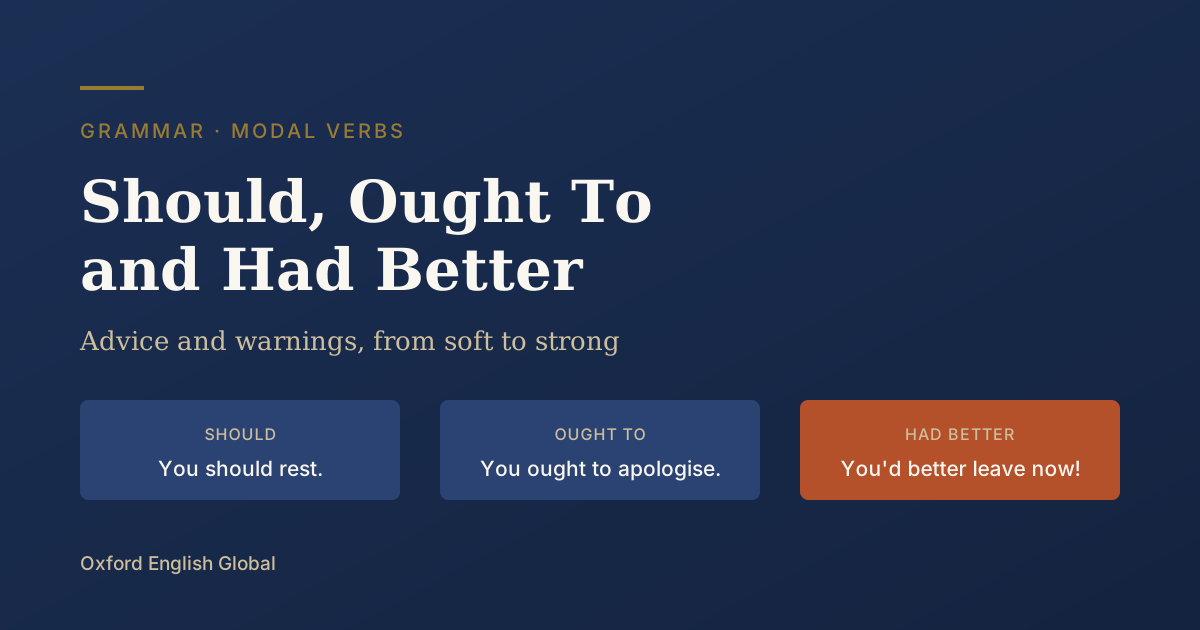
- Should, ought to and had better: a quick comparison
- Should: the everyday way to give advice
- Ought to: same meaning, different feel
- Had better: strong advice with a warning
- Strength and tone: how not to sound bossy
- Talking about the past: should have and ought to have
- The most common learner mistakes
- Practice: choose should, ought to or had better
- How to practise these forms
- What this article cannot tell you
Should, ought to and had better all give advice, but they differ in strength and tone. Should is the normal, neutral way to give advice ("You should try the soup"). Ought to means almost the same but is less common and sounds a little more formal or moral ("You ought to tell her the truth"). Had better is the strongest: it is advice for a specific situation with a warning that something bad will happen if you ignore it ("You'd better leave now or you'll miss the train"). This guide explains the form of each one, when to use it, the most common mistakes and how to sound polite rather than bossy.
Sources. Grammar rules in this guide follow the Cambridge Dictionary's grammar entry for had better and its section on modal verbs and modality. Examples are written by the Oxford English Global team.
Should, ought to and had better: a quick comparison
| should | ought to | had better | |
|---|---|---|---|
| Strength | Medium | Medium | Strong |
| Typical use | General advice and opinions | Advice, especially about what is right or expected | Urgent advice for a specific situation, often a warning |
| Hidden message | "This is a good idea." | "This is the right thing to do." | "Do this, or there will be a problem." |
| Form | should + base verb | ought to + base verb | had better + base verb |
| Negative | shouldn't | ought not to (rare) | had better not |
| Contraction | - | - | 'd better |
| Example | You should drink more water. | You ought to apologise. | You'd better take an umbrella. It's going to pour. |
Should: the everyday way to give advice
Should is a modal verb. Like other modals, it does not change form, it is followed by the base verb without to, and it makes questions and negatives without do. For the wider family of modals, see our guide to can, could, may, might and must.
- Positive: You should book early. (Not: You should to book early.)
- Negative: You shouldn't eat so late.
- Question: Should I call him? (Not: Do I should call him?)
Common uses of should
- Advice: "You should see a doctor about that cough."
- Opinions about what is right: "People should recycle more."
- Asking for advice: "What should I wear to the interview?"
- Expectation: "The parcel should arrive tomorrow." (= I expect it will.)
Softening should
Adults often soften advice so it sounds friendly. Compare:
- "You should change your password." (direct)
- "I think you should change your password." (softer)
- "Maybe you should change your password." (softer still)
- "You might want to change your password." (very polite, common at work)
Ought to: same meaning, different feel
Ought to means almost the same as should. In most sentences you can swap them:
- You should call your mother. = You ought to call your mother.
The differences are about frequency and tone:
- It is less common. In everyday speech, most people say should.
- It often sounds a little moral or emphatic, as if the speaker is thinking about duty or what is right: "We ought to help them; they helped us."
- The negative and question forms are rare and formal. "You ought not to do that" and "Ought we to tell him?" are correct, but most people say "You shouldn't do that" and "Should we tell him?"
Remember that to is part of the expression: "You ought to go", never "You ought go". In fast speech it often sounds like "oughta".
Had better: strong advice with a warning
The Cambridge Dictionary describes had better as "a strong expression" used when "there will be negative results if someone does not do what is desired or suggested." Three form rules surprise many learners:
- It is always had, never have, even though it refers to the present or future: "I'd better go now." (Not: I have better go.)
- It is followed by the base verb without to: "You'd better hurry." (Not: You'd better to hurry.)
- The negative is had better not: "You'd better not be late again." (Not: You hadn't better.)
In speech and informal writing we nearly always use the contraction 'd better. Sometimes the 'd is so weak that it disappears: "You better hurry!" This is common in casual speech but not correct in careful writing.
When had better sounds right
- A specific, immediate situation: "It's five o'clock. I'd better leave before the traffic gets bad."
- A clear consequence, stated or understood: "We'd better book now, or there won't be any seats."
- Advice to yourself or your group: "I'd better check my email" sounds natural and is not rude at all.
When had better is the wrong choice
- General advice: "People had better exercise" sounds odd. Use should: "People should exercise regularly."
- Rules and obligations: Cambridge notes that we use have to or must for requirements: "You must have a valid licence to hire a car", not "You'd better have…".
- Preferences: "I'd rather take a taxi" (I prefer) is different from "I'd better take a taxi" (it's advisable).
Strength and tone: how not to sound bossy
Using had better with you to a manager, client or stranger can sound like a threat: "You'd better send me the report" may sound like "…or else". Here is a scale from softest to strongest:
| Phrase | Strength | Good for |
|---|---|---|
| You might want to check the figures. | Very soft | Colleagues, clients, emails |
| Maybe you should check the figures. | Soft | Friendly advice |
| You should check the figures. | Neutral | Friends, people you know well |
| You ought to check the figures. | Neutral, slightly moral | When it is clearly the right thing |
| You'd better check the figures. | Strong, warning | Urgent situations, close friends, family |
| You must check the figures. | Very strong, obligation | Rules, instructions |
For workplace writing, our guide to writing clear work emails shows more polite ways to make suggestions.
Talking about the past: should have and ought to have
To talk about past mistakes or regrets, use should have or ought to have + past participle:
- "I should have left earlier." (I didn't, and it was a mistake.)
- "You ought to have told me." (You didn't tell me.)
- "We shouldn't have eaten so much." (We did.)
Had better has no past form for this meaning. Say "I should have…", not "I had better have…". Past regrets often combine with the third conditional, explained in our guide to English conditionals.
The most common learner mistakes
| Mistake | Correct | Why |
|---|---|---|
| You should to rest. | You should rest. | No to after should |
| You ought rest. | You ought to rest. | To is part of ought to |
| You have better hurry. | You'd (had) better hurry. | Always had |
| You'd better to hurry. | You'd better hurry. | No to after had better |
| You hadn't better go. | You'd better not go. | Negative is had better not |
| Do I should go? | Should I go? | Modals make questions without do |
| Students had better study every day. | Students should study every day. | General advice uses should |
For more errors like these, see 20 common English grammar mistakes.
Practice: choose should, ought to or had better
- It's starting to snow. We ___ leave now or we'll get stuck.
- I think everyone ___ learn basic first aid.
- You ___ not touch that wire. It's dangerous!
- What ___ I say if they ask about my salary?
- He ___ have apologised, but he didn't.
- You ___ thank your neighbours; they looked after your cat all week.
Answers: 1 had better ('d better) · 2 should (or ought to) · 3 had better ('d better) · 4 should · 5 should (or ought to) · 6 ought to (or should).
How to practise these forms
- Advice role-play: Write five everyday problems ("I can't sleep", "My laptop is slow") and give two pieces of advice for each, one with should and one with you might want to.
- Warning sentences: For each had better sentence, add the consequence with or: "You'd better save your work, or you'll lose it."
- Notice them: Listen for 'd better in series and podcasts; it is very common in films and very easy to miss because the 'd is so short.
What this article cannot tell you
- Every regional difference. Usage varies between varieties of English and between speakers. Ought to, for example, is used differently by different groups.
- Tone in every culture. How direct advice can be depends on the relationship and the culture, not only on grammar.
- All the meanings of should. We focus on advice and warnings. Should also appears in formal conditionals ("Should you need help, call us") and after some verbs ("They suggested that we should wait").
Want to practise giving advice in real conversation with feedback? See our English courses or browse our free English lessons.
Frequently asked questions
What is the difference between should and had better?
Should gives general or neutral advice. Had better is stronger and is used for a specific situation where there will be a bad result if the advice is ignored, for example: You'd better leave now or you'll miss the train.
Is ought to the same as should?
Almost. In most sentences they mean the same, but ought to is less common and can sound a little more formal or moral. Its negative and question forms are rare; most people say shouldn't and should I instead.
Is it had better or have better?
Always had better, even for the present or future, and usually contracted to 'd better: I'd better go. It is followed by the base verb without to.
What is the negative of had better?
Had better not, or 'd better not: You'd better not be late. Hadn't better is not the normal negative.
Is had better rude?
It can be. Said to a colleague, client or stranger with you, it can sound like a warning or threat. Use should, maybe you should or you might want to for polite advice.