
The Order of Adjectives in English: Rules and Natural Examples
Why a big old house and not an old big house? This guide explains the order of adjectives in English, from opinion to purpose, with natural examples, when to use commas and and, the main exceptions, common mistakes and a practice exercise with answers.

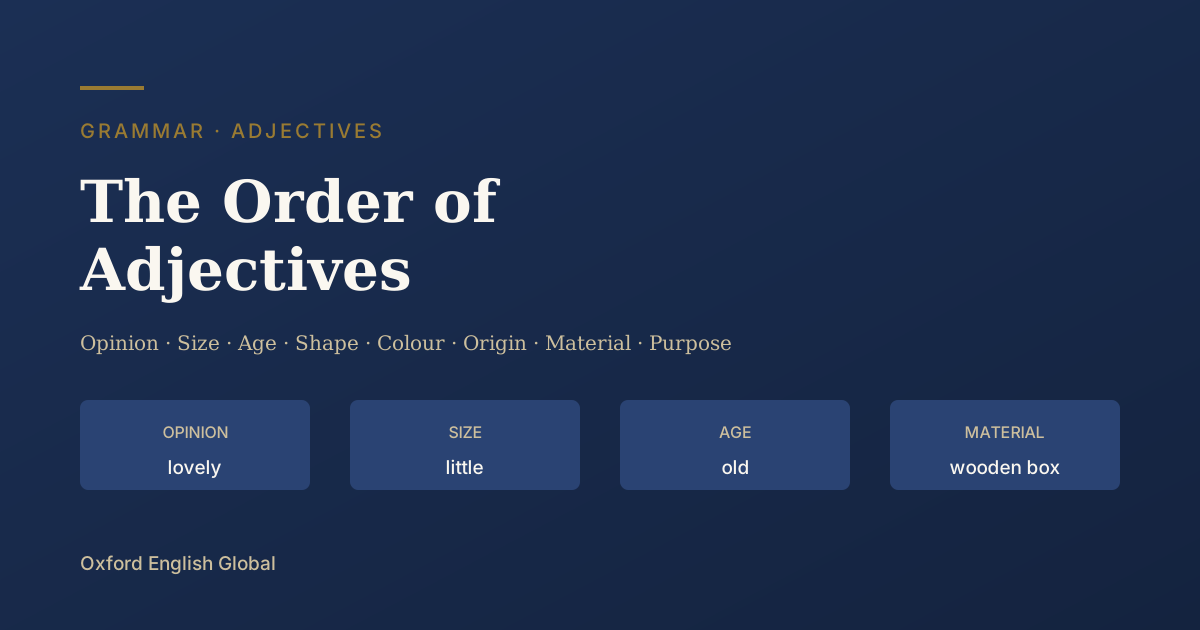
- The order of adjectives in one table
- Each category, with natural examples
- Natural examples from everyday English
- When to use commas and "and"
- Adjectives after the verb
- Exceptions and flexible cases
- Common learner mistakes
- Using adjective order to describe things well
- Practice: put the adjectives in order
- What this article cannot tell you
When you put two or more adjectives before a noun in English, they usually follow this order: opinion, size, age, shape, colour, origin, material, purpose, then the noun. That is why native speakers say a lovely little old rectangular green French silver serving dish, not a green old little lovely dish. In real speech people rarely use more than two or three adjectives together, so the rule matters most for short combinations like a beautiful old house or a small black leather bag. This guide explains each category with natural examples, shows when to use commas and and, covers the exceptions, and ends with a practice exercise.
Memory trick: OSASCOMP. Opinion · Size · Age · Shape · Colour · Origin · Material · Purpose. Say it like a made-up word, "o-sas-comp", and you will remember the order.
The order of adjectives in one table
| Position | Category | Question it answers | Examples |
|---|---|---|---|
| 1 | Opinion | What do you think of it? | beautiful, nice, ugly, delicious, boring, comfortable |
| 2 | Size | How big? | big, small, tiny, huge, tall, long |
| 3 | Age | How old? | old, new, young, ancient, modern |
| 4 | Shape | What shape? | round, square, flat, rectangular, oval |
| 5 | Colour | What colour? | red, dark blue, grey, pale green |
| 6 | Origin | Where is it from? | Italian, Japanese, British, Mexican |
| 7 | Material | What is it made of? | wooden, cotton, leather, plastic, gold |
| 8 | Purpose | What is it for? | running (shoes), sleeping (bag), dining (table) |
Before all of these come determiners: articles (a, the), possessives (my, her), demonstratives (this, those) and numbers (two, the first). So the full pattern is: determiner + opinion + size + age + shape + colour + origin + material + purpose + noun.
Each category, with natural examples
1. Opinion comes first
Opinion adjectives show what you think, so they come before facts. There are two kinds: general opinion adjectives that can describe almost anything (good, bad, lovely, terrible) and specific ones that describe certain things (delicious food, comfortable chairs, clever people). When you use both, general comes before specific: a lovely comfortable sofa.
- a wonderful old city
- an interesting young writer
- delicious homemade bread
2. Size
Size adjectives come after opinion: a nice big garden, a tiny old cottage. Some grammars split size and shape, or put physical qualities such as heavy and hot near size; in practice, size before age is the part learners most often need.
3. Age
a big old tree, a small new company, a charming ancient church.
4. Shape
an old round table, a large square window.
5. Colour
a long black coat, small blue flowers. Colour can be modified: a dark green jacket.
6. Origin
Origin adjectives (nationality and place) come after colour: a red Italian sports car, white Greek yoghurt.
7. Material
a Japanese wooden box, a black leather wallet. Many material words are nouns used like adjectives (cotton, silk, metal); a few have adjective forms (wooden, woollen, golden).
8. Purpose
Purpose words sit right next to the noun because they are almost part of it. Often they are -ing forms or nouns: walking boots, a coffee cup, a sleeping bag, a dining table. You can't move them: new running shoes, never running new shoes.
Natural examples from everyday English
Here are combinations you might actually say or read:
| Phrase | Order used |
|---|---|
| a lovely old farmhouse | opinion + age |
| a big black dog | size + colour |
| a small Italian restaurant | size + origin |
| my new blue cotton shirt | age + colour + material |
| an expensive Swiss watch | opinion + origin |
| a comfortable old leather armchair | opinion + age + material |
| two tall young trees | number + size + age |
| a cheap plastic shopping bag | opinion + material + purpose |
Notice that none of these uses more than three adjectives. Long chains like a beautiful big old round brown English wooden dining table are grammatically possible but sound unnatural. Good writers usually split the information: a beautiful old dining table, round and made of dark English oak.
When to use commas and "and"
The rule about commas depends on whether the adjectives are from the same category or different categories.
- Different categories, no comma: a big old house, a small black leather bag. These are called cumulative adjectives: each one describes the whole group that follows.
- Same category, use a comma or "and": a warm, friendly teacher (two opinions), a long, narrow street. These are coordinate adjectives.
- Two colours: use and: a black and white photo, a red and gold flag.
Quick test for commas. If you can put and between the adjectives, or swap their order, and it still sounds natural, use a comma. A warm and friendly teacher ✓ → a warm, friendly teacher. A big and old house ✗ → no comma: a big old house.
Adjectives after the verb
The order rule applies to adjectives before a noun. After verbs like be, look, seem and feel, adjectives are linked with and (or commas plus and), and the order is freer:
- The house was old and beautiful. / The house was beautiful and old.
- The room felt small, dark and cold.
This is a useful escape route: if a chain feels awkward before the noun, move some adjectives after the verb.
Exceptions and flexible cases
- Emphasis can change the order. A speaker might say an old, beautiful house with a pause to stress old. This is a stylistic choice, so stick to the standard order unless you have a reason.
- Fixed phrases. Some combinations are fixed expressions: the Big Bad Wolf, little old me, a great big hug. Learn them as chunks. Our guide to learning vocabulary in chunks explains why this works.
- Compound nouns. In a new car park or an old bus station, the first noun belongs to the compound, so adjectives go before the whole compound.
- Comparatives and superlatives usually come early, like opinion: the best small hotel in town, a bigger red box. See our guide to comparatives and superlatives.
- Little and old. Little often carries affection rather than size, as in a lovely little café, and old can mean "familiar" in good old Tom.
Common learner mistakes
| Mistake | Correction | Rule |
|---|---|---|
| a leather black jacket | a black leather jacket | colour before material |
| an Italian delicious pizza | a delicious Italian pizza | opinion before origin |
| a old big house | a big old house | size before age |
| a blue big car | a big blue car | size before colour |
| a beautiful, old house | a beautiful old house | no comma between different categories |
| the shoes running new | the new running shoes | purpose next to the noun; adjectives before the noun |
| a black white cat | a black and white cat | use "and" between two colours |
Speakers of languages such as Spanish, French, Portuguese and Italian often place adjectives after the noun (una casa grande). In English, adjectives go before the noun in almost all cases. For more patterns that trip learners up, see our list of common English grammar mistakes.
Using adjective order to describe things well
Adjective order is most useful when you describe people, places and objects: in a hotel review, a lost-property report, an IELTS Speaking answer or a product description.
- Lost property: "I've lost a small black leather wallet with a silver zip."
- Describing a place: "We stayed in a charming little hotel in a quiet old street."
- Shopping: "Do you have this in a larger dark blue version?"
- IELTS Speaking Part 2: "I'd like to describe a beautiful old wooden box that my grandmother gave me."
Tip: two well-chosen adjectives usually beat four average ones. A cosy little café paints a clearer picture than a nice good small pleasant café.
Practice: put the adjectives in order
- a (wooden / old / small) box
- a (Mexican / delicious / spicy) dish
- some (cotton / white / new) T-shirts
- a (round / big / glass) table
- an (Japanese / expensive / red) car
- a (hiking / brown / comfortable) pair of boots → a comfortable pair of ___ boots
- (young / tall / two) men
- a (silk / beautiful / blue) scarf
Answers: 1 a small old wooden box · 2 a delicious spicy Mexican dish (two opinion words: general before specific) · 3 some new white cotton T-shirts · 4 a big round glass table · 5 an expensive red Japanese car · 6 a comfortable pair of brown hiking boots · 7 two tall young men · 8 a beautiful blue silk scarf
What this article cannot tell you
- A rule for every combination. Grammars describe the order slightly differently, especially for size, shape and physical qualities. OSASCOMP is a reliable guide, not a law of nature; native speakers sometimes break it for emphasis.
- How it sounds in your own speech. The best test is listening. Read and listen widely, and notice combinations; our guide to learning vocabulary through reading shows how.
- Personal feedback. For corrections on your speaking and writing, try our free lessons or a structured course.
Frequently asked questions
What is the correct order of adjectives in English?
The usual order is opinion, size, age, shape, colour, origin, material and purpose, followed by the noun: a beautiful small old round red Italian wooden dining table. In practice, people rarely use more than two or three adjectives together.
What does OSASCOMP stand for?
OSASCOMP is a memory aid for adjective order: Opinion, Size, Age, Shape, Colour, Origin, Material, Purpose.
Do I need commas between adjectives?
Not between adjectives from different categories: a big old house. Use a comma or and between adjectives from the same category: a warm, friendly teacher. Use and between two colours: a black and white photo.
Is it a big black dog or a black big dog?
A big black dog. Size comes before colour.
Can native speakers break the adjective order?
Sometimes, for emphasis or in fixed expressions such as a great big hug. For everyday speaking and writing, the standard order is the safest choice.