
Comparatives and Superlatives in English: Rules, Irregular Forms and Common Mistakes
Is it more cheap or cheaper? The most good or the best? This guide explains how to form comparatives and superlatives for short and long adjectives, the spelling rules, irregular forms like good, better, best, useful sentence patterns and the mistakes learners make most often.

- What are comparatives and superlatives?
- Short adjectives: -er and -est
- Long adjectives: more and most
- Two-syllable adjectives: the tricky group
- Irregular forms: good, better, best
- Useful sentence patterns for comparing
- Comparing adverbs: more slowly, harder
- Common mistakes and how to fix them
- Practice: comparative or superlative?
- What this article cannot tell you
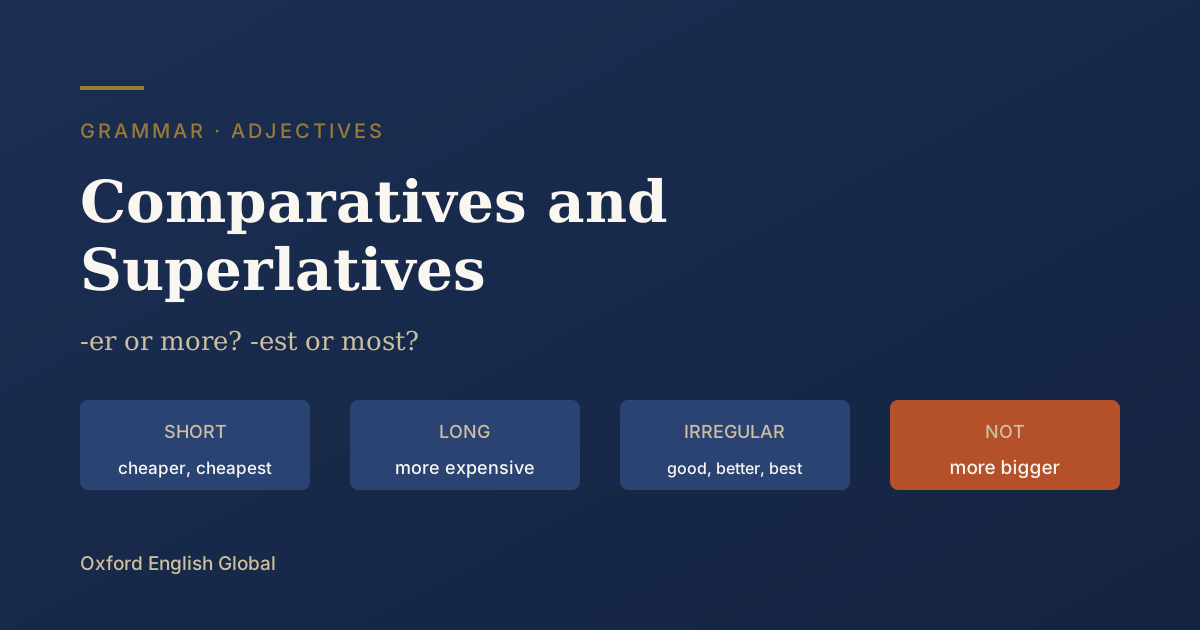
To compare two things in English, use a comparative: add -er to short adjectives (cheaper, bigger) and put more before long ones (more expensive), followed by than. To say something is at the top or bottom of a group of three or more, use a superlative: the + -est for short adjectives (the cheapest) and the most for long ones (the most expensive). A few common adjectives are irregular: good, better, best; bad, worse, worst; far, further/farther, furthest/farthest. This guide explains the rules for short and long adjectives, the spelling changes, the irregular forms and the mistakes learners make most often, with tables, examples and a practice exercise.
Quick rule. One syllable: -er / -est. Two syllables ending in -y: -ier / -iest. Most other adjectives with two or more syllables: more / most. Never use both: say bigger, not more bigger.
What are comparatives and superlatives?
An adjective describes a noun: a fast train. English adjectives have three forms:
| Form | Use | Example |
|---|---|---|
| Base (positive) | describes one thing | This train is fast. |
| Comparative | compares two things or groups | This train is faster than the bus. |
| Superlative | puts one thing at the top or bottom of a group of three or more | This is the fastest train in Europe. |
The same system works with many adverbs, which describe verbs: She speaks more slowly than her brother. We look at adverbs later in this guide.
Short adjectives: -er and -est
For adjectives with one syllable, add -er for the comparative and the ... -est for the superlative.
| Adjective | Comparative | Superlative |
|---|---|---|
| cheap | cheaper | the cheapest |
| old | older | the oldest |
| long | longer | the longest |
| small | smaller | the smallest |
| fast | faster | the fastest |
- My new flat is smaller than my old one, but it's cheaper.
- This is the oldest building in the city.
Spelling changes
Three spelling rules cover almost every short adjective:
| Rule | Examples |
|---|---|
| Ends in -e: add only -r / -st | large → larger → the largest; nice → nicer → the nicest; safe → safer → the safest |
| Ends in one vowel + one consonant: double the consonant | big → bigger → the biggest; hot → hotter → the hottest; thin → thinner → the thinnest; sad → sadder → the saddest |
| Ends in consonant + -y: change y to i | dry → drier → the driest |
Do not double w, x or y: new → newer, low → lower, grey → greyer.
Long adjectives: more and most
For most adjectives with two or more syllables, put more before the adjective for the comparative and the most for the superlative. The adjective itself does not change.
| Adjective | Comparative | Superlative |
|---|---|---|
| expensive | more expensive | the most expensive |
| interesting | more interesting | the most interesting |
| difficult | more difficult | the most difficult |
| modern | more modern | the most modern |
| careful | more careful | the most careful |
- Speaking is more difficult for me than reading.
- That was the most interesting lecture of the course.
The opposite direction uses less and the least, with adjectives of any length: This phone is less expensive than that one. It's the least useful app I've downloaded. With short adjectives, native speakers usually prefer the opposite adjective instead: cheaper rather than less expensive in casual speech, smaller rather than less big.
Two-syllable adjectives: the tricky group
Two-syllable adjectives are where most learners hesitate. Use these guidelines:
- Ending in -y: use -ier / -iest. happy → happier → the happiest; easy → easier → the easiest; busy → busier → the busiest; funny → funnier → the funniest; early → earlier → the earliest.
- Ending in -ful, -less, -ing, -ed, -ous, -ive: use more / most. more useful, more careless, more boring, more tired, more famous, more active.
- Some can take either form. Adjectives such as quiet, simple, narrow, clever, gentle and polite are used with both: quieter or more quiet, simpler or more simple. The -er form is often more common in everyday speech.
If you are not sure, more / most is usually the safer choice with a two-syllable adjective that does not end in -y. A good learner's dictionary will show the forms in the entry.
Irregular forms: good, better, best
A small number of very common adjectives (and adverbs) have irregular forms. Learn these by heart; they appear in almost every conversation.
| Base | Comparative | Superlative | Example |
|---|---|---|---|
| good / well | better | the best | Her English is better than mine. She's the best student in the class. |
| bad / badly | worse | the worst | The traffic is worse today. It was the worst day of the week. |
| far | further / farther | the furthest / the farthest | The station is further than I thought. |
| much / many | more | the most | I have more time on Fridays. |
| little (amount) | less | the least | I spend less money now. |
Further or farther? For physical distance, both are correct: further is more common in British English, farther in American English. For the meaning "more, additional", use further: For further information, contact us.
Old, older, elder: older and the oldest work in every situation. Elder and eldest are used mainly for family members, before a noun: my elder sister, their eldest son. You cannot say She is elder than me; say She is older than me.
Useful sentence patterns for comparing
Comparatives and superlatives become much more natural when you know the patterns around them.
Comparatives
- much / a lot / far + comparative (big difference): The train is much faster than the bus.
- a bit / slightly / a little + comparative (small difference): This one is slightly cheaper.
- comparative + and + comparative (change over time): My English is getting better and better. Rents are getting more and more expensive.
- the + comparative, the + comparative (one thing causes another): The more you practise, the easier it gets.
Equality: as ... as
- My brother is as tall as my father. (the same)
- The second film wasn't as good as the first. (less good)
- The new office is twice as big as the old one.
Superlatives
- the + superlative + in + place or group: the tallest building in the world, the best player in the team.
- the + superlative + of + a period or a group with a number: the best day of my life, the cheapest of the three.
- the + superlative + I've ever + past participle: It's the best book I've ever read. Our guide to the present perfect vs past simple explains why this pattern uses the present perfect.
- one of the + superlative + plural noun: She is one of the best teachers I know.
Comparing adverbs: more slowly, harder
Adverbs follow similar rules. Adverbs ending in -ly use more / most: quickly → more quickly → most quickly; carefully → more carefully. Adverbs with the same form as the adjective use -er / -est: hard → harder, fast → faster, early → earlier, late → later. And well and badly are irregular: better, best and worse, worst.
- Could you speak more slowly, please?
- She works harder than anyone in the office.
Common mistakes and how to fix them
| Mistake | Correct | Why |
|---|---|---|
| She is more taller than me. | She is taller than me. | Use -er or more, never both. |
| This is more cheap. | This is cheaper. | One-syllable adjectives take -er. |
| It's more good than the old one. | It's better than the old one. | Good is irregular. |
| My English is badder than yours. | My English is worse than yours. | Bad is irregular. |
| He is taller that his brother. | He is taller than his brother. | Comparatives use than, not that. |
| She is the most intelligent of the world. | She is the most intelligent person in the world. | Use in with places and groups. |
| It's best restaurant in town. | It's the best restaurant in town. | Superlatives normally need the. |
| He is the more intelligent student in the class. | He is the most intelligent student in the class. | Use the superlative for three or more. |
| My sister is elder than me. | My sister is older than me. | Elder is used before a noun, not with than. |
| The more you read, the more easy it is. | The more you read, the easier it is. | Keep the normal form of the adjective. |
For more grammar fixes like these, see our list of 20 common English grammar mistakes. If the before superlatives confuses you, our guide to a, an and the explains the logic.
Practice: comparative or superlative?
Complete each sentence with the correct form of the adjective in brackets.
- This exercise is ______ than the last one. (easy)
- Mount Everest is ______ mountain in the world. (high)
- My new job is ______ than my old one, but the pay is ______. (interesting / bad)
- That was ______ meal I've ever eaten. (good)
- The weather today is ______ than yesterday. (hot)
- The ______ you start, the ______ you'll finish. (early / soon)
- For ______ information, please read the attached document. (far)
- Your pronunciation isn't as ______ as you think. It's actually quite clear. (bad)
Answers: 1. easier 2. the highest 3. more interesting / worse 4. the best 5. hotter 6. earlier / sooner 7. further 8. bad
Speaking task: Compare the city you live in now with another city you know. Use at least three comparatives, one as ... as and one superlative. If you want feedback on your rhythm and intonation, try our free Speaking Lab.
What this article cannot tell you
- Every two-syllable adjective. Usage varies for adjectives such as clever, quiet and polite, and between British and American English. Check a learner's dictionary when you are unsure.
- Style choices in formal writing. Some style guides prefer one form over another; follow the guide your teacher, university or employer uses.
- Your personal weak points. A guide gives the rules; feedback on your own speaking and writing shows where you actually go wrong.
For more grammar in simple steps, see our complete English grammar guide, explore our free lessons, or join one of our English courses for regular feedback from a teacher.
Frequently asked questions
When do I use -er and when do I use more?
Use -er and -est with one-syllable adjectives (cheaper, the cheapest) and with two-syllable adjectives ending in -y (happier). Use more and most with most other adjectives of two or more syllables (more expensive, the most expensive).
What are the irregular comparatives and superlatives?
The most common are good, better, best; bad, worse, worst; far, further or farther, furthest or farthest; much or many, more, most; and little, less, least.
Can I say more bigger or most biggest?
No. Use either -er/-est or more/most, never both. Say bigger and the biggest.
What is the difference between further and farther?
For physical distance both are correct; further is more common in British English and farther in American English. For the meaning additional, use further: further information.
Do superlatives always need the?
Usually, yes: the best, the most interesting. The article may be dropped after a possessive (my best friend) and in some phrases such as at best.