
IDP Emerging Futures Survey: How Visa Policy Is Shaping Where International Students Study
IDP's October 2026 Emerging Futures survey of 4,834 students shows visa policy now shapes destination choice: 51% say visa chances strongly influence where they apply. Here are the key findings, what is verified, and what they mean if you plan to study in an English-speaking country.

- About the survey: who IDP asked and when
- The main finding: visa chances shape the shortlist
- Destinations: Australia down, the UK and US up
- Students are comparing more countries
- How students research: the rise of AI tools
- What this means if you are choosing an English-speaking destination
- What this article cannot tell you
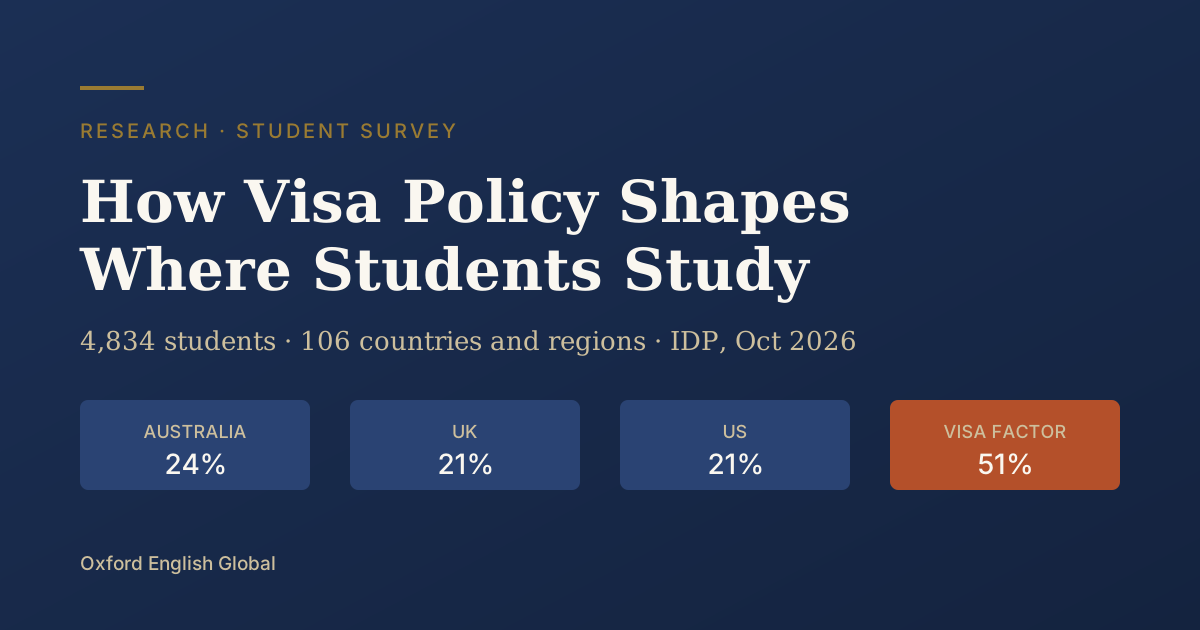
IDP Education's October 2026 "Emerging Futures" survey of 4,834 students in 106 countries and regions found that visa policy is now one of the biggest forces shaping where international students choose to study. 51% of prospective and applied students said their chances of getting a student visa strongly influenced which destinations they would consider, and 83% of prospective students were considering more than one country. Australia's share as students' first choice fell from 31% to 24% in six months, while the UK and the US each rose to 21%. For anyone planning to study in an English-speaking country, the message is simple: keep more than one option open, check visa rules early, and make sure your English evidence is strong enough for every destination on your list.
Checked on 11 November 2026 against IDP's own global media release (28 October 2026) and the Emerging Futures hub, with additional figures from StudyTravel Network and The PIE News (both 28 October 2026). Where a figure comes only from news coverage, we say so. This page contains no affiliate links.
About the survey: who IDP asked and when
IDP Education is a large international student placement company and a co-owner of IELTS. Since 2020 it has run regular surveys of international students, first called Crossroads, then New Horizons and now Emerging Futures. IDP says more than 125,000 students have taken part across the series.
| Detail | What IDP reports |
|---|---|
| Name | Emerging Futures October 26, "Voice of the International Student" (often called Emerging Futures 10) |
| Sample | 4,834 students across 106 countries and regions |
| Who | Prospective, applied and current international students |
| Prospective students | 42% of respondents (up from 27% in the previous survey in March 2026) |
| Fieldwork | August 2026 (The PIE News gives 18 August to 16 September 2026) |
| Released | 27–28 October 2026, at the Australian International Education Conference in Sydney |
Source: IDP global media release and Emerging Futures hub, read 11 November 2026. Exact fieldwork dates from The PIE News only.
It is worth remembering what kind of survey this is. IDP recruited the respondents itself, so the sample is not a random sample of all students worldwide, and IDP's public release does not give a full method statement or margin of error. The results are best read as a strong signal of how students in the international study pipeline are thinking, not as exact market shares.
The main finding: visa chances shape the shortlist
IDP's release highlights two visa figures:
- 51% of prospective and applied students said their chances of getting a student visa strongly influenced which destinations they would consider.
- 47% of applied students said they thought about their visa prospects before or during shortlisting destinations.
In other words, about half of students now check whether they are likely to get a visa before they fall in love with a university. Simon Emmett, IDP's Chief Partner Officer, put it this way in the release: "Countries aren't just competing on the strength of their universities anymore. Policy certainty, affordability and the opportunities available to students during and after their studies are increasingly part of the equation."
This fits what has happened in 2026. Australia tightened onshore applications and family rules from 2 October (see our guide to Australia's October 2026 student visa changes), New Zealand made English ability a key visa factor from 27 October (see New Zealand's tougher English checks), and the UK raised English levels on several routes (see the UK visa B2 English requirement).
Destinations: Australia down, the UK and US up
The headline number from IDP is students' first-choice destination:
| Destination | First choice, March 2026 | First choice, October 2026 survey | Source |
|---|---|---|---|
| Australia | 31% | 24% | IDP release |
| United Kingdom | Not stated by IDP | 21% | IDP release |
| United States | Not stated by IDP | 21% | IDP release |
| Canada | Not stated | 13% | StudyTravel Network |
IDP says the UK and US both "rose" to 21%. News coverage adds detail on which countries students were considering (not only their first choice):
- Australia was considered by 54% (down 5 points) and the UK by 53% (up 8 points), according to StudyTravel Network. The PIE News reports that the US also rose 8 points.
- New Zealand rose from 21% to 25%, and Ireland from 16% to 19% (StudyTravel Network).
- Australia still ranked first for post-study work and graduate jobs, while the UK ranked first for education quality (StudyTravel Network).
- Australia was the only destination whose rating for international student policy fell, from 6.6 to 6.3 (The PIE News).
Students are comparing more countries
IDP reports that 83% of prospective students are considering more than one destination. StudyTravel Network adds that 19% are comparing four countries and 5% five or more. Students are also open to new formats: 59% of prospective students would consider studying at an international branch campus (up from 52%), with "reduced overall cost" the leading reason.
At the same time, some students are dropping out of the process. The PIE News reports that the share of students no longer considering study abroad rose from 11% to 16%. Among students who withdrew, StudyTravel Network lists the main reasons as cost of living (41%), no longer being able to afford tuition (40%), expensive visa fees (22%) and visas becoming harder to obtain (19%).
How students research: the rise of AI tools
The survey also asked where students get information. In IDP's release, 41% used generative AI as a source, compared with 37% who used education counsellors. Of those using AI, 61% said it confirmed their decision and 23% said it changed their preferences. 42% named AI and technology skills as the most important for future job success, and 33% said AI-related jobs had increased their interest in a subject.
A word of caution for learners: AI tools can be out of date on visa rules, which changed several times in 2026. Use them to build a list of questions, then check every answer on the official government page.
What this means if you are choosing an English-speaking destination
The survey describes a market where rules change quickly and students hedge their bets. Practical lessons:
- Shortlist two or three countries, not one. That is what most students in the survey are doing, and it protects you if one country changes its rules mid-application.
- Check visa rules first. Read the official pages for each country before you apply to universities. Rules on onshore switching, family members and work rights differ widely.
- Prepare one strong English score that works everywhere. Each country accepts different tests. For example, TOEFL and the Duolingo English Test are not UK SELTs, while Australia and New Zealand set their own score tables. Compare our guides to UK approved tests, the TOEFL 1–6 scale and the Duolingo English Test, and aim for a score above the minimum.
- Budget realistically. Cost of living and tuition were the top reasons students gave up. Use each government's official living-cost figure, not an agent's estimate.
- Treat English as a visa issue, not only an admission issue. New Zealand now lets visa officers ask for test results even after a school has accepted you. Strong, verifiable English is the safest evidence everywhere.
If you need to raise your level, our exam preparation courses, free lessons and IELTS score calculator are a good place to start.
What this article cannot tell you
- The full dataset. IDP's complete report and infographic are gated. Country-level consideration figures, the Canada, New Zealand and Ireland numbers and the decliner statistics come from news reports, not from IDP's public text.
- Method details. IDP's public release does not give weighting, response rates or margins of error, and the sample was recruited by IDP.
- Conflicting dates. One outlet dates the previous survey to February 2026; IDP and The PIE News say March 2026. We use March.
- Future trends. A survey shows intentions in August–September 2026, not actual enrolments, and visa rules in all major destinations continue to change.
This page is independent analysis by Oxford English Global and contains no affiliate or sponsored links.
Frequently asked questions
What is IDP's Emerging Futures survey?
It is a regular survey of international students run by IDP Education. The October 2026 edition, 'Voice of the International Student', surveyed 4,834 prospective, applied and current students across 106 countries and regions.
How much does visa policy affect where students choose to study?
In IDP's October 2026 survey, 51% of prospective and applied students said their chances of getting a student visa strongly influenced which destinations they would consider, and 47% of applied students thought about visa prospects while shortlisting.
Which countries are international students choosing in 2026?
In IDP's survey, Australia was the first choice for 24% of students (down from 31% in March 2026), and the UK and US each rose to 21%. News reports put Canada at 13%.
Is the survey representative of all international students?
Not exactly. IDP recruited the respondents itself and its public release does not give weighting or margins of error, so the results are best read as a strong signal of student thinking rather than exact market shares.