
English Tests for Canada PR: CLB Levels and Express Entry Points Explained
For Canadian permanent residence through Express Entry, your English test decides both whether you qualify and a large share of your CRS score. Here are the three accepted tests, IRCC's CLB score tables, the points each level is worth and what the 3 November 2026 changes mean for you.

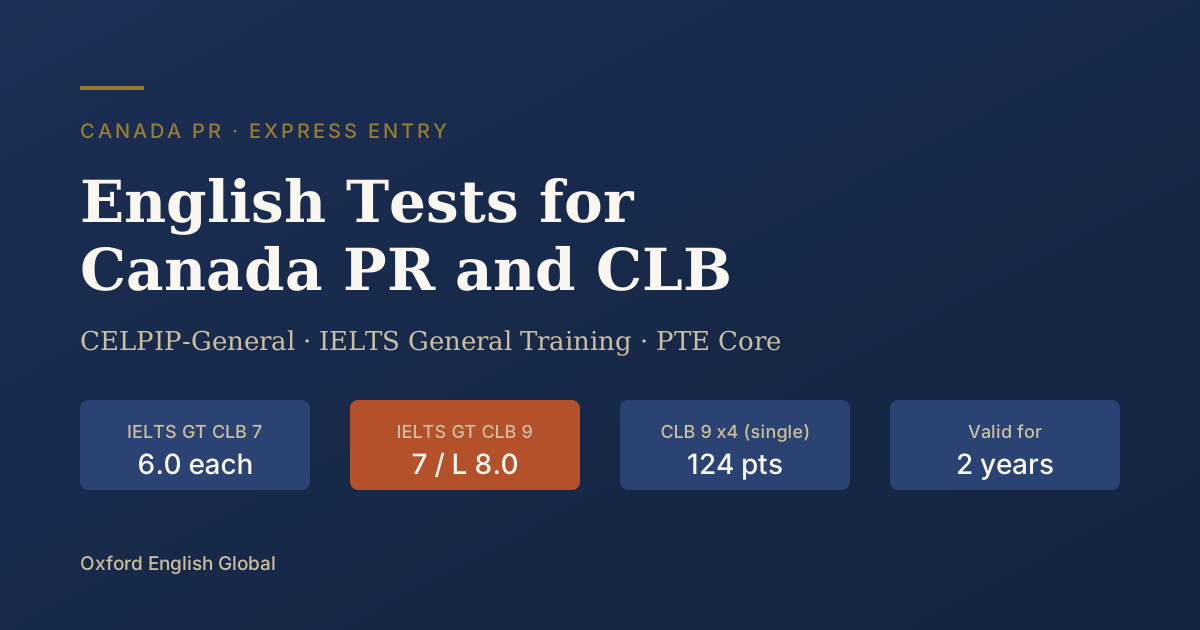
- The three English tests IRCC accepts
- What CLB levels are
- Minimum language levels by program
- Score tables: IELTS, CELPIP and PTE Core to CLB
- How language scores affect your CRS points
- What changed on 3 November 2026
- How to prepare for CLB 7 or CLB 9
- Common mistakes with language results
- What this article cannot tell you
To apply for Canadian permanent residence through Express Entry in English, you must take one of three approved tests: CELPIP-General, IELTS General Training or PTE Core. Your scores are converted into Canadian Language Benchmark (CLB) levels for reading, writing, speaking and listening. The Federal Skilled Worker Program and the Canadian Experience Class (for TEER 0 and 1 jobs) need at least CLB 7 in all four abilities; the Federal Skilled Trades Program needs CLB 5 for speaking and listening and CLB 4 for reading and writing. Language is also one of the biggest parts of your Comprehensive Ranking System (CRS) score: up to 136 points for a single applicant's first official language alone, plus up to 100 skill transferability points that depend on reaching CLB 7 or CLB 9. The changes that took effect on 3 November 2026 added a new Labour Market Integration factor for Canadian work experience and job offers; the language point tables were not part of that change. This guide shows the tests, the score tables and how much each CLB level is worth.
Checked on 10 November 2026 against Immigration, Refugees and Citizenship Canada (IRCC) pages: Express Entry: Language test results, Comprehensive Ranking System (CRS) criteria (modified 3 November 2026) and 2026 changes to points for Canadian work experience and job offers. IRCC updates its rules and score tables. Check the official pages before you book a test or create a profile. Oxford English Global is an English school, not an immigration consultant.
The three English tests IRCC accepts
For Express Entry, IRCC accepts three English tests and two French tests. You must take the exact version named below.
| Test | Version you must take | Watch out for |
|---|---|---|
| CELPIP (Canadian English Language Proficiency Index Program) | CELPIP-General | Other CELPIP versions do not count for Express Entry |
| IELTS (International English Language Testing System) | IELTS General Training | IELTS Academic is not accepted; IRCC also does not accept IELTS One Skill Retake for Express Entry |
| PTE (Pearson Test of English) | PTE Core | PTE Academic is a different test |
Source: IRCC, "Express Entry: Language test results", read 10 November 2026. French tests accepted: TEF Canada and TCF Canada.
Your results must be less than two years old both when you complete your Express Entry profile and when you submit your application for permanent residence. IRCC warns that if you apply with expired results, your application will be refused. If your results will expire while you wait in the pool, plan a retest early.
What CLB levels are
The Canadian Language Benchmarks (CLB) are Canada's national scale for describing English ability in adults, from CLB 1 to CLB 12. French uses a parallel scale called NCLC. IRCC converts your test scores into a CLB level for each of the four abilities separately. Your levels can differ: for example CLB 9 in listening but CLB 7 in writing.
Two thresholds matter most in Express Entry:
- CLB 7 is the minimum for the Federal Skilled Worker Program and unlocks the first tier of skill transferability points.
- CLB 9 in all four abilities unlocks the full skill transferability points and a much higher core score.
IRCC does not publish an official conversion between CLB and the European CEFR scale (A1–C2), so we do not give one here. To estimate your general level, start with our free English level test guide, then take an official practice test for the exam you plan to sit.
Minimum language levels by program
| Program | Minimum English level |
|---|---|
| Federal Skilled Worker Program | CLB 7 in all 4 abilities |
| Canadian Experience Class, job in TEER 0 or 1 | CLB 7 in all 4 abilities |
| Canadian Experience Class, job in TEER 2 or 3 | CLB 5 in all 4 abilities |
| Federal Skilled Trades Program | CLB 5 speaking and listening; CLB 4 reading and writing |
Meeting the minimum only makes you eligible to enter the pool. Invitations go to the highest CRS scores, so in practice most candidates aim well above the minimum.
Score tables: IELTS, CELPIP and PTE Core to CLB
These are IRCC's conversion tables for the levels that matter most. You need the listed score in each ability to reach that CLB level.
IELTS General Training
| CLB | Speaking | Listening | Reading | Writing |
|---|---|---|---|---|
| 10+ | 7.5–9.0 | 8.5–9.0 | 8.0–9.0 | 7.5–9.0 |
| 9 | 7.0 | 8.0 | 7.0 | 7.0 |
| 8 | 6.5 | 7.5 | 6.5 | 6.5 |
| 7 | 6.0 | 6.0 | 6.0 | 6.0 |
| 6 | 5.5 | 5.5 | 5.0 | 5.5 |
| 5 | 5.0 | 5.0 | 4.0 | 5.0 |
| 4 | 4.0 | 4.5 | 3.5 | 4.0 |
Notice that listening needs a higher IELTS band than the other skills at CLB 8 and above: 7.5 for CLB 8 and 8.0 for CLB 9. Many candidates who are "band 7 overall" find listening is the skill that holds them at CLB 8.
CELPIP-General
CELPIP-General is the simplest to read: the score for each ability equals the CLB level. A CELPIP score of 9 in reading is CLB 9 in reading, and 10 or above counts as CLB 10+.
PTE Core
| CLB | Speaking | Listening | Reading | Writing |
|---|---|---|---|---|
| 10+ | 89+ | 89+ | 88+ | 90+ |
| 9 | 84–88 | 82–88 | 78–87 | 88–89 |
| 8 | 76–83 | 71–81 | 69–77 | 79–87 |
| 7 | 68–75 | 60–70 | 60–68 | 69–78 |
| 6 | 59–67 | 50–59 | 51–59 | 60–68 |
| 5 | 51–58 | 39–49 | 42–50 | 51–59 |
Source: IRCC "Check your language level" tables on the Express Entry language test page, read 10 November 2026.
How language scores affect your CRS points
Language affects your CRS score in three places: core points for your first official language, skill transferability points, and (if you have a partner coming with you) your partner's language points.
1. Core points for your first official language
| CLB level per ability | Points per ability (single) | Points per ability (with partner) | Total for 4 abilities (single) |
|---|---|---|---|
| Less than CLB 4 | 0 | 0 | 0 |
| CLB 4 or 5 | 6 | 6 | 24 |
| CLB 6 | 9 | 8 | 36 |
| CLB 7 | 17 | 16 | 68 |
| CLB 8 | 23 | 22 | 92 |
| CLB 9 | 31 | 29 | 124 |
| CLB 10+ | 34 | 32 | 136 |
The "total" column is our multiplication of IRCC's per-ability points, assuming the same CLB level in all four abilities. The biggest single jump is from CLB 6 to CLB 7: plus 8 points per ability, or 32 in total for a single applicant. Moving from CLB 8 to CLB 9 adds another 32.
2. Skill transferability points
Skill transferability combines language with education or foreign work experience, up to a maximum of 100 points. For a post-secondary credential of one year or longer, or for one or two years of foreign work experience, IRCC awards:
- 13 points with CLB 7 or more in all abilities but one or more under CLB 9;
- 25 points with CLB 9 or more in all four abilities.
For two or more credentials (one of three years or longer), a master's or a doctorate, or for three or more years of foreign work experience, the figures rise to 25 and 50 points. This is why reaching CLB 9 in every ability often matters more than the core table suggests: one weak ability below CLB 9 can halve these points.
3. Your partner's English
If your spouse or common-law partner comes with you, their first-language results can add up to 20 points: 1 point per ability at CLB 5 or 6, 3 at CLB 7 or 8 and 5 at CLB 9 or more.
Bonus for French
Candidates with NCLC 7 or higher in all four French abilities get 25 additional points, or 50 if they also score CLB 5 or higher in all four English abilities.
What changed on 3 November 2026
IRCC's change notice describes two main changes from 3 November 2026:
- a new Labour Market Integration factor in the core CRS, worth up to 150 points for a single applicant (140 with a partner), awarded for either Canadian work experience (with extra points for high-wage occupations) or a qualifying high-wage job offer (up to 100 points), but not both;
- job offers no longer need a Labour Market Impact Assessment (LMIA).
IRCC said recalculating existing profiles could take up to two weeks and that invitation rounds would pause in the meantime. The change notice does not list any change to language tests, CLB conversion tables or language points, and the language tables on the updated CRS criteria page are the ones shown above.
What this means for English learners: language is still one of the few CRS factors you can actively improve in a few months. Age only goes one way, and Canadian work experience takes years. A move from CLB 7 to CLB 9 in all four abilities is worth 56 core points for a single applicant (from 68 to 124), plus any extra skill transferability points.
How to prepare for CLB 7 or CLB 9
- Choose your test early. IRCC accepts all three equally. Their formats differ, for example in how the speaking section is delivered and how long the test takes, so compare the official format pages of CELPIP, IELTS and PTE Core and pick the one you perform best in.
- Take an official practice test and map each ability to CLB using the tables above. Find your weakest ability; it limits both your core and transferability points.
- Target listening if you take IELTS. Because CLB 9 needs 8.0 in IELTS listening, train with natural-speed audio. Our guide on improving English listening has a daily routine.
- Build speaking fluency. Practise timed answers and record yourself. Our Speaking Lab and the guide on improving English speaking help with pace and clarity.
- Get your writing marked. Writing is the ability most candidates cannot assess alone. Our English courses include exam preparation with teacher feedback.
- Retest strategically. If one ability is just below a threshold, a retest focused on that skill can be worth more points than months of work on anything else in your profile.
Common mistakes with language results
Small errors with language tests cost candidates points or even their application. These are the ones IRCC's own pages warn about, plus practical traps we see learners fall into.
| Mistake | Why it matters | How to avoid it |
|---|---|---|
| Booking IELTS Academic or PTE Academic | Not accepted for Express Entry | Book IELTS General Training or PTE Core by name |
| Using an IELTS One Skill Retake result | IRCC says it does not accept One Skill Retake for Express Entry | Plan a full retest if one skill is low |
| Letting results expire in the pool | Applications with expired results are refused | Check the two-year date before you accept an invitation |
| Entering an overall band instead of each ability | CLB is calculated per ability | Enter the four separate scores exactly as on your result |
| Assuming "band 7" means CLB 9 | CLB 9 needs 8.0 in IELTS listening | Check every ability against IRCC's table |
| Ignoring your partner's English | A partner's results can add up to 20 points | If your partner is coming with you, consider a test for them too |
Worked example
Imagine a single applicant with IELTS General Training scores of speaking 7.0, listening 7.5, reading 7.0 and writing 6.5. Using IRCC's table, that is CLB 9 for speaking and reading, CLB 8 for listening and CLB 8 for writing. Core language points are 31 + 23 + 31 + 23 = 108. Because two abilities are below CLB 9, skill transferability uses the lower tier.
If the same applicant raises listening to 8.0 and writing to 7.0, every ability reaches CLB 9. Core language points rise to 124 (an extra 16), and the language-based skill transferability points can move to the higher tier, which can double them. This is why the last half band in one or two abilities is often the most valuable study time in an Express Entry plan. The figures here are our own calculation from IRCC's published tables, not an official estimate.
What this article cannot tell you
- Invitation cut-off scores. CRS cut-offs change with every draw and depend on the draw type. We do not predict them.
- Your full CRS score. Age, education, work experience, the new Labour Market Integration factor, provincial nomination and other factors all count. Use IRCC's official CRS tool.
- Test prices and dates. These vary by country and provider, so we have not listed them.
- CEFR equivalents. We found no official IRCC conversion from CLB to CEFR, so we have not given one.
- Other programs. Provincial nominee programs, citizenship and study permits have their own language rules.
This page is independent guidance from Oxford English Global. It contains no affiliate links, and we receive nothing from any test provider or government body mentioned.
Frequently asked questions
Which English tests are accepted for Canada Express Entry?
IRCC accepts CELPIP-General, IELTS General Training and PTE Core. IELTS Academic and PTE Academic are not accepted for Express Entry, and IRCC does not accept the IELTS One Skill Retake.
What IELTS score do I need for CLB 7?
CLB 7 needs IELTS General Training scores of at least 6.0 in each of speaking, listening, reading and writing, according to IRCC's conversion table.
What IELTS score is CLB 9?
CLB 9 needs 7.0 in speaking, reading and writing and 8.0 in listening in IELTS General Training. Listening has a higher band requirement than the other skills at CLB 8 and above.
Did the November 3, 2026 Express Entry changes affect language points?
IRCC's change notice covers a new Labour Market Integration factor for Canadian work experience and job offers and the removal of LMIA requirements. It does not list changes to language tests or language points.
How long are language test results valid for Express Entry?
Results must be less than two years old when you create your Express Entry profile and when you submit your application for permanent residence. IRCC refuses applications made with expired results.