
IELTS Paper Test Ends: How to Prepare for Computer Delivery and Writing on Paper
From mid-2026 IELTS stopped offering the paper-based test and moved every candidate to computer delivery, with a new Writing on Paper option in selected countries. Here is exactly what changed, how Writing on Paper works, and what to practise now: typing your essays and reading on screen.

- What changed, and when
- What the change means for you
- How the Writing on Paper option works
- Should you type or handwrite your Writing?
- How to practise typing your essays
- How to practise reading and listening on screen
- A four-week plan before a computer-delivered IELTS
- How this compares with other English tests
- What this article cannot tell you
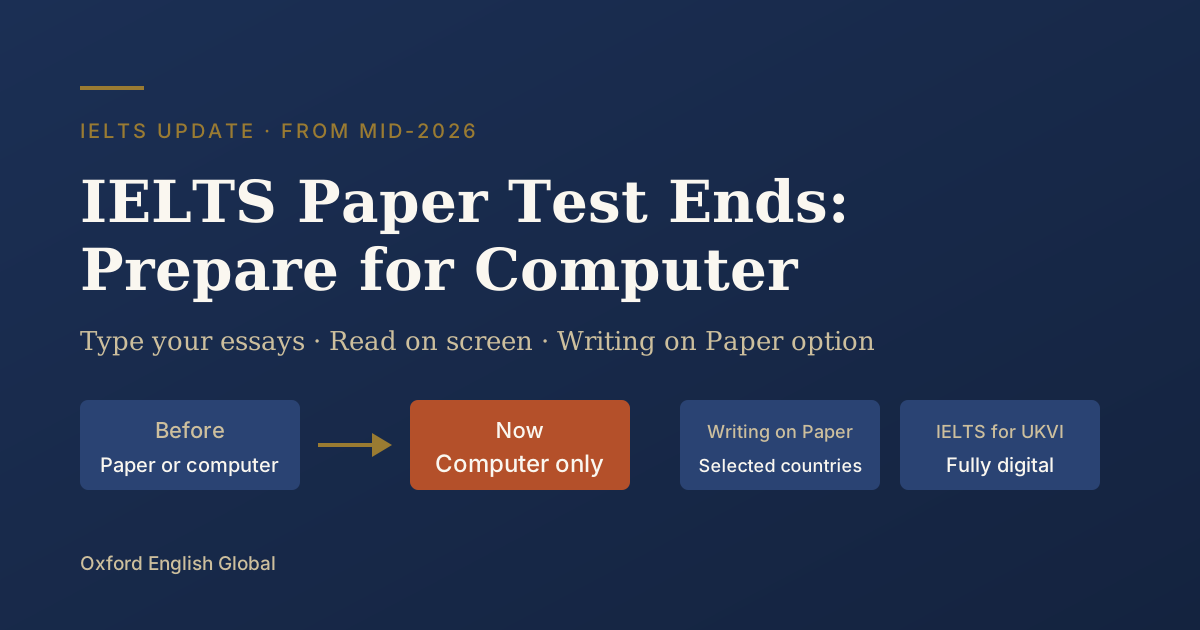
IELTS is no longer offered as a paper-based test: the IELTS partners announced on 5 March 2026 that from mid-2026 all IELTS tests would be delivered on computer, with exact timelines varying by country. In selected countries there is a new option called IELTS on computer (Writing on Paper), where you take Listening and Reading on screen but handwrite your two Writing tasks on an answer sheet. Writing on Paper is available for IELTS Academic and General Training, but not for IELTS for UKVI, which is now fully digital. Paper-based results you already have stay valid for the usual two-year period. For most candidates this means one thing: practise reading on a screen and, unless your country offers Writing on Paper and you choose it, practise typing your essays under exam timing.
Checked on 9 November 2026. This page is based on the official IELTS announcement Updates to IELTS test delivery (published 5 March 2026), the IELTS pages IELTS on computer (Writing on Paper), Updates to IELTS Writing test delivery mode, Ways to take IELTS and the IELTS Academic Writing format, plus the British Council's copy of the same announcement. IELTS has not published a single global list of countries or end dates, so always check your local booking site before you plan.
What changed, and when
Until 2026, most countries offered two ways to sit IELTS at a test centre: on paper or on computer. The official announcement explains why the paper version is going. The IELTS partners (British Council, IDP and Cambridge University Press & Assessment) say they found "higher satisfaction among test takers who choose IELTS on computer because it is more convenient, results are faster, and it offers One Skill Retake." Their conclusion: "from mid-2026, we will no longer offer IELTS as a paper-based test. All IELTS tests will be delivered on computer. Exact timelines will vary by market."
Three points in that wording matter for learners:
- It is not one global switch-off date. The change was rolled out country by country from mid-2026. IELTS did not publish one cut-off date that applies everywhere.
- The test itself has not changed. IELTS says the update "does not change the IELTS skills assessed, the test construct, or the way results should be interpreted by institutions." The questions, the four skills, the timing and the band scale stay the same. Only the way you answer changes.
- The Speaking test does not change. It is still a face-to-face conversation with a trained examiner, as it was in both the paper and computer versions.
By the date of this check, local booking sites were already reflecting the change. For example, the IDP IELTS India site now states that "IELTS on Paper has been discontinued" and offers IELTS Writing on Paper instead. We did not find an official source that confirms the exact last paper test date for every country, so we do not list dates here.
What the change means for you
Your situation depends on whether you already have a paper result, which version of IELTS you need, and where you will sit the test.
| Your situation | What happens now |
|---|---|
| You already have a paper-based IELTS result | It stays valid. IELTS says all current paper-based results "are not affected and will remain valid until the end of the recommended two-year period." |
| You are booking IELTS Academic or General Training | You take the test on computer. In selected countries you can choose Writing on Paper for the Writing section. |
| You are booking IELTS for UKVI (for a UK visa) | Fully digital only. Writing on Paper is not available for IELTS for UKVI. |
| You need IELTS Academic and want to test at home | IELTS Online is offered in some countries for IELTS Academic only. Listening, Reading and Writing work the same way as IELTS on computer. |
| You need access arrangements (for example large print or braille) | IELTS says it will continue its current access arrangements, including large print, braille, lip reading for hearing-impaired candidates, and One Skill Retake for candidates with access arrangements. Apply through your test centre well before test day. |
Sources: IELTS, Updates to IELTS test delivery (5 March 2026) and Ways to take IELTS, both read 9 November 2026.
If you need IELTS for a UK visa, see our guide to the UK visa B2 English requirement, which lists the IELTS for UKVI scores needed for the main work routes.
How the Writing on Paper option works
Writing on Paper is a version of IELTS on computer, not a return of the old paper test. The official description is short: "If you choose Writing on Paper, your Writing component tasks will be shown on screen, but you will be given an IELTS Writing Answer Sheet and a pen to complete the tasks."
| Test part | IELTS on computer | IELTS on computer (Writing on Paper) | Time |
|---|---|---|---|
| Listening | On computer | On computer | 30 minutes |
| Reading | On computer | On computer | 60 minutes |
| Writing | Questions on screen, typed answers | Questions on screen, handwritten answers | 60 minutes |
| Speaking | With an examiner | With an examiner | 11–14 minutes |
Source: IELTS, IELTS on computer (Writing on Paper), read 9 November 2026.
The rules that come with it:
- Only in selected countries. IELTS describes Writing on Paper as available "in selected countries from mid-2026". It has not published a country list. Your test centre's booking page shows whether the option exists where you are.
- Academic and General Training only. It is available for both IELTS Academic and IELTS General Training, but not for IELTS for UKVI.
- Same tasks, same marking. "The task types, scoring and time allocation of the Writing component are the same whether you take it on computer or write on paper."
- Your certificate does not show it. Results come within five days of the test date, and the Test Report Form "will not specify that you chose the Writing on Paper option."
- A retake must use the same mode. One Skill Retake is available for Writing on Paper, but if you chose Writing on Paper, your Writing retake must also be on paper, not typed.
IELTS says it ran a field trial in November 2025 in which participants took Writing on Paper within 90 days of a previous paper-based test. It reports that scores were "effectively the same" across both and that participants found the format fair and easy to use. This is the test owner's own research summary; we have not seen the full data.
Should you type or handwrite your Writing?
If your country offers both, the choice is yours, and neither option is marked more generously. IELTS states that scoring is the same. So choose the mode in which you produce your best English in 60 minutes. Ask yourself four questions:
- How fast do you type in English? Time yourself typing a 250-word Task 2 answer you have already planned. If typing takes you much longer than handwriting, you lose thinking time.
- Do you edit a lot? On a screen you can move a sentence or rewrite a paragraph without crossing out. If you tend to reorganise ideas as you write, typing can help.
- Is your handwriting clear under pressure? Examiners must be able to read your answer. If your handwriting becomes hard to read when you write quickly, typing removes that risk.
- Which do you use in daily life? Many adult learners type every day at work and rarely write long texts by hand. Others, often those who learned English mainly in school, still think better with a pen.
Whatever you choose, practise in that mode from now on. Switching on test day to a mode you have not practised is a common way to lose time.
How to practise typing your essays
Because IELTS on computer asks you to "type your answers on the screen", typing becomes part of the Writing test for most candidates. Typing is a separate physical skill from writing English, and it can be trained quickly. A practical routine:
- Use a plain editor. Practise in a simple text editor with automatic spelling and grammar correction switched off. Word processors fix many errors for you, which hides the mistakes an examiner will see. The free official familiarisation test (see below) shows you the real screen.
- Train with the real word targets. Task 1 needs at least 150 words in about 20 minutes; Task 2 needs at least 250 words in about 40 minutes, and Task 2 counts twice as much as Task 1. Type full answers to these targets, with a timer.
- Plan first, then type. Spend the first few minutes of each task planning. IELTS says you may use the note-taking tool, but the examiner will not see your notes. A clear plan keeps your typing focused.
- Proofread on screen. Leave three to five minutes at the end of each practice essay to reread it. Check verb forms, articles, plurals and spelling, one at a time. Our post on the 20 common English grammar mistakes is a useful checklist.
- Write in full sentences. IELTS is clear that answers must be in full sentences, not notes or bullet points. Typing can tempt you to use lists; do not.
- Build speed with short daily sessions. Ten minutes of typing practice in English each day, for example retyping a model paragraph and then writing your own, usually helps more than one long session a week.
For more on structure and style, our free PDF 100 Tips to Avoid Mistakes in Academic Writing covers planning, clarity, style and grammar in formal English.
How to practise reading and listening on screen
Reading and Listening are now on computer for every candidate, including those who choose Writing on Paper. Reading 60 minutes of academic text on a screen is a different experience from reading on paper: you scroll, you cannot fold pages, and your eyes tire in a different way. Prepare for that:
- Take the official familiarisation test. IDP describes its free IELTS on Computer Familiarisation test as giving you "the actual test experience on your computer". It is untimed, so you can explore the screens, tools and navigation before you practise under time pressure. The British Council links to the same familiarisation test from its free practice page.
- Read long texts on screen every day. Choose articles of 700–900 words from quality news or science sites and read them on a laptop, not a phone, because the test uses a full screen. Summarise each one in two sentences.
- Practise moving between text and questions. On paper you can see both at once. On screen you may need to scroll. Do timed practice reading sections on a computer so that finding your place again becomes automatic.
- Listen with headphones and answer on screen. Do practice Listening tests at a computer and type or click your answers, so that typing does not distract you while the recording continues.
- Look after your eyes. Adjust screen brightness, sit at a proper desk and take short breaks between practice sections, as you would in a long working day.
A four-week plan before a computer-delivered IELTS
This plan assumes you already know the IELTS format and want to adapt to computer delivery. Adjust the length if your test is sooner or later.
| Week | Focus | What to do |
|---|---|---|
| 1 | Get used to the screen | Take the familiarisation test untimed. Decide whether to type or handwrite (if Writing on Paper is offered). Start 10 minutes of daily typing practice. |
| 2 | Reading and Listening on computer | Do two timed Reading sections and two Listening sections at a computer. Read one long article on screen daily. |
| 3 | Writing under exam timing | Write three Task 2 essays and three Task 1 reports in your chosen mode, timed. Get feedback on at least two. |
| 4 | Full rehearsal | Sit one full practice test in a single morning at a computer. Use our IELTS score calculator to turn your practice section scores into band scores and see where you stand. |
If you are not sure your English is ready for the band you need, take our free English level test first. Our English courses include exam preparation for adults, and the free lesson library has writing and reading practice you can do on screen today.
How this compares with other English tests
With the paper option gone, IELTS now works like tests such as TOEFL iBT, PTE Academic and the Duolingo English Test, which are also taken on a computer. If you are choosing between tests, compare which ones your university, employer or visa authority accepts first; the delivery mode is a secondary question. Our guides to the TOEFL 1–6 score scale and the Duolingo English Test explain those exams, and our study abroad page covers the wider application process.
What this article cannot tell you
- Exact dates for your country. IELTS says timelines "vary by market" and has not published a global list of last paper test dates. Dates you see on social media or unofficial sites may not be accurate. Check your local British Council or IDP booking page.
- Where Writing on Paper is offered. IELTS says "selected countries" but publishes no full list. We confirmed it on the IDP India booking site; for anywhere else, check locally.
- Every detail of the test screen. The official pages we checked describe the delivery modes but not every on-screen tool. Use the free familiarisation test to see the interface for yourself.
- Fees. Test fees vary by country and are not covered here.
- Your required score. Universities, employers and visa authorities set their own minimum bands. Confirm the exact score and test version they accept before booking.
This page is independent guidance from Oxford English Global. It contains no affiliate links, and we receive nothing from IELTS, the British Council, IDP, Cambridge or any other test provider mentioned.
Frequently asked questions
Is the paper-based IELTS test still available?
No. The IELTS partners announced on 5 March 2026 that from mid-2026 IELTS would no longer be offered as a paper-based test and all tests would be delivered on computer, with exact timelines varying by country. Paper-based results you already have remain valid until the end of the recommended two-year period.
What is IELTS Writing on Paper?
It is an option of IELTS on computer offered in selected countries. You take Listening and Reading on computer, see the Writing tasks on screen, and write your answers by hand on an IELTS Writing Answer Sheet with a pen. The task types, timing and scoring are the same as typed Writing, and your Test Report Form does not show which option you chose.
Can I choose Writing on Paper for IELTS for UKVI?
No. IELTS states that Writing on Paper is not available for IELTS for UKVI, and that the Secure English Language Test for UK Visas and Immigration is only available in the fully digital format.
Is it easier to get a high Writing score on paper or on computer?
Neither. IELTS says the task types, scoring and time allocation are the same in both modes, and its November 2025 field trial found scores effectively the same. Choose the mode in which you write your best English in 60 minutes, and practise in that mode.
If I take One Skill Retake for Writing, can I switch from paper to typing?
No. If you chose Writing on Paper for your original test, your One Skill Retake for Writing must also be taken with Writing on Paper, not typed on computer.