
The New TOEFL 1–6 Score Scale Explained: Old Scores, CEFR Levels and University Requirements
Since January 2026 TOEFL iBT reports every score from 1 to 6, tied directly to CEFR levels. Here is how the new bands convert from old 0–120 scores, using ETS's own tables, and how to work out the score your university actually needs.

- What changed in January 2026
- The 1–6 scale and the CEFR, band by band
- Converting old 0–120 scores to the new scale
- How your score report works during the transition
- What score do universities ask for now?
- How to choose your own target score
- The TOEFL iBT format behind the new scores
- What this article cannot tell you
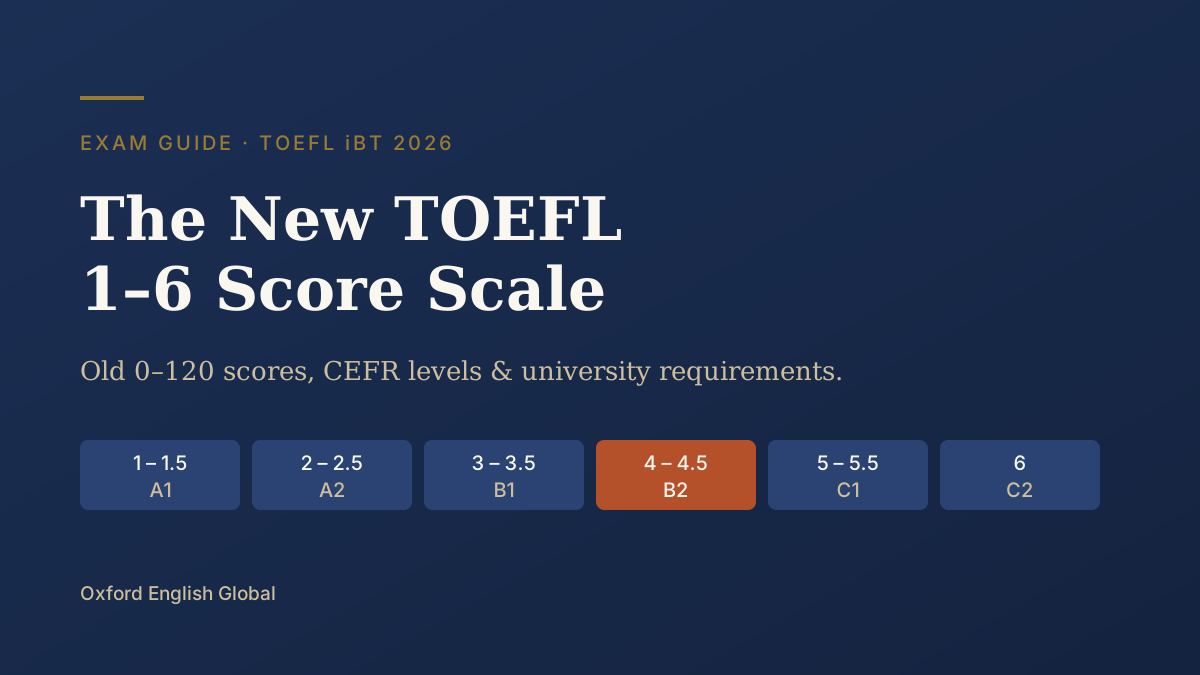
Since 21 January 2026, TOEFL iBT reports every score on a 1–6 scale in half-band steps, and each band is tied directly to a CEFR level: 1–1.5 is A1, 2–2.5 is A2, 3–3.5 is B1, 4–4.5 is B2, 5–5.5 is C1 and 6 is C2. Your overall score is now the average of the four section scores, not their sum, and for two years your report also shows a comparable score on the old 0–120 scale. Most universities that have published new requirements ask for somewhere between 4.0 and 4.5 overall, which corresponds roughly to 72–85 and 86+ on the old scale. This guide explains the conversion, using ETS's own published tables, and shows how to work out which score you actually need.
Checked on 9 November 2026. All tables on this page come from the official ETS pages What your TOEFL scores mean and TOEFL score scale update: a guide for institutions. University requirements were read on the universities' own admissions pages on the same date. Requirements change, so confirm yours before you book.
What changed in January 2026
For almost twenty years the TOEFL iBT reported four section scores from 0 to 30 and an overall score from 0 to 120. On 21 January 2026, ETS replaced that with a single 1–6 scale used for both the sections and the total. Three things changed at once:
- The numbers. Every section and the total are reported from 1 to 6 in half-point steps (1, 1.5, 2 … 5.5, 6).
- The meaning. Each half band now sits inside one CEFR level, and the same number means the same CEFR level in every section. Under the old scale, the score needed to reach B2 was different for Reading, Listening, Speaking and Writing, which confused applicants and admissions officers alike. ETS explains this reasoning in its post Why the 1–6 score scale?
- The arithmetic. The overall score is the average of the four section scores, rounded to the nearest half band. ETS gives the example that an average of 5.25 becomes an overall 5.5. Under the old scale the total was the sum of the sections.
The test itself was redesigned at the same time. Reading and Listening are now adaptive, so the questions you see depend on how you are doing, and new task types such as Complete the Words, Build a Sentence, Listen and Repeat and Take an Interview were introduced. We cover the format briefly below; our TOEFL exam guide goes into the sections in more depth.
The 1–6 scale and the CEFR, band by band
The CEFR (Common European Framework of Reference for Languages) is the six-level scale from A1 to C2 that most schools, employers and governments use to describe language ability. If you are not sure what each level means in practice, our English level test gives can-do descriptions for every level. The table below is ETS's official alignment for tests taken on or after 21 January 2026. It applies to the total and to each of the four sections.
| TOEFL score (1–6) | CEFR level | What that usually means for a learner |
|---|---|---|
| 6 | C2 | Near-native precision across academic and everyday English |
| 5 – 5.5 | C1 | Effective, flexible English for demanding academic study |
| 4 – 4.5 | B2 | Can follow lectures and argue a point; the most common university threshold |
| 3 – 3.5 | B1 | Independent in familiar situations; often the floor for pathway or pre-sessional courses |
| 2 – 2.5 | A2 | Basic everyday exchanges |
| 1 – 1.5 | A1 | Beginner |
The right-hand column is our own plain-English summary, not ETS wording. The practical point is that each CEFR level is split into a lower and an upper half: a 4 is a B2, and a 4.5 is a stronger B2. That split matters, because many universities that ask for "B2" actually set their threshold at the upper half.
Converting old 0–120 scores to the new scale
If you took the TOEFL before 21 January 2026, or a university still lists its requirement on the old scale, you need the comparison table. ETS built it from the performance of thousands of test takers in more than 80 countries who were scored on both scales. This is ETS's published comparison:
| New score (1–6) | Reading (0–30) | Listening (0–30) | Speaking (0–30) | Writing (0–30) | Total (0–120) |
|---|---|---|---|---|---|
| 6 | 29–30 | 28–30 | 28–30 | 29–30 | 114+ |
| 5.5 | 27–28 | 26–27 | 27 | 27–28 | 107+ |
| 5 | 24–26 | 22–25 | 25–26 | 24–26 | 95+ |
| 4.5 | 22–23 | 20–21 | 23–24 | 21–23 | 86+ |
| 4 | 18–21 | 17–19 | 20–22 | 17–20 | 72+ |
| 3.5 | 12–17 | 13–16 | 18–19 | 15–16 | 58+ |
| 3 | 6–11 | 9–12 | 16–17 | 13–14 | 44+ |
| 2.5 | 4–5 | 6–8 | 13–15 | 11–12 | 34+ |
| 2 | 3 | 4–5 | 10–12 | 7–10 | 24+ |
| 1.5 | 2 | 2–3 | 5–9 | 3–6 | 12+ |
| 1 | 0–1 | 0–1 | 0–4 | 0–2 | 0+ |
Source: ETS, TOEFL iBT score comparison for tests taken before January 21, 2026, read 9 November 2026. The "+" in the total column means "from this score up to the next band".
How to read the table
Each new band covers a range of old scores. A 4 on the new scale corresponds to an old total of 72 to 85; a 4.5 starts at 86. ETS notes that two half bands can contain different numbers of old score points, so the steps are not evenly sized. Three examples:
- Old total 80. That sits in the 72–85 range, so the comparable new score is 4 (B2).
- Old total 90. That sits in the 86–94 range, so the comparable score is 4.5 (upper B2).
- Old total 100. That sits in the 95–106 range, so the comparable score is 5 (C1).
Notice how the same section score converts differently by skill. A 22 in Reading converts to 4.5, but a 22 in Speaking converts to 4. This is exactly the inconsistency the new scale was designed to remove: under the old system, a 22 meant a different level depending on the section.
How your score report works during the transition
ETS has built in a two-year transition period so that nobody is left with a score an admissions office cannot read:
- Comparable 0–120 score. For two years after January 2026, your report also shows a comparable overall score on the 0–120 scale. ETS says this is the midpoint of the matching old range, not a separate measurement.
- MyBest scores. MyBest combines your best section scores from different test dates. If your latest test is on the new scale, older 0–120 scores are converted to 1–6 for the MyBest section. If your report is from a test on the old scale, MyBest only includes old-scale scores.
- Validity. TOEFL scores remain valid for two years from the test date, on either scale.
In practice, if you hold a valid old-scale score from 2025, you do not need to retake the test just because the scale changed. Universities that have updated their requirements usually list both versions, as the examples below show.
What score do universities ask for now?
There is no single answer, because each university and often each programme sets its own threshold. What we can do is show how real institutions translated their old requirements. These were read on each university's own admissions page on 9 November 2026:
| Institution (programme level) | New-scale requirement | Old-scale equivalent they list |
|---|---|---|
| University of Arizona, Graduate College | Minimum 4.0 overall | See the page for tests taken before 21 January 2026 |
| University of Kansas, graduate (full proficiency) | 4.5 overall, no part below 4.5 | 80 overall, no part below 20 |
| University of Kansas, graduate (admission proficiency) | 3.5 overall, no part below 3.5 | 55 overall, no part below 13 |
| Tufts University, Graduate School of Arts and Sciences | 4.5 generally advised | 90 |
| Princeton Graduate School | Speaking below 5.5 triggers additional English testing on enrolment | Speaking below 27 |
Two patterns stand out. First, 4.0 to 4.5 is the most common overall threshold for graduate study, which is the B2 band. Second, universities did not all convert the same way. Kansas mapped its old 80 to a 4.5, although ETS's table places 80 in the 4 band. Universities are allowed to be stricter than a straight conversion, and some are. So never convert a university's old requirement yourself if the university has published a new one: use the number it gives.
Watch the section minimums. Many universities set a minimum for each section as well as for the total. Because the total is now an average, you can reach 4.5 overall with a 4 in one section, and still be rejected if the university requires 4.5 in every part. Read the whole requirement, not just the headline number.
How to choose your own target score
Here is the process we use with students at Oxford English Global who are preparing for an English test:
- List every institution you are applying to and copy the requirement exactly as each one states it, including section minimums and which scale it uses.
- Take the highest requirement as your target. If one university wants 4.0 and another wants 4.5 with no section below 4.5, your target is 4.5 in every section.
- Find your current level. A practice test is best. If you do not have one, our free CEFR self-assessment gives a reasonable starting estimate.
- Measure the gap in CEFR terms. Moving from 4 to 4.5 is a step within B2; moving from 3.5 to 4.5 means crossing from B1 to B2, which typically takes months of study, not weeks. Our guide on how long it takes to learn a language discusses realistic timelines.
- Book the test when you are inside the band, not at its edge. If you need 4.5, aim for practice scores that are consistently 4.5 or above. Exam-day nerves cost most candidates something.
If you are weighing up whether TOEFL is the right test at all, compare it with IELTS and the Duolingo English Test in our Duolingo English Test guide, which includes a three-way comparison table. Students taking IELTS instead can turn four band scores into an overall result with our IELTS score calculator.
The TOEFL iBT format behind the new scores
The new scale came with a shorter, partly adaptive test. ETS lists the following structure on its test content page (read 9 November 2026). Times are approximate base times and can vary because the test adapts.
| Section | Task types | Items | Approx. base time |
|---|---|---|---|
| Reading | Complete the Words; Read in Daily Life; Read an Academic Passage | 50 | 30 min |
| Listening | Listen and Choose a Response; Listen to a Conversation; Listen to an Announcement; Listen to an Academic Talk | 47 | 29 min |
| Writing | Build a Sentence; Write an Email; Write for an Academic Discussion | 12 | 23 min |
| Speaking | Listen and Repeat; Take an Interview | 11 | 8 min |
ETS advises allowing approximately two hours in total, including directions. If your preparation materials still describe four integrated speaking tasks or long reading passages with "insert a sentence" questions, they were written for the old test. Update them, because the task types now feeding your score are different.
What this article cannot tell you
- Your university's requirement. We show examples, not rules. Requirements differ by university, by programme and sometimes by year of entry.
- Immigration and visa rules. Visa authorities set their own lists of accepted tests and scores, and these are separate from university admissions. Check the relevant government website.
- Exact equivalence with IELTS or other tests. ETS publishes TOEFL–CEFR and TOEFL old–new tables. Comparisons with other exams are concordance studies by each test provider and should be treated as approximate.
- Whether the tables will change. Everything here was checked on 9 November 2026. ETS may revise its guidance as more scores on the new scale come in.
This page is independent guidance from Oxford English Global. It contains no affiliate links, and we receive nothing from ETS or any university mentioned.
Frequently asked questions
What is a good TOEFL score on the new 1–6 scale?
It depends on where you are applying. On the new scale, 4 to 4.5 is the B2 band and is the most common overall requirement for graduate study among the universities we checked on 9 November 2026: for example, the University of Arizona Graduate College asks for at least 4.0 and Tufts generally advises 4.5. Very selective programmes and those with heavy speaking or teaching duties often ask for 5 or more, which is C1.
What is 80 on the old TOEFL scale in the new 1–6 scale?
According to ETS's comparison table, an old total of 80 falls in the 72–85 range, which corresponds to 4 on the new scale (B2). A 4.5 starts at 86 on the old scale. Be careful, though: some universities converted their old requirement of 80 to a 4.5, so always use the new-scale number your university publishes instead of converting it yourself.
Is my TOEFL score from 2025 still valid after the change?
Yes. TOEFL scores are valid for two years from the test date on either scale. ETS has also built in a two-year transition period from January 2026, during which new score reports show a comparable 0–120 score next to the 1–6 score, and universities that have updated their requirements usually list both versions.
How is the TOEFL overall score calculated now?
The overall score is the average of the four section scores, rounded to the nearest half band. ETS gives the example that an average of 5.25 becomes 5.5. Under the old scale the total was the sum of the four 0–30 section scores. Because the total is now an average, check whether your university also sets a minimum for each section.
Does the new scale make TOEFL easier or harder?
Neither, by design. The scale changes how ability is reported, not how much English you need. ETS aligned the new bands with the old scores using data from thousands of test takers. The test format did change at the same time, with adaptive Reading and Listening and new task types, so preparation materials written before 2026 may no longer match what you will see.