
Future Continuous and Future Perfect in English: When to Use Each, With Timelines and Examples
At 10 tomorrow I will be presenting; by 10 tomorrow I will have finished. The future continuous describes an action in progress at a future time, and the future perfect describes an action completed before it. This guide explains both with timelines, everyday examples, common mistakes and practice.

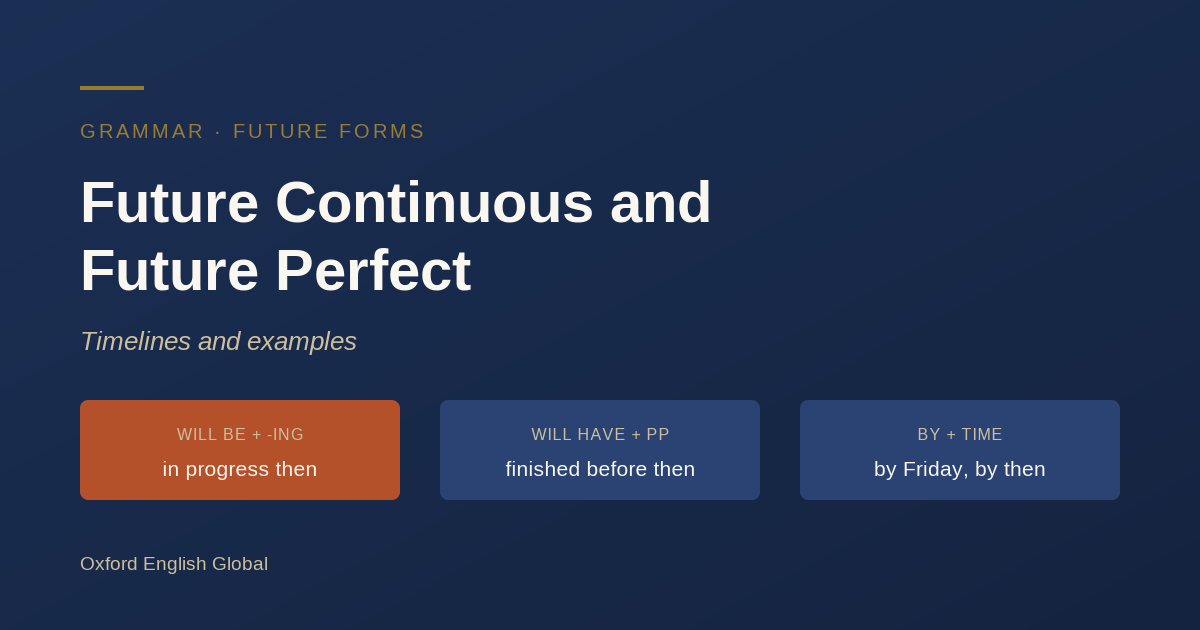
- Future continuous vs future perfect at a glance
- The future continuous: form
- When the future continuous is natural
- The future perfect: form
- When the future perfect is natural
- Side by side: the same situation, different meanings
- Examples from work and daily life
- Common mistakes
- Practice: future continuous or future perfect?
- What this article cannot tell you
Use the future continuous (will be + -ing) for an action that will be in progress at a particular moment in the future: At 10 tomorrow, I'll be presenting the report. Use the future perfect (will have + past participle) for an action that will be finished before a particular moment in the future: By 10 tomorrow, I'll have finished the report. In short, the future continuous puts you in the middle of an action at a future time; the future perfect looks back on a completed action from a future time. Both are also used for polite questions about plans (Will you be using the car tonight?) and for talking about duration up to a future point (By June, I'll have worked here for ten years). This guide explains each tense with timelines, examples from work and daily life, the most common mistakes and a practice exercise.
Sources. The rules on this page follow the Cambridge Dictionary grammar entries for the future continuous and the future perfect simple (read 27 November 2026). The timelines and example sentences are our own.
Future continuous vs future perfect at a glance
| Future continuous | Future perfect | |
|---|---|---|
| Form | will be + verb-ing | will have + past participle |
| Main idea | in progress at a future time | completed before a future time |
| Typical time words | at 8 o'clock tomorrow, this time next week, when you arrive | by Friday, by the time you arrive, before the end of the year |
| Example | This time next week, I'll be lying on a beach. | By next week, I'll have finished all my exams. |
| Other uses | polite questions about plans; things that will happen as a matter of routine | duration up to a future point; assumptions about now |
Both tenses are less common than will, going to and the present continuous for the future. If you are not yet confident with those, start with our guide to will, going to and the present continuous.
The future continuous: form
| Positive | Negative | Question |
|---|---|---|
| I'll be working. | I won't be working. | Will you be working? |
| She'll be travelling. | She won't be travelling. | Will she be travelling? |
| They'll be waiting. | They won't be waiting. | Will they be waiting? |
In speech, will is almost always contracted to 'll, and will not to won't.
When the future continuous is natural
1. An action in progress at a specific future time
Imagine a timeline. Put a point on it (tomorrow at 9 a.m.). The action has already started at that point and will continue after it.
now ……… [ 8:30 —— 9:00 —— 10:30 ] ………
meeting in progress at 9:00 → At 9 tomorrow, I'll be sitting in a meeting.
- Don't call me at 9; I'll be driving to work.
- This time next year, we'll be living in Lisbon.
- When you arrive, the children will be sleeping, so please be quiet.
Compare with will + base verb: When you arrive, I'll make dinner (I'll start after you arrive) vs When you arrive, I'll be making dinner (I'll already be in the middle of it).
2. Polite questions about someone's plans
Will you be + -ing? asks about plans without sounding like a request. This makes it polite and indirect, useful at work.
- Will you be using the meeting room this afternoon? (= Are you planning to? I might want it.)
- Will you be joining us for lunch?
- How will you be paying today? (common in shops and hotels)
Compare: Will you use the car tonight? can sound like a request or pressure; Will you be using the car tonight? simply asks about plans.
3. Things that will happen as part of the normal course of events
The future continuous can describe something that will happen anyway, as part of a routine or schedule, not because of a new decision.
- I'll be seeing Sara at the conference, so I can give her the documents.
- We'll be landing in about twenty minutes. (a typical pilot announcement)
- The shop will be closing in ten minutes.
The future perfect: form
| Positive | Negative | Question |
|---|---|---|
| I'll have finished. | I won't have finished. | Will you have finished? |
| She'll have left. | She won't have left. | Will she have left? |
| They'll have arrived. | They won't have arrived. | Will they have arrived? |
The past participle is the third form of the verb: finish → finished, go → gone, write → written.
When the future perfect is natural
1. An action completed before a future time
The future perfect looks back from a point in the future. The action happens at some time before that point.
now —— [ writing the report ] —— ✓ done …… Friday 5 p.m.
→ By Friday at 5, I'll have written the report.
- By the time you get home, I'll have cooked dinner.
- The project will have finished before the end of March.
- Don't worry, they won't have left yet.
The most common time expression is by (= not later than): by Monday, by 2030, by the time… Other useful ones: before, within the next…, in two years' time.
2. Duration up to a future point
Use the future perfect with for to say how long something will have lasted at a future moment. This is common for anniversaries and milestones.
- In June, I'll have worked here for ten years.
- By the end of this course, you'll have studied English for 200 hours.
- Next month, we'll have been married for twenty years.
To emphasise the activity continuing, you can use the future perfect continuous: By June, I'll have been working here for ten years. For more on for and since, see our guide to since and for.
3. Assumptions about the present
Will have + past participle can also express a confident guess about something that has probably already happened:
- It's 8 o'clock. The film will have started by now.
- Don't phone her now; she'll have gone to bed.
Side by side: the same situation, different meanings
| Sentence | Meaning |
|---|---|
| At 6 p.m., I'll cook dinner. | I'll start cooking at 6. |
| At 6 p.m., I'll be cooking dinner. | At 6, I'll be in the middle of cooking. |
| By 6 p.m., I'll have cooked dinner. | Dinner will be ready before 6. |
| When you arrive, we'll have lunch. | We'll start lunch after you arrive (together). |
| When you arrive, we'll be having lunch. | We'll already be eating when you arrive. |
| When you arrive, we'll have had lunch. | Lunch will be finished before you arrive. |
Examples from work and daily life
At work
- I'll be working from home on Friday, so call my mobile.
- By the end of the quarter, we'll have hired three new developers.
- Will you be attending the training session on Monday?
- By the time the client arrives, I'll have prepared the slides.
- Next week I'll be visiting our office in Madrid.
The polite Will you be…? question is especially useful in emails. See our guide to writing work emails in English.
In daily life
- This time tomorrow, I'll be flying to Toronto.
- By the time you read this message, I'll have landed.
- Don't come at 7; we'll be having dinner.
- By December, I'll have saved enough for a new laptop.
- In two years' time, I'll have finished my degree.
Talking about your goals
The future perfect is ideal for goals and deadlines: By the end of the year, I'll have read ten books in English. / By next summer, I'll have reached B2. If you want to measure progress towards a goal like that, try our free English level test.
Common mistakes
| Incorrect | Correct | Why |
|---|---|---|
| By Friday, I will finish the report. | By Friday, I will have finished the report. | With by + a future time, the future perfect is clearer and more natural. |
| At 9 tomorrow, I will work. | At 9 tomorrow, I will be working. | An action in progress at a time needs the continuous. |
| When I will arrive, I'll call you. | When I arrive, I'll call you. | After when, by the time, before and until, use a present tense for the future. |
| By the time you will come, we'll have left. | By the time you come, we'll have left. | Same rule: no will in the time clause. |
| I will be knowing the answer tomorrow. | I will know the answer tomorrow. | State verbs (know, believe, own, need) are not normally used in continuous forms. |
| Next year I will have lived here since five years. | Next year I will have lived here for five years. | Use for with a length of time. |
Practice: future continuous or future perfect?
Complete each sentence with the future continuous or the future perfect of the verb in brackets.
- Don't phone me at 8 tonight. I ______ (watch) the match.
- By the end of this month, I ______ (finish) the online course.
- This time next week, we ______ (travel) around Scotland.
- By the time we get to the cinema, the film ______ (start).
- ______ you ______ (use) your laptop tomorrow? I need to borrow one.
- In September, she ______ (work) at the company for five years.
- At midday tomorrow, I ______ (have) my job interview.
- Don't worry about the dishes. I ______ (wash) them before you get home.
- The plane ______ (land) in about ten minutes.
- By 2030, scientists ______ (find) new ways to store energy.
Answers
- 'll be watching
- 'll have finished
- 'll be travelling
- will have started
- Will … be using
- will have worked (or will have been working)
- 'll be having
- 'll have washed
- will be landing
- will have found
Speaking practice
Answer these questions aloud: What will you be doing at this time tomorrow? What will you have done by the end of this year? Where will you be living in five years' time? How long will you have been learning English by next summer?
For a complete map of English tenses, see English tenses explained, and for the present-time equivalent of the future perfect continuous, see our guide to the present perfect continuous. Our free lessons include more grammar practice.
What this article cannot tell you
- Every nuance. In some sentences, more than one future form is correct, and the choice depends on what the speaker wants to emphasise. Native speakers do not always agree.
- How often each form is used. Both tenses are less frequent than will, going to and the present continuous. We have not given frequency statistics because they vary by type of text.
- The future perfect continuous in depth. We mention it briefly; it deserves its own guide.
This page is independent guidance from Oxford English Global. It contains no affiliate links.
Frequently asked questions
What is the difference between the future continuous and the future perfect?
The future continuous (will be + -ing) describes an action in progress at a future moment: At 9 I will be driving. The future perfect (will have + past participle) describes an action finished before a future moment: By 9 I will have arrived.
When do I use by with the future perfect?
By means not later than, and it is the most common time expression with the future perfect: By Friday, I will have finished the report. By the time you arrive, we will have eaten.
Why is Will you be using the car tonight? polite?
The future continuous asks about plans without sounding like a request or pressure, so Will you be using the car tonight? is more indirect than Will you use the car tonight?
Can I use will after by the time or when?
No. In time clauses after when, by the time, before and until, use a present tense for the future: By the time you come, we will have left, not By the time you will come.