
Relative Clauses in English: How to Use Who, Which and That
The friend who called, the book that I bought, the city where we met: relative clauses let you describe people and things precisely in one sentence. This guide explains when to use who, which and that, the difference that commas make, when you can leave the pronoun out, and the mistakes learners make most often.

- What a relative clause is
- Who, which and that: the basic rules
- Defining relative clauses
- Non-defining relative clauses
- When you can leave the pronoun out
- Whose, where, when and why
- Relative clauses with prepositions
- Some of which, all of whom and other quantifiers
- Common learner mistakes
- Practice: join the sentences
- What this article cannot tell you
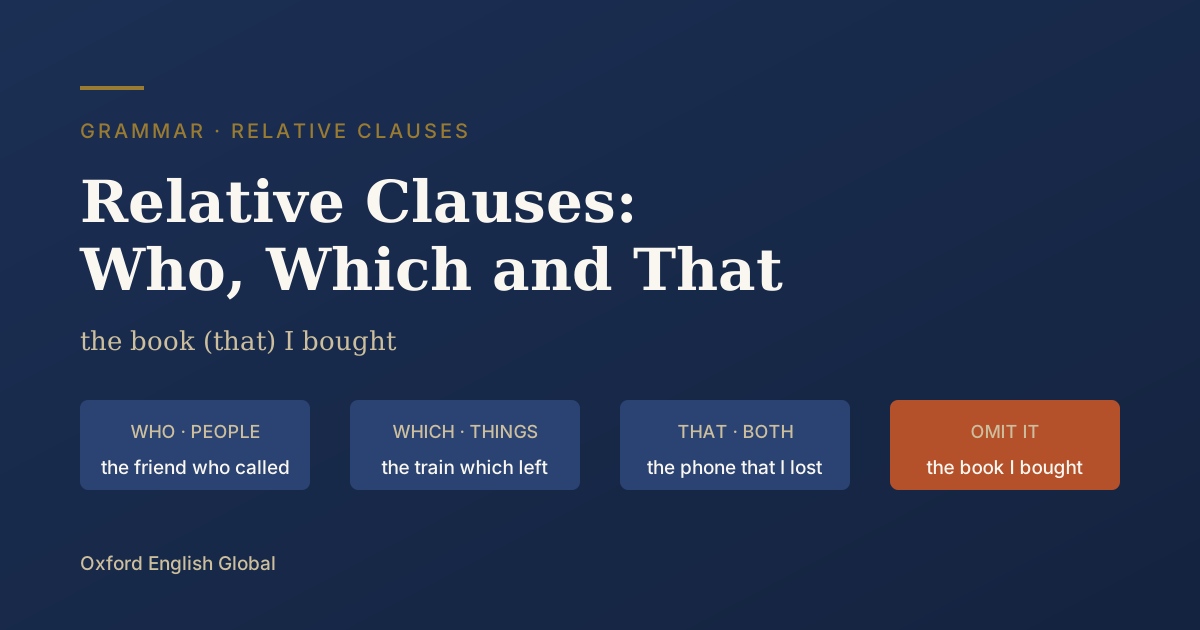
Relative clauses add information about a noun, and they usually start with who, which or that. Use who for people, which for things and animals, and that for people or things in defining clauses: The teacher who helped me, the book which I bought, the phone that I lost. In a defining clause you can leave the pronoun out when it is the object of the clause (the book I bought), but not when it is the subject (the teacher who helped me, never the teacher helped me in the same meaning). Non-defining clauses, which add extra information between commas, never use that and never drop the pronoun. This guide explains both kinds of relative clause, when each pronoun is correct, how to use whose, where and when, what happens to prepositions, and the mistakes learners make most often, with a short exercise at the end.
Quick reference. The rules on this page follow standard learner grammars, including Cambridge Dictionary's relative pronouns and defining and non-defining relative clauses, and the British Council's LearnEnglish page on relative pronouns and relative clauses.
What a relative clause is
A relative clause is part of a sentence that describes or identifies a noun. It comes directly after the noun it describes, and it usually begins with a relative pronoun.
- I have a friend. She lives in Oxford. → I have a friend who lives in Oxford.
- This is the laptop. I bought it last week. → This is the laptop that I bought last week.
Relative clauses let you join two short sentences into one longer, more natural sentence. They are one of the main tools that move a learner's English from B1 towards B2, because they make descriptions more precise without extra sentences.
Key terms
- Antecedent: the noun the clause describes (a friend, the laptop).
- Relative pronoun: the word that starts the clause and refers back to the antecedent: who, whom, which, that, whose.
- Relative adverb: where, when and why, which start clauses about places, times and reasons.
Who, which and that: the basic rules
The choice of pronoun depends on two things: what kind of noun you are describing, and what kind of clause you are writing.
| Pronoun | Use it for | Defining clauses | Non-defining clauses | Example |
|---|---|---|---|---|
| who | People (and often pets with names) | Yes | Yes | The woman who called you is my manager. |
| which | Things, animals, ideas | Yes | Yes | The train which leaves at 8 is usually late. |
| that | People or things | Yes | No | The train that leaves at 8 is usually late. |
| whom | People, as the object (formal) | Yes | Yes | The candidate whom we interviewed was excellent. |
| whose | Possession (people and things) | Yes | Yes | The student whose bag was stolen called the police. |
Who or that for people?
Both are correct in defining clauses: the man who lives next door and the man that lives next door. Who is more common in writing and sounds slightly more careful; that is very common in everyday speech. If you are not sure, who is always safe for people.
Which or that for things?
Both are correct in defining clauses in British English: the car which I rented and the car that I rented. Many American style guides prefer that for defining clauses and keep which for non-defining clauses with commas. If you write mainly for an American audience, following that habit will make your writing look polished. For more differences of this kind, see our guide to British vs American English.
Whom
Whom is the object form of who. It is correct but formal, and in everyday English most speakers use who, that or no pronoun instead: the person (who/that) I met. You will still see whom in formal letters and after prepositions: the people to whom I wrote.
Defining relative clauses
A defining (or identifying) relative clause tells us which person or thing we mean. Without it, the sentence is incomplete or means something different.
- The students who passed the exam received a certificate. (Only those students, not all of them.)
- I need a phone that has a good camera. (Not any phone.)
Rules for defining clauses:
- No commas. The clause is part of the noun phrase.
- That is allowed for both people and things.
- The pronoun can be left out when it is the object of the clause (see the next section).
Non-defining relative clauses
A non-defining (or non-identifying) relative clause adds extra information about a noun that is already clear. If you remove it, the sentence still makes complete sense.
- My sister, who lives in Madrid, is a doctor. (I have one sister; the clause adds information.)
- The Eiffel Tower, which was finished in 1889, is in Paris.
Rules for non-defining clauses:
- Use commas (or brackets or dashes) around the clause. In speech, there is usually a small pause.
- Never use that. My sister, that lives in Madrid, … is wrong.
- Never leave out the pronoun. The Eiffel Tower, was finished in 1889, … is wrong.
- They are more common in writing than in speech.
Comma or no comma? The meaning changes
| Sentence | Type | Meaning |
|---|---|---|
| My brother who lives in Canada is an engineer. | Defining | I have more than one brother; I mean the one in Canada. |
| My brother, who lives in Canada, is an engineer. | Non-defining | I have one brother; he lives in Canada. |
| The employees who worked late got a bonus. | Defining | Only the employees who worked late got a bonus. |
| The employees, who worked late, got a bonus. | Non-defining | All the employees worked late, and all got a bonus. |
Which referring to a whole sentence
A non-defining clause with which can refer to the whole previous idea, not just one noun: He arrived two hours late, which annoyed everyone. Here which means "the fact that he arrived late". You cannot use what or that in this position: …, what annoyed everyone is a common error.
When you can leave the pronoun out
This is the rule learners ask about most. In a defining clause, you can leave out who, which or that when the pronoun is the object of the verb in the clause. You cannot leave it out when it is the subject.
How to check: is there a new subject after the pronoun?
Look at the words straight after the pronoun. If a new subject (a noun or a pronoun such as I, you, she, they) follows, the relative pronoun is the object, and you can drop it. If a verb follows directly, the pronoun is the subject, and you must keep it.
| Full sentence | What follows the pronoun? | Can you omit it? | Shorter version |
|---|---|---|---|
| The book that I bought was expensive. | A subject (I) | Yes | The book I bought was expensive. |
| The man who we met was friendly. | A subject (we) | Yes | The man we met was friendly. |
| The film which my friends recommended was boring. | A subject (my friends) | Yes | The film my friends recommended was boring. |
| The man who lives next door is a pilot. | A verb (lives) | No | — |
| The bus that goes to the airport is full. | A verb (goes) | No | — |
| My boss, who I really like, is leaving. | A subject, but the clause is non-defining | No | — |
Dropping the object pronoun is extremely common in natural spoken English. Sentences such as Is this the one you wanted? and Everything she said was true sound more natural than the full versions. In formal writing both are fine.
Reduced relative clauses
You can also shorten some subject clauses by removing the pronoun and the verb be, or by using an -ing form:
- The woman who is sitting by the window is my aunt. → The woman sitting by the window is my aunt.
- The cars which were made in this factory are exported. → The cars made in this factory are exported.
- Anyone who wants to join should email me. → Anyone wanting to join should email me.
The second example uses a past participle with a passive meaning; see our guide to the passive voice in English for how these forms work.
Whose, where, when and why
Whose: possession
Whose replaces his, her, its or their and shows that something belongs to the antecedent. It works for people and for things.
- That's the girl. Her father is a pilot. → That's the girl whose father is a pilot.
- It's a company whose products are sold worldwide.
Do not confuse whose (possession) with who's (who is or who has): Who's the man whose car is outside?
Where, when and why
| Word | Use | Example | Alternative |
|---|---|---|---|
| where | Places | This is the café where we first met. | …the café in which we first met / …the café (that) we first met in. |
| when | Times | I remember the day when I got the job. | …the day (that) I got the job. |
| why | Reasons, after the reason | That's the reason why I left. | …the reason (that) I left. |
A common error is using where for things that are not places: a situation where… is acceptable in everyday English, but a book where the hero dies sounds informal; a book in which the hero dies is better in writing.
Relative clauses with prepositions
When the verb in the clause needs a preposition (talk about, work for, rely on), English offers two positions.
| Style | Pattern | Example |
|---|---|---|
| Everyday (most common) | Preposition at the end; pronoun often omitted | The company I work for is based in Cape Town. |
| Everyday with pronoun | who/which/that + preposition at the end | The company that I work for is based in Cape Town. |
| Formal | Preposition + whom/which | The company for which I work is based in Cape Town. |
Two rules to remember:
- After a preposition, use only whom (people) or which (things). The person with who I spoke and the company for that I work are wrong.
- Do not use the preposition twice: write the company for which I work, not the company for which I work for.
Choosing the right preposition after the verb is a separate skill. Our guide to in, on and at for time and place covers the most common cases.
Some of which, all of whom and other quantifiers
In non-defining clauses, you can combine a quantifier with which or whom. This is common in formal writing, reports and IELTS Writing Task 1 descriptions.
- We interviewed ten candidates, three of whom were invited back.
- She speaks four languages, none of which she studied at school.
- The survey had 500 replies, most of which came from students.
Use whom, not them or who, in this pattern: three of them were invited starts a new sentence, and three of who is incorrect.
Common learner mistakes
| Wrong | Correct | Why |
|---|---|---|
| The man which lives here is a doctor. | The man who lives here is a doctor. | Use who (or that) for people. |
| This is the book that I read it. | This is the book that I read. | The pronoun already replaces it; do not repeat the object. |
| My mother, that is a nurse, works nights. | My mother, who is a nurse, works nights. | No that in non-defining clauses. |
| The woman lives next door is French. | The woman who lives next door is French. | A subject pronoun cannot be omitted. |
| He failed the test, what surprised me. | He failed the test, which surprised me. | Use which to refer to a whole clause. |
| The people who's car was damaged… | The people whose car was damaged… | Whose shows possession; who's = who is. |
| The city where I visited was beautiful. | The city (that/which) I visited was beautiful. | Visit takes a direct object, so where does not fit. |
| The person to who I spoke… | The person to whom I spoke… / The person I spoke to… | After a preposition, use whom. |
The repeated-object mistake (the book that I read it) is especially common for speakers of Arabic, Persian, Hebrew and some other languages, whose relative clauses keep a pronoun in that position. For more errors of this kind, see 20 common English grammar mistakes and how to fix them.
Practice: join the sentences
Join each pair of sentences with a relative clause. Add commas where needed, and say whether the pronoun can be left out.
- I met a woman. She speaks six languages.
- This is the report. My manager asked for it.
- London is the capital of the UK. It stands on the River Thames.
- That's the man. His dog bit me.
- I'll never forget the year. We moved to Canada then.
- The hotel was very expensive. We stayed in it.
- She didn't call me back. This made me angry.
- We invited twenty people. Most of them came.
Answers: 1. I met a woman who/that speaks six languages. (Cannot omit.) 2. This is the report (that/which) my manager asked for. (Can omit.) 3. London, which stands on the River Thames, is the capital of the UK. (Non-defining: commas, no that, cannot omit.) 4. That's the man whose dog bit me. 5. I'll never forget the year (when/that) we moved to Canada. 6. The hotel (that/which) we stayed in was very expensive. / The hotel in which we stayed was very expensive. / The hotel where we stayed was very expensive. 7. She didn't call me back, which made me angry. 8. We invited twenty people, most of whom came.
What this article cannot tell you
- Every regional and style preference. British and American usage differ on which versus that in defining clauses, and individual publishers, universities and companies have their own style guides. When you write for one of them, their guide wins.
- How natural your own sentences sound. Long chains of relative clauses (the man who owns the shop that sells the bikes which…) are grammatical but hard to read. Feedback from a teacher is the best way to learn when to split a sentence.
- Your current level. Relative clauses are usually taught at A2 to B2. If you are not sure where you are, our free English level test is a quick place to start.
This page is independent guidance from Oxford English Global. It contains no affiliate or sponsored links. For a complete reference, download our free English Grammar: A Complete Guide, try our free lessons, or browse more free English PDF books.
Frequently asked questions
When do I use who, which or that?
Use who for people, which for things and animals, and that for people or things in defining relative clauses. In non-defining clauses, which are separated by commas, use who or which, never that.
When can I leave out who, which or that?
You can leave the pronoun out in a defining clause when it is the object of the clause, that is, when a new subject follows it: the book (that) I bought. You cannot leave it out when it is the subject (the man who lives here) or in a non-defining clause.
What is the difference between defining and non-defining relative clauses?
A defining clause tells you which person or thing is meant and has no commas: my brother who lives in Canada (I have more than one brother). A non-defining clause adds extra information between commas: my brother, who lives in Canada (I have one brother).
Can I use that after a comma?
No. That cannot start a non-defining relative clause. Write My mother, who is a nurse, works nights, not My mother, that is a nurse, works nights.
Is whom still used in English?
Yes, but mainly in formal writing and after prepositions, as in the people to whom I wrote. In everyday speech most people use who, that or no pronoun: the person I spoke to.