
Causative Verbs Make, Let, Have and Get: Patterns, Examples and Common Mistakes
Make, let, have and get show how one person causes another to do something: by force, by permission, by arrangement or by persuasion. Learn the patterns for each verb, when to use have something done, why get needs to, the most common learner mistakes, and test yourself with a short exercise.

- What causative verbs are
- The four causative verbs at a glance
- Make: force, obligation and strong causes
- Let: permission
- Have someone do something: asking someone to do a task
- Have something done: services
- Get: persuading, and getting things done
- Make, let, have or get? Choosing the right verb
- Common learner mistakes
- Practice exercise with answers
- How to remember the patterns
- What this article cannot tell you
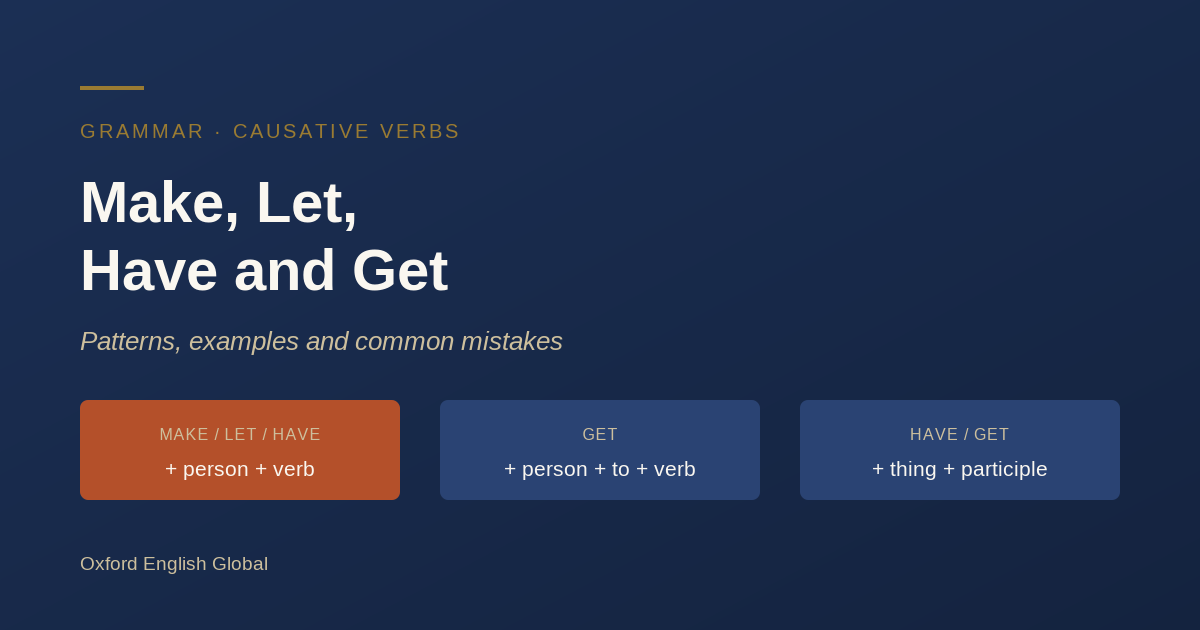
The causative verbs make, let, have and get describe how one person causes another person to do something. Use make + person + base verb for force or obligation (She made me wait), let + person + base verb for permission (They let us leave early), have + person + base verb for asking someone to do a task (I'll have my assistant call you) and get + person + to + verb for persuading (I got my brother to help me). Have and get also have a passive-style pattern, have/get + thing + past participle, for services someone does for you: I had my hair cut, We're getting the car repaired. The most common learner mistakes are adding to after make, let and have (made me to wait instead of made me wait) and forgetting it after get. This guide explains each pattern with clear examples, tables, common mistakes and a practice exercise.
Sources. The patterns on this page follow the Cambridge Dictionary grammar guide to have something done, read 28 November 2026, which explains that we use have + object + -ed form "when we talk about someone doing something for us which we ask or instruct them to do", and the dictionary entries for make and let. The example sentences are our own.
What causative verbs are
A causative verb shows that the subject does not do the action itself, but causes, allows or arranges for someone else to do it. Compare:
- I cleaned the windows. (I did it myself.)
- I had the windows cleaned. (I paid or asked someone to do it.)
- I made my son clean the windows. (I forced him.)
- I let my son clean the windows. (He wanted to, and I allowed it.)
- I got my son to clean the windows. (I persuaded him.)
Each verb adds a different meaning: force, permission, arrangement or persuasion. Choosing the right one changes how polite or how strong your sentence sounds.
The four causative verbs at a glance
| Verb | Pattern | Meaning | Example |
|---|---|---|---|
| make | make + person + base verb | force or strongly cause | My boss made me redo the report. |
| let | let + person + base verb | allow, give permission | My parents let me stay out late. |
| have | have + person + base verb | ask or instruct someone (often their job) | I'll have the receptionist book a taxi. |
| get | get + person + to + verb | persuade or convince | I finally got him to see a doctor. |
| have | have + thing + past participle | arrange a service | I'm having my eyes tested tomorrow. |
| get | get + thing + past participle | arrange a service (more informal); finish a task | We need to get the boiler fixed. |
The key grammar point: make, let and have take the base verb without to; get takes to + verb.
Make: force, obligation and strong causes
Pattern: make + person/thing + base verb
Make means that someone causes another person to do something, often when that person does not want to. It can also describe something that causes a feeling or reaction.
- The teacher made us rewrite the essay. (obligation)
- Don't make me laugh, I'm trying to concentrate. (cause a reaction)
- That film made me cry. (cause a feeling)
- What makes you think that? (very common question)
Make in the passive: add to
This is a common surprise for learners. In the active, make takes no to. In the passive, it does:
| Active | Passive |
|---|---|
| They made him sign the contract. | He was made to sign the contract. |
| The manager made us work late. | We were made to work late. |
For more on passive forms, see our guide to the passive voice in English.
Make + adjective
Make also combines with adjectives: The news made her happy. This noise is making me crazy. This is not strictly the causative verb pattern, but it follows the same idea of causing a change.
Let: permission
Pattern: let + person + base verb
Let means allow. The person wants to do something, and the subject gives permission or does not stop them.
- My landlord lets me keep a cat.
- Let me help you with that bag. (polite offer)
- Please let me know if you have any questions. (very common in emails)
- They didn't let us take photos inside the museum.
Let has no passive
Let is not normally used in the passive. Use be allowed to instead:
- Active: They let us leave early.
- Passive meaning: We were allowed to leave early. (not We were let leave early.)
Let vs allow vs permit
| Verb | Pattern | Formality | Example |
|---|---|---|---|
| let | let + person + base verb | neutral, very common in speech | Let me explain. |
| allow | allow + person + to + verb | neutral to formal | The rules allow students to retake the test. |
| permit | permit + person + to + verb | formal, often in rules and signs | Visitors are not permitted to smoke. |
Have someone do something: asking someone to do a task
Pattern: have + person + base verb
This use of have means you ask or instruct someone to do something, usually because it is their job or you have authority. It is common in work, hotels, shops and services, and is more common in American English than British English.
- I'll have my assistant send you the details.
- The doctor had the nurse take my blood pressure.
- Could you have someone check the air conditioning in my room?
Unlike make, have does not suggest the person is unwilling. It simply means you arranged it.
Have something done: services
Pattern: have + thing + past participle
This is the most useful causative pattern in everyday life. We use it when someone else does a job for us, usually because we pay them. The focus is on the thing and the result, not on who did the work.
- I had my hair cut on Saturday. (A hairdresser cut it.)
- We're having the kitchen painted next week.
- You should have your eyes tested every two years.
- Where do you have your car serviced?
Have something done in different tenses
Only have changes; the past participle stays the same.
| Tense | Example |
|---|---|
| Present simple | I have my car washed every month. |
| Present continuous | I'm having my car washed right now. |
| Past simple | I had my car washed yesterday. |
| Present perfect | I've just had my car washed. |
| Future (going to) | I'm going to have my car washed tomorrow. |
| Modal | You should have your car washed. |
When something bad happens to you
The same pattern can describe something unpleasant that happened to you, without you arranging it:
- She had her phone stolen on the train.
- He had his flight cancelled at the last minute.
The meaning comes from context: nobody pays to have their phone stolen.
Get: persuading, and getting things done
Get someone to do something
Pattern: get + person + to + verb
Get suggests effort: you persuade, convince or encourage someone to do something.
- I got my sister to lend me her car.
- Can you get the kids to tidy their rooms?
- It took weeks, but we finally got the company to give us a refund.
Get something done
Pattern: get + thing + past participle
This means the same as have something done but is more informal and very common in spoken British and American English. It can also suggest effort or urgency.
- I need to get my passport renewed before the summer.
- We got the house cleaned before the guests arrived.
- Let's get this finished today. (finish a task yourself)
Make, let, have or get? Choosing the right verb
Look at the same situation with each verb. The grammar is almost the same, but the meaning changes completely.
| Sentence | What it tells you |
|---|---|
| My manager made me work on Saturday. | I didn't want to; I had no choice. |
| My manager let me work on Saturday. | I wanted to (perhaps for extra pay), and she agreed. |
| My manager had me work on Saturday. | She arranged it as part of my job; neutral. |
| My manager got me to work on Saturday. | She persuaded me; I agreed in the end. |
In polite requests at work, avoid make, which can sound forceful. Could you have someone look at this? or Would you let me know? sounds much more professional. Our guide to writing work emails in English has more polite request patterns.
Common learner mistakes
| Incorrect | Correct | Why |
|---|---|---|
| She made me to apologise. | She made me apologise. | No to after active make. |
| Let me to explain. | Let me explain. | No to after let. |
| I got him help me. | I got him to help me. | Get + person needs to. |
| I cut my hair at the hairdresser's. | I had my hair cut at the hairdresser's. | You didn't do it yourself. |
| I had cut my hair. | I had my hair cut. | Word order: object before the participle. I had cut my hair is past perfect and means you cut it yourself. |
| We were let leave early. | We were allowed to leave early. | Let has no passive. |
| He was made sign it. | He was made to sign it. | Passive make needs to. |
Many of these errors come from mixing up verbs followed by to + infinitive and verbs followed by the base form. Our guide to gerunds and infinitives explains the wider pattern, and our list of common English grammar mistakes covers other frequent errors.
Practice exercise with answers
Complete each sentence with the correct form of make, let, have or get, and the verb in brackets.
- My parents never ______ me ______ (watch) TV on school nights.
- I'm going to ______ my suit ______ (clean) before the wedding.
- The film was so sad it ______ everyone ______ (cry).
- How did you ______ your brother ______ (agree) to that?
- Please ______ me ______ (know) if you need anything else.
- She ______ her bag ______ (steal) at the airport last year.
- I'll ______ my secretary ______ (call) you this afternoon.
- We were ______ ______ (wait) for two hours at the border.
- We need to ______ the roof ______ (repair) before winter.
- Students are not ______ ______ (use) phones during the exam.
Answers
- let … watch
- have … cleaned (or get … cleaned)
- made … cry
- get … to agree
- let … know
- had … stolen
- have … call
- made to wait
- get … repaired (or have … repaired)
- allowed to use (let has no passive)
Speaking practice
Answer these questions aloud using a causative verb:
- What did your parents make you do when you were a child?
- What did they let you do that your friends couldn't?
- What do you usually have done rather than doing it yourself?
- Who is easy to get to help you, and who is difficult?
How to remember the patterns
- Remember "M-L-H: no to". Make, let and have + person + base verb. Get is the odd one out with to.
- Learn one fixed phrase for each. Make me laugh, let me know, have my hair cut, get it done.
- Talk about your week. Each Sunday, say three things you had done or got done (a haircut, a repair, a delivery).
- Notice them in emails. Let me know, I'll have someone contact you and We'll get this sorted are everywhere in professional writing.
For more grammar practice, try our free lessons, or see our complete guide to English tenses to use causatives in every tense with confidence.
What this article cannot tell you
- Every causative verb. Verbs such as help, cause, force, persuade and require also describe causing actions, with their own patterns. We focus on the four core verbs.
- All regional differences. Have someone do something is more common in American English; British speakers often prefer get someone to do something or ask someone to. Both are correct.
- Tone in every situation. Whether make sounds rude or get sounds too informal depends on context and relationship. When in doubt at work, use a polite request instead.
This page is independent guidance from Oxford English Global. It contains no affiliate links. For structured grammar practice with a teacher, see our General English courses.
Frequently asked questions
What are the causative verbs in English?
The four main causative verbs are make (force), let (permission), have (arrange or instruct) and get (persuade). They show that the subject causes someone else to do the action.
Is it make someone do or make someone to do?
Make someone do, without to: She made me wait. In the passive, to is needed: I was made to wait.
What is the difference between have something done and get something done?
Both mean someone else does a job for you, usually a service: I had my hair cut, I got my hair cut. Get is more informal and can suggest more effort or urgency.
Why does get need to but make, let and have do not?
It is a fixed pattern of the verbs. Get + person takes to + verb (I got him to help), while make, let and have + person take the base verb (I made him help, I let him help, I had him help).
Can let be used in the passive?
Not normally. Use be allowed to instead: We were allowed to leave early, not We were let leave early.