
The Complete Business English Handbook (Free PDF Download)
A practical 99-page guide to the English the workplace actually requires — vocabulary, sentence structures and phrasal verbs put to work in real emails, meetings, presentations and negotiations — free to download as a PDF, and built to be used, not just saved.
 By Marco Ruiz
The meeting that decides next year's budget, the email that wins the client, the interview that changes a career — at some point in a modern career, all three happen in English. Yet most of us were never taught the English that work actually requires. School taught textbook English; the office runs on something else. The Complete Business English Handbook closes that gap, and you can download the full book as a free PDF below. It is a practical guide for professionals — the language of the modern workplace, from the first email to closing the deal.
This page tells you exactly what is inside, who the handbook is for, and — just as importantly — how to use a business English PDF so it actually changes the emails you send and the meetings you run, rather than sitting unread in your downloads folder.
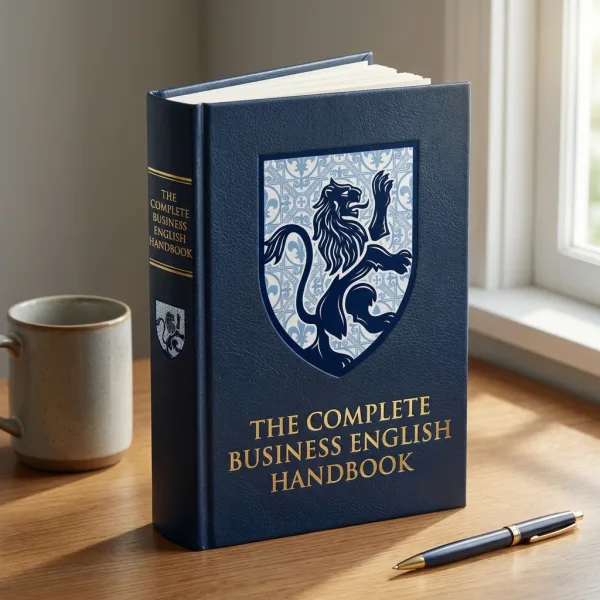
The Complete Business English Handbook
↓ Download the free PDFNo email required. Free for personal study and classroom use.
- A 99-page practical guide to the English of the international workplace (CEFR B1–C2).
- The building blocks — business vocabulary, sentence structures and phrasal verbs — taught for use, not just recognition.
- The four situations work really runs on: emails, meetings, presentations and negotiation, each with the phrases professionals actually reach for.
- Notes on the British and American conventions where they differ, so you can pick one and stay consistent.
- Free to download for personal study and professional development.
What this book covers
The handbook is built around a simple idea: textbook English and business English are not the same thing. So instead of teaching grammar in the abstract, it teaches the language each workplace situation demands, and shows it in use. The example companies, names and figures are fictitious — invented to illustrate real language, not real deals. The major parts are:
- Business vocabulary — the words and word partnerships of the modern office, from reporting and finance to projects and clients, chosen for how often they actually come up.
- Sentence structures — the reusable frames that make professional English sound clear and measured rather than blunt or vague.
- Phrasal verbs — the ones that genuinely belong at work (follow up, roll out, scale back, touch base), with the register to know when to use them and when not to.
- Emails — openings, requests, chasing, apologising, and sign-offs that strike the right tone, plus the British–American differences in greetings and dates.
- Meetings, presentations and negotiation — the phrases to open and chair a meeting, signpost a presentation, handle questions, and move a negotiation forward to a close.
Crucially, the first three parts and the last four are not separate courses. The vocabulary, sentence structures and phrasal verbs are the raw material; the emails, meetings, presentations and negotiation chapters are where you see that material assembled into the things you actually have to produce. A phrasal verb learnt in isolation is a flashcard; the same phrasal verb shown inside a polite chasing email is a tool you can use on Monday morning.
Because the language is always shown in context — a real email, a line you would actually say in a meeting — the book works equally well read front to back or kept open as a reference the next time you have to write something that matters.
Who it's for
The handbook is written for working professionals who can already get by in English but want to operate in it. It runs from B1 to C2, which covers a wide span. If you are around B1–B2 — you can hold a conversation but freeze when a difficult email or a meeting lands — start with the vocabulary and the emails chapters and build from there; those two alone will change how you come across at work. If you are C1–C2, you do not need the basics, but the negotiation language, the register notes, and the British–American distinctions are exactly the kind of detail that separates fluent from genuinely polished.
It also suits anyone preparing for a specific moment: a job interview in English, a first week at an international company, a presentation to a client, or a salary conversation. Use the contents list to jump straight to the situation in front of you rather than reading in order.
How to use a business English PDF so it works
Here is the honest part. A business English PDF is a brilliant reference and a poor teacher — if you only read it. Reading a model email is not the same as writing one under deadline, and recognising a negotiation phrase is not the same as producing it when the other side pushes back. The book gives you the language; you have to put it to work.
Nobody at work cares whether you can name the right phrase. They care whether you can use it — in the email that goes out today, in the meeting that starts in ten minutes.
So use it actively. When you read the emails chapter, rewrite a real email you sent last week using the structures shown, and notice what changed. Before a meeting, pick three phrases and say them out loud until they feel like yours, not the book's. After the negotiation section, script your own opening line for a conversation you are genuinely about to have. The language only becomes yours when you produce it about your own work, under something like real pressure. We expand on this method in our guide to learning from English PDFs the right way.
Professionals who come to us are rarely short of business vocabulary — they can recognise the right words on the page. What they often cannot do yet is reach for them live: the email gets written in cautious, over-formal English, or the meeting phrase arrives a beat too late. The shift happens fastest when they stop studying business English and start drafting their own real emails and rehearsing their own meeting lines, then getting those corrected.
Based on instructor intake notes. Directional observation, not a controlled study.
What makes this handbook different
Most business English material teaches either grammar with a corporate coat of paint or lists of jargon with no sense of when to use them. This handbook does neither. It starts from the situations that actually decide outcomes at work — the email, the meeting, the presentation, the negotiation — and gives you the precise language each one needs, complete with the tone and register that make the difference between sounding capable and sounding clumsy. It treats English as the working language of international business, because that is what it has become, and it is honest about where British and American conventions part ways — in spelling, in date formats, and in the everyday phrasing of emails and meetings — so you are never caught out. The aim throughout is not to make you sound more native, but to make you sound more effective: clear, appropriate, and in control of the impression you make.
Pair it with these free PDFs
Business English sits on top of two things: confident delivery and natural word choice. Three other free books in our library round out the picture:
- Writing a strong email is one skill; standing up and holding a room is another — Command the Room handles the presentations-and-public-speaking side of professional English.
- The vocabulary chapter gets you started, but word partnerships are what make English sound native rather than merely correct — English Collocations in Use is the natural next step.
- Want the mindset behind self-directed learning that actually sticks? The $20,000 English Teacher is about getting expert-level results without the expert-level fee.
All three sit in the same free library — see the full set on our free English learning PDFs page.
Download The Complete Business English Handbook
Grab the PDF, read the emails chapter, and rewrite one real message before you close it. That single habit will do more for your professional English than another evening of reading vocabulary lists.
The Complete Business English Handbook
↓ Download the free PDFNo email required. Free for personal study and classroom use.
Want the phrases explained and the emails you actually write corrected? Our free English track adds the one thing a PDF cannot — feedback on the English you really produce at work.
Prefer an app to a book? See our pick for The best language learning app 2026.
Frequently asked questions
Is The Complete Business English Handbook really free to download?
Yes. The full 99-page PDF is free to download from this page, with no email sign-up and no paywall. It was written and produced by Oxford English Global, and you are free to use it for personal study and professional development.
What level is this business English book for?
It runs from CEFR B1 to C2, so it suits anyone from a confident intermediate professional to a fluent speaker polishing the finer points. If you can already hold a workplace conversation but freeze when writing a difficult email or chairing a meeting, this is pitched at you.
Does it cover British and American business conventions?
Yes. It describes the language of the international workplace and notes the major British–American differences where they matter — in spelling, date formats, and the phrases used in emails, meetings and negotiation — so you can choose one set of conventions and stay consistent.
Can I learn business English from a PDF alone?
A PDF is an excellent reference but cannot react to the email you actually send or the meeting you actually chair. Use it actively — draft real emails, rehearse your phrases out loud, and self-test — and pair it with a source of feedback. Our free English track is built to add exactly that correction layer.