
UK Settlement English Requirement: B2 (A Level Standard) From 26 March 2027
The UK's earned settlement plan makes English at an A Level standard (CEFR B2) a non-negotiable condition for indefinite leave to remain. Here is what B2 means, the key dates, who is exempt, which tests count today, and a realistic plan for getting from B1 to B2.

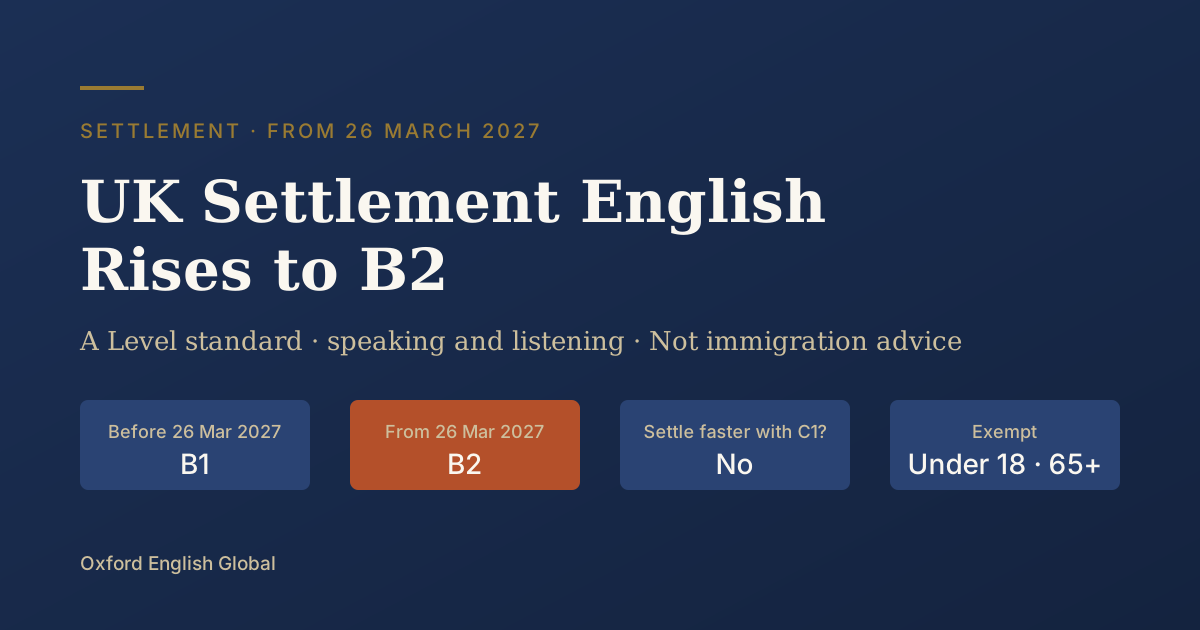
Under the UK's earned settlement reforms, most people applying for settlement (indefinite leave to remain) will need English at CEFR level B2, which the government describes as equivalent to A Level English as a foreign language. The rule change behind it, laid before Parliament on 5 March 2026 in statement of changes HC 1691, comes into force on 26 March 2027. Until then the settlement standard stays at B1, the GCSE-equivalent level. From 26 March 2027 the Immigration Rules require a pass in an approved speaking and listening test at B2 or above, taken no more than two years before you apply, unless you are exempt or can use a degree or an earlier B2 qualification instead. On 2 November 2026 the Home Secretary confirmed this "high standard" of spoken English as one of four non-negotiable conditions for settlement. This guide explains what the requirement means, who it applies to, the key dates, and a realistic plan for reaching B2 before you apply.
Checked on 10 November 2026. This page is based on official UK government sources only: the Home Office news story Home Secretary unveils new rules for migrants settling in the UK (2 November 2026), the government response A Fairer Pathway to Settlement (CP 1707, November 2026), the news story Higher standard of English now required to settle in the UK (5 March 2026), the explanatory memorandum to HC 1691 and Immigration Rules Appendix KoLL. Immigration rules change often. Oxford English Global is an English school, not an immigration adviser: confirm the rules on GOV.UK and take regulated advice for your own case.
What the earned settlement plan says about English
On 2 November 2026 the Home Office set out its earned settlement model before Parliament. The headline change is that settlement will no longer come almost automatically after five years. How long you wait will depend on your contribution: the highest earners could settle within 3 years, people earning more than £50,271 and some public service workers (such as doctors, nurses and teachers) after 5 years, and others at a new default of 10 years. People who have breached immigration rules would wait at least 20 years.
Whatever the waiting period, the government says every applicant must first meet four "non-negotiable" conditions:
- a clean criminal record;
- English spoken to a high standard, described as "equivalent to A-Level English as a foreign language";
- no debt owed to the taxpayer;
- a record of sustained National Insurance contributions.
The government response to the consultation (CP 1707) gives the detail on English. It says that under the current rules applicants "generally need to meet B1 level (equivalent of GCSE in a foreign language)", and that under earned settlement "B2 will be the standard English-language requirement for settlement". It also confirms that a higher level does not help you settle faster: "C1 English will not provide a further reduction in the qualifying period for applicants."
In other words, for the English part the target is fixed and clear. Everyone in scope needs B2. Reaching C1 is good for your career, but it will not shorten your route to settlement.
Key dates and timeline
The English change was announced before the wider earned settlement package and has its own start date. The government gave a full year's notice so that people already in the UK have time to prepare.
| Date | What happened | Source |
|---|---|---|
| 8 January 2026 | Skilled Worker, Scale-up and High Potential Individual visas move to B2 English for most new applicants | GOV.UK route pages |
| 5 March 2026 | Statement of changes HC 1691 laid, raising the settlement English level from B1 to B2 | HC 1691 explanatory memorandum |
| 2 November 2026 | Earned settlement model set out; B2 English confirmed as a mandatory condition | Home Office news; CP 1707 |
| 26 March 2027 | Settlement applications made on or after this date must meet B2 (unless exempt) | HC 1691 explanatory memorandum, para 5.62; Appendix KoLL |
Source: HC 1691 explanatory memorandum, which states: "These changes will come into force on 26 March 2027. The changes will therefore apply to those already on a pathway to settlement in the UK." Read 10 November 2026.
The key point is the date of application, not the date you arrived. Appendix KoLL sets two versions of the rule side by side: B1 for applications made before 26 March 2027, and B2 for applications made on or after that date. If you are already in the UK and plan to apply after March 2027, B2 applies to you.
The explanatory memorandum lists the routes covered by the change. They include settlement under Appendix KoLL, Skilled Worker, Minister of Religion, Representative of an Overseas Business, UK Ancestry, Global Talent, Scale-up, Innovator Founder, International Sportsperson, Long Residence, Bereaved Partner, Private Life and Settlement Family Life. The new waiting periods under earned settlement are a separate part of the package; the news story of 2 November did not give a start date for them, so check GOV.UK for updates.
What B2 English means in practice
B2 is the fourth of six levels on the Common European Framework of Reference for Languages (CEFR), usually called "upper intermediate". The Council of Europe's global scale says a B2 user "can interact with a degree of fluency and spontaneity that makes regular interaction with native speakers quite possible without strain for either party", and can "explain a viewpoint on a topical issue giving the advantages and disadvantages of various options".
| Skill | At B1 (old settlement level) | At B2 (new settlement level) |
|---|---|---|
| Listening | Follows clear, standard speech on familiar topics | Follows extended speech and discussion at normal speed, including on less familiar topics |
| Speaking | Describes experiences and plans, gives short reasons | Takes an active part in discussion, argues a point, compares options |
| Typical example | Explains a problem to a GP receptionist | Discusses treatment options with a doctor, or a pay rise with a manager |
The settlement test checks speaking and listening. That is good news for many adults who have lived and worked in the UK for years: your listening is often already strong. The usual gap between B1 and B2 is in speaking: answering follow-up questions at length, giving reasons and examples, and talking about abstract topics, not only about yourself.
Not sure of your level? Our free English level test guide describes each CEFR level in can-do terms.
Who is affected and who is exempt
Appendix KoLL lists the ways to meet the English part of settlement. From 26 March 2027 you meet it if one of these applies:
- Nationality. You are a national of Antigua and Barbuda, Australia, the Bahamas, Barbados, Belize, the British Overseas Territories, Canada, Dominica, Grenada, Guyana, Jamaica, Malta, New Zealand, St Kitts and Nevis, St Lucia, St Vincent and the Grenadines, Trinidad and Tobago or the USA.
- A degree. You hold a UK bachelor's, master's or PhD, or an equivalent degree confirmed by the qualification and language assessment provider (Ecctis) as taught or researched in English.
- An earlier B2 qualification. Your current permission was granted because you had an English qualification at B2 or higher, and the provider is still approved.
- A test. You passed an approved Secure English Language Test (SELT) in speaking and listening at B2 or above, taken no more than two years before you apply.
Point 3 matters for many workers. If your Skilled Worker visa was granted on or after 8 January 2026 on the basis of a B2 test, KoLL lets that earlier B2 qualification count, as long as the provider is still approved. People who entered at B1 will usually need to prove B2 again.
The general exemptions stay the same. You do not need to meet the English requirement if you are under 18 or aged 65 or over at the date of application, or if the decision maker accepts that a physical or mental condition makes it unreasonable. The government response confirms these exemptions continue under earned settlement.
Do not forget the Life in the UK test. Settlement under Appendix KoLL needs both English and the Life in the UK test. The book and test are in English, so preparing for one helps with the other.
Which English tests count
For the test route, only tests on the Home Office list of approved SELTs count, taken at an approved centre. When we checked the official lists on 10 November 2026, the speaking and listening only tests (IELTS Life Skills, PTE Home, LanguageCert International ESOL SELT speaking and listening, Trinity GESE and Skills for English two-component tests) were listed only up to B1. Every test approved at B2 was a four-skill test:
| Test at B2 | Provider | Minimum in each skill | Where |
|---|---|---|---|
| IELTS for UKVI | IELTS SELT Consortium | 5.5 | UK and outside the UK |
| PTE Academic UKVI | Pearson | 59 | UK and outside the UK |
| LanguageCert Academic SELT / General SELT | LanguageCert | 60 | UK and outside the UK |
| LanguageCert International ESOL SELT B2 (4 skills) | LanguageCert | 33/50 | UK and outside the UK |
| Integrated Skills in English II (ISE II) | Trinity College London | Pass | UK only |
| Skills for English UKVI B2 (4 component) | PSI Services (UK) Ltd | Pass | Outside the UK only |
Source: Home Office lists of approved Secure English Language Tests taken in and outside the UK, linked from the UKVI SELT guidance (page last updated 2 November 2026), read 10 November 2026.
The Home Office may add B2 speaking and listening tests before March 2027, but at the time of writing it had not published any. Check the list again before you book. Our separate guide to approved UK SELT tests covers every level, how to book and the rules on test day.
How long it takes to get from B1 to B2
The Home Office itself estimates that "it takes an estimated 200 hours of learning to move between the two levels". That matches Cambridge English's guidance of roughly 200 guided learning hours per CEFR level. Guided hours mean structured study with a teacher or course, and they are averages.
| Study per week | Strong B1 (about 120 hours) | Typical B1 (about 200 hours) |
|---|---|---|
| 3 hours | About 10 months | About 15 months |
| 6 hours | About 5 months | About 8 months |
| 10 hours | About 3 months | About 5 months |
The months are our own arithmetic (hours divided by weekly study), not a promise. If you plan to apply soon after 26 March 2027, a working adult studying three to six hours a week should ideally start now. Leave extra weeks for booking a test and receiving the result, and remember that a SELT result is valid for two years.
How to prepare: a practical plan
The plan below focuses on speaking and listening, because those are the skills the settlement test checks. If you choose a four-skill test such as IELTS for UKVI, add reading and writing practice too.
- Find your starting point (week 1). Take a full practice test of the exact SELT you plan to sit. Note your speaking and listening scores separately. If you sit IELTS for UKVI, our IELTS score calculator converts practice section scores into bands.
- Listen to longer, faster English (daily). B2 listening means following discussions, not just announcements. Use radio phone-ins, podcasts and news discussions about UK life. Our guide on improving English listening has a step-by-step routine.
- Practise extended answers (daily, 15 minutes). B2 speakers can talk for a minute or more on one topic. Pick a question ("Should the UK have a four-day working week?"), speak for 90 seconds, and give an opinion, two reasons, an example and the other side.
- Record and review (twice a week). Listen back for long pauses, repeated words and very short answers. Our article on improving English speaking explains self-recording drills.
- Learn phrases for discussion. B2 speech uses linking language: "on the other hand", "the main reason is", "it depends on whether". Our guide to vocabulary in chunks shows how to learn them as whole phrases.
- Get feedback from a teacher. Self-study is useful, but a teacher spots the mistakes you cannot hear. Our English courses include exam preparation for adults, and the free lesson library has B1 and B2 practice.
- Book when your practice scores are clearly above the line. If you need 5.5 in IELTS for UKVI, aim for 6.0 or more in practice in every relevant skill.
What this article cannot tell you
- Your own eligibility. We cover the English part only. Settlement has other requirements, including residence, criminality, debt and National Insurance conditions, which we do not cover. Speak to a regulated immigration adviser for your case.
- When the new waiting periods start. The 2 November 2026 news story did not give a commencement date for the 3, 5, 10 and 20 year pathways. We only state the date confirmed for English: 26 March 2027.
- Future test lists. We could not find any official statement on whether new B2 speaking and listening tests will be added. The table above reflects the lists published on GOV.UK on 10 November 2026.
- Test prices. Fees vary by country and provider, so we have not listed them. Use the provider's official booking site.
- Exact study time for you. The 200-hour figure is an average. Your time depends on your starting level, study habits and feedback.
This page is independent guidance from Oxford English Global. It contains no affiliate links, and we receive nothing from any test provider or government body mentioned.
Frequently asked questions
When does the B2 English requirement for UK settlement start?
It applies to settlement applications made on or after 26 March 2027, according to the explanatory memorandum to statement of changes HC 1691 and Appendix KoLL. Applications made before that date still need B1 speaking and listening.
Is B2 English really the same as A Level?
The Home Office describes B2 as equivalent to A Level English as a foreign language, and B1 as equivalent to GCSE. B2 is the upper-intermediate level on the Common European Framework of Reference for Languages.
Will C1 English let me settle sooner?
No. The government response to the earned settlement consultation (CP 1707) says C1 English will not provide a further reduction in the qualifying period. B2 is the standard for everyone in scope.
Who does not need to meet the English requirement for settlement?
Under Appendix KoLL, applicants under 18 or aged 65 and over are exempt, as are people for whom a physical or mental condition makes it unreasonable. Nationals of listed majority English-speaking countries and holders of qualifying degrees taught in English also meet the requirement without a test.
How long does it take to go from B1 to B2?
The Home Office estimates about 200 hours of learning to move between the two levels, in line with Cambridge English guidance on guided learning hours. At six hours a week that is roughly eight months for a typical B1 learner.