
In, On and At: Prepositions of Time and Place With Rules, Examples and Exceptions
In, on and at are some of the most common words in English, and some of the most confusing. This guide explains the big-to-small rule for time and place, when to use no preposition, the fixed exceptions such as at night and on the bus, common mistakes and a practice exercise.

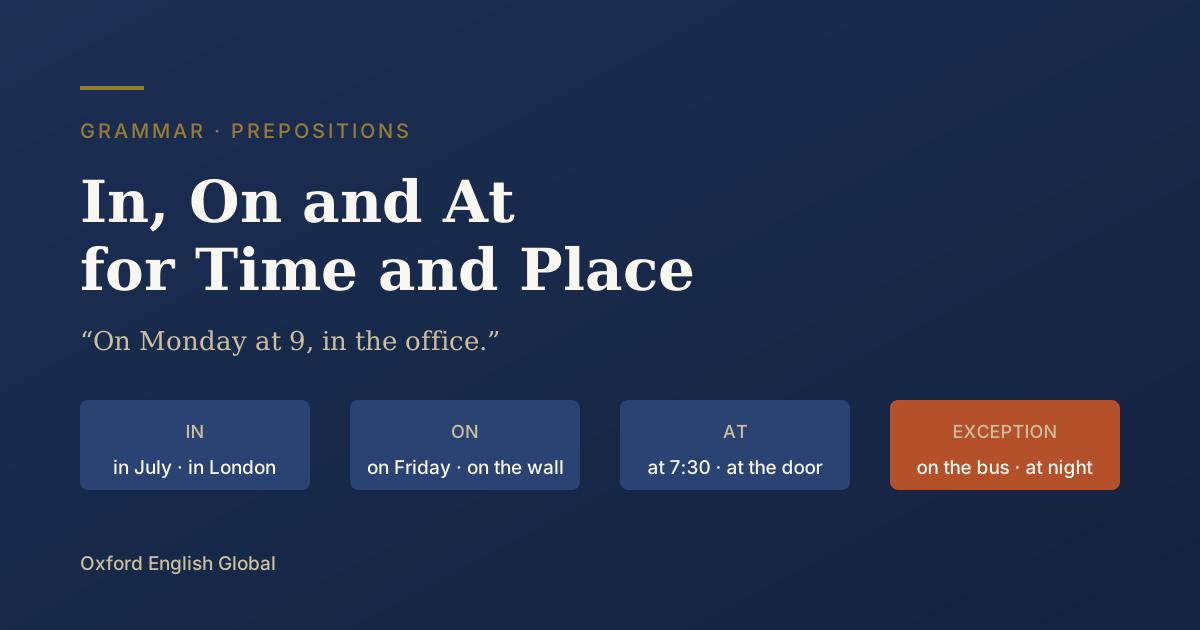
- In, on and at: the core idea
- In for time: months, years, seasons and long periods
- On for time: days and dates
- At for time: clock times and exact points
- When you use no preposition for time
- In for place: enclosed spaces and areas
- On for place: surfaces, lines and floors
- At for place: points, addresses and activities
- The address ladder: in, on, at
- The most useful exceptions and fixed phrases
- Common learner mistakes
- Practice: choose in, on or at
- How to learn prepositions so they stick
- What this article cannot tell you
The basic rule for in, on and at is to move from big to small. For time, use in for long periods (in July, in 2026, in the morning), on for days and dates (on Monday, on 14 November), and at for exact times and points (at 7 o'clock, at night). For place, use in for an enclosed space or area (in the room, in London), on for a surface or line (on the table, on the wall, on the main road), and at for a point or a place where an activity happens (at the bus stop, at work, at the cinema). There are also a number of fixed exceptions, such as at the weekend (British English), on the bus and in the car. This guide explains every rule with examples, lists the exceptions learners need most, and ends with a practice exercise.
The triangle rule: think of an upside-down triangle. IN is at the wide top (months, years, countries, cities), ON is in the middle (days, dates, streets, surfaces) and AT is the small point at the bottom (clock times, addresses, exact points).
In, on and at: the core idea
Prepositions are short words that show relationships of time and place. In, on and at are among the most common words in English, and they are hard for learners because many languages use a single preposition where English uses three, or divide the meanings differently. Reference grammars such as Cambridge Dictionary's pages on at, on and in for time and at, on and in for place describe the same core system used in this guide.
| Preposition | Core idea | Time examples | Place examples |
|---|---|---|---|
| in | Inside a period or space | in May, in 2026, in summer, in the evening | in the kitchen, in Spain, in a box, in the park |
| on | On a surface or a specific day | on Friday, on 3 March, on my birthday | on the table, on the wall, on the second floor |
| at | A point | at 6:30, at noon, at night, at the moment | at the door, at the station, at 12 Park Road |
In for time: months, years, seasons and long periods
Use in for periods longer than a day, and for parts of the day:
- Months: in January, in November
- Years and decades: in 1999, in 2026, in the 1980s
- Seasons: in spring, in (the) winter
- Centuries and long periods: in the 21st century, in the Middle Ages, in the past, in the future
- Parts of the day: in the morning, in the afternoon, in the evening
- Weeks: in the first week of July
In for "after a period of time"
In also means "at the end of a period from now": The train leaves in ten minutes. I'll be back in two weeks. Compare within, which means "before the end of": Reply within 24 hours.
On for time: days and dates
Use on for specific days and dates:
- Days of the week: on Monday, on Saturdays (= every Saturday)
- Dates: on 14 November, on the 1st of May, on May 1 (American style)
- Special days: on my birthday, on Christmas Day, on New Year's Eve, on our anniversary
- A day plus part of the day: on Monday morning, on Friday evening, on the morning of the 5th
Notice the last point: in the morning, but on Monday morning. When you name the day, the day "wins" and you use on.
At for time: clock times and exact points
Use at for precise times and for some fixed expressions:
- Clock times: at 9 o'clock, at 7:45, at half past six
- Times of day as points: at noon, at midday, at midnight, at sunrise, at sunset, at lunchtime, at dinner
- Night: at night (but in the night for one particular night: I woke up in the night.)
- Holiday periods: at Christmas, at Easter (the whole holiday period; compare on Christmas Day)
- Fixed phrases: at the moment, at present, at the same time, at the beginning / end of the month
At the weekend or on the weekend?
British English normally says at the weekend; American English normally says on the weekend. Both are correct in their variety. Choose one and use it consistently. Our guide to British vs American English lists other differences like this.
When you use no preposition for time
Do not use in, on or at before this, next, last, every, each, today, tomorrow, yesterday, tonight:
| Correct | Wrong |
|---|---|
| I'll see you next Monday. | I'll see you on next Monday. |
| We met last year. | We met in last year. |
| She runs every morning. | She runs in every morning. |
| Are you free this weekend? | Are you free at this weekend? |
| Call me tomorrow afternoon. | Call me in tomorrow afternoon. |
In for place: enclosed spaces and areas
Use in when something is inside a space with limits, whether it is small or very large:
- Rooms and buildings (inside): in the kitchen, in the office, in the shop
- Containers: in a box, in my bag, in the drawer, in a cup
- Cities, regions and countries: in Oxford, in Cape Town, in Texas, in Brazil
- Areas with boundaries: in the park, in the garden, in the sea, in the sky, in a queue / line
- Printed and written texts: in a book, in the newspaper, in a photo, in an email
- Cars and taxis: in the car, in a taxi
On for place: surfaces, lines and floors
Use on when something touches a surface or is positioned along a line:
- Surfaces: on the table, on the floor, on the wall, on the ceiling, on my shirt
- Floors of a building: on the ground floor, on the third floor
- Lines (roads, rivers, coasts): on the main road, on the River Thames, on the coast, on the border
- Streets (British usage): on Oxford Street is common, and in Oxford Street is also used in British English. American English uses on: on Fifth Avenue.
- Screens and media: on the screen, on the website, on TV, on the radio, on page 12
- Large public transport and bikes: on the bus, on the train, on a plane, on a ship, on a bike, on a horse
- Sides: on the left, on the right
In the car but on the bus
A common way to remember this: you can stand up and walk around on a bus, train or plane, but you sit in a car or a taxi. For bikes and horses, you sit on top, so it is on.
At for place: points, addresses and activities
Use at when you think of a place as a point, or as a place where an activity happens:
- Points: at the door, at the bus stop, at the traffic lights, at the corner, at the top / bottom of the page
- Exact addresses: at 12 Park Road (compare on Park Road and in London)
- Places for an activity or event: at the cinema, at the doctor's, at the airport, at a party, at a meeting, at a concert
- Institutions and routines: at work, at school, at university, at home
- Someone's house or business: at Maria's, at the dentist's
At the station or in the station?
Both are possible, with different meanings. I'm at the station is the normal way to say where you are (the station as a meeting point). I'm in the station emphasises that you are inside the building: It's raining, so I'll wait in the station.
The same contrast works for many places: She's at the hospital (visiting or working there) and She's in hospital (British English: she is a patient; American English: in the hospital).
The address ladder: in, on, at
An address shows the big-to-small system very clearly:
| Level | Preposition | Example |
|---|---|---|
| Country | in | She lives in the UK. |
| City | in | She lives in Oxford. |
| Street | on (or in, British) | She lives on High Street. |
| Exact address | at | She lives at 25 High Street. |
| Floor | on | Her flat is on the second floor. |
| Room | in | She's in the kitchen. |
The most useful exceptions and fixed phrases
Some expressions do not follow the general rules, so they are best learned as fixed chunks:
| Phrase | Note |
|---|---|
| at night | But in the morning, in the afternoon, in the evening. |
| at the weekend (UK) / on the weekend (US) | Both correct in their variety. |
| at Christmas vs on Christmas Day | Holiday period vs the specific day. |
| in time vs on time | On time = punctual (The train left on time). In time = early enough (We arrived in time to see the start). |
| in the end vs at the end | In the end = finally (In the end, we stayed home). At the end of = at the final point of something (at the end of the film). |
| on the bus / train / plane vs in the car / taxi | See the explanation above. |
| in bed, in hospital, in prison (UK) | No article in British English when talking about the usual purpose. |
| on holiday (UK) / on vacation (US) | Not in holiday. |
| on foot | But by car, by bus, by train. |
| in the photo / picture | Not on the photo, a common error for some European learners. |
| arrive in (city, country) / arrive at (building, point) | Never arrive to: We arrived in Rome. We arrived at the hotel. |
Many of these are listed among the most common English grammar mistakes. For more fixed word combinations, see our guide to learning vocabulary in chunks.
Common learner mistakes
- I was born in 14 March. Fix: I was born on 14 March. (date)
- See you on Monday morning is correct; See you in Monday morning is wrong.
- The meeting is on 3 pm. Fix: The meeting is at 3 pm.
- I'll call you in next week. Fix: I'll call you next week.
- I live at London. Fix: I live in London.
- I'm in the bus. Fix: I'm on the bus.
- There's a picture in the wall. Fix: There's a picture on the wall.
- We arrived to the airport. Fix: We arrived at the airport.
- I'll meet you in the bus stop. Fix: I'll meet you at the bus stop.
- I work in night. Fix: I work at night.
Practice: choose in, on or at
Fill each gap with in, on, at or nothing (–). Answers are below.
- The shop opens ___ 9:30.
- My sister was born ___ 1998.
- We're having a party ___ Saturday evening.
- I'll see you ___ next Friday.
- Our office is ___ the fifth floor.
- He's waiting for you ___ the front door.
- They live ___ a small village ___ Portugal.
- Please write your name ___ the top of the page.
- I always feel tired ___ the afternoon.
- She read about it ___ the newspaper.
- Don't use your phone ___ the plane.
- The film starts ___ ten minutes.
Answers
1 at. 2 in. 3 on. 4 – (no preposition). 5 on. 6 at. 7 in, in. 8 at. 9 in. 10 in. 11 on. 12 in.
How to learn prepositions so they stick
- Learn them with their nouns. Do not memorise on on its own; memorise on Monday, on the bus, on the wall. Chunks are easier to recall in conversation.
- Describe your week out loud. On Monday I work from home. At 8 I take the kids to school. In the evening I go to the gym. This combines all three time prepositions in a natural way.
- Describe a room. Look around and say where things are: The lamp is on the desk. My keys are in my bag. Someone is at the door.
- Notice them while reading. When you read an article, underline every in, on and at and ask why the writer chose it. Our guide to learning vocabulary through reading explains how to read actively.
- Practise with feedback. Preposition errors rarely stop communication, so people often don't correct them. A teacher can. Try our free lessons, the Word Runner game or our courses.
What this article cannot tell you
- Every use of in, on and at. These words have many other meanings (in love, on purpose, at risk, good at maths) that follow no simple rule. This guide covers time and place only.
- A rule for every exception. Some uses are simply conventional. The triangle rule explains most cases, but not all; fixed phrases have to be learned one by one.
- Regional preferences in detail. British, American, Australian and other varieties differ in some cases (at / on the weekend, in / on a street, in hospital / in the hospital). We note the main differences only.
- Your level. Basic time and place prepositions are usually taught at CEFR A1–A2, and fixed phrases such as in time / on time around B1. Check your level with our English level test.
This page is independent guidance from Oxford English Global. It contains no affiliate or sponsored links.
Frequently asked questions
What is the rule for in, on and at for time?
Use in for long periods such as months, years, seasons and parts of the day, on for days and dates, and at for clock times and exact points such as at noon and at night.
What is the rule for in, on and at for place?
Use in for enclosed spaces and areas such as rooms, cities and countries, on for surfaces and lines such as tables, walls, floors and roads, and at for points and places where an activity happens, such as at the bus stop or at work.
Is it at the weekend or on the weekend?
At the weekend is British English and on the weekend is American English. Both are correct in their own variety.
Why do we say in the car but on the bus?
By convention, in is used for small vehicles you sit inside, such as cars and taxis, and on for larger public transport you can walk around in, such as buses, trains and planes, and for bikes.
When do I use no preposition before a time word?
Do not use in, on or at before this, next, last, every, today, tomorrow, yesterday or tonight. Say next Monday, not on next Monday.