
Ofqual Fines Cambridge English £875,000 Over IELTS Marking Errors: What Test Takers Should Know
Ofqual fined Cambridge English £875,000 after automated marking errors in IELTS Listening and Reading issued incorrect results between August 2023 and September 2025. Here are the verified numbers, who was affected, what Cambridge did, and what to do if you doubt an IELTS score.

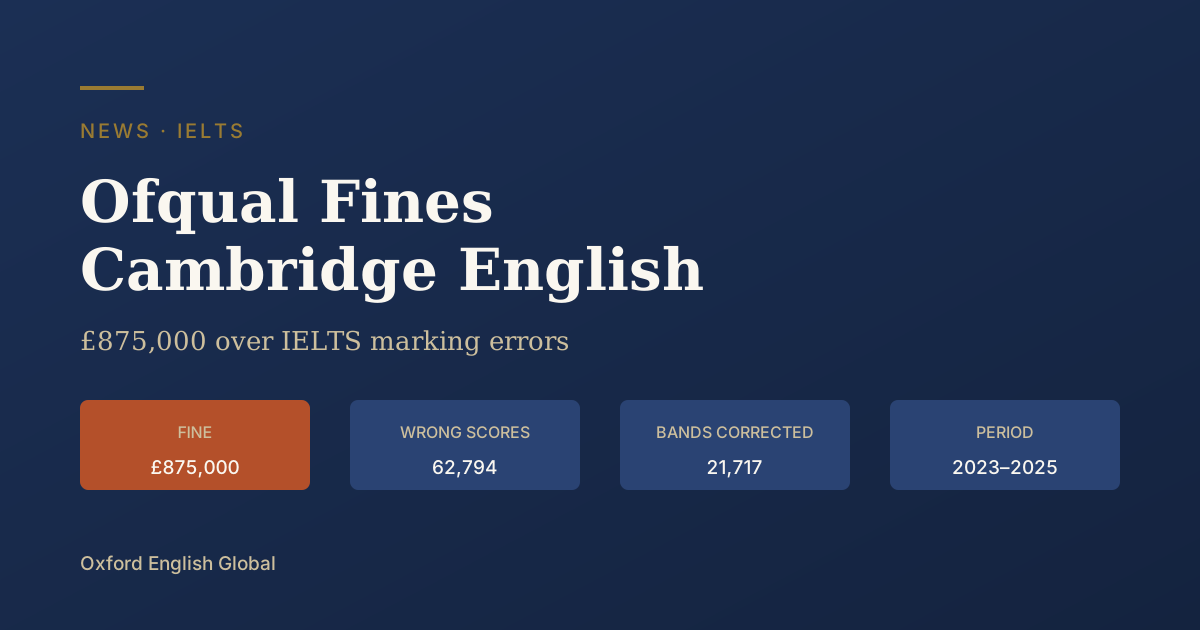
Ofqual, the regulator of qualifications in England, fined Cambridge English £875,000 on 11 June 2026 after computer marking errors in the IELTS Listening and Reading sections gave incorrect results to tens of thousands of test takers between August 2023 and September 2025. According to Ofqual, 62,794 people received incorrect Listening or Reading scores that were later corrected, and 21,717 of them had their overall IELTS band changed, almost always upward and usually by half a band. This article explains what went wrong, who was affected, what Cambridge did to fix it, and what you can do today if you doubt an IELTS score.
Sources and date. Checked on 21 November 2026. All figures about the fine and the errors come from Ofqual's press release "Ofqual fines Cambridge English £875,000 after incorrect results for global English language tests" (published 11 June 2026) and the linked notice of financial penalty. Re-mark rules come from the British Council's IELTS re-mark page, read today.
What happened, in one paragraph
On computer-delivered IELTS, the Listening and Reading answers are marked automatically. Ofqual explains that the system marked words typed into gaps in sentences against "predefined answers set by human subject experts", with "no machine learning or adaptive behaviour". Over roughly two years, that system marked some responses incorrectly. Cambridge English did not detect the failures until September 2025, during an update to its error-monitoring system, and then notified Ofqual. Ofqual's enforcement panel concluded that the case showed "weaknesses in Cambridge English's approach to automated marking systems, involving inadequate monitoring and error-detection mechanisms" and imposed a fine of £875,000.
Timeline of the case
| Date | Event (as reported by Ofqual) |
|---|---|
| August 2023 | Start of the period in which the auto-marking errors affected results |
| September 2025 | Cambridge English detects the failures during an update to its error-monitoring system and notifies Ofqual |
| After detection | Incorrect Listening and Reading results are corrected; Cambridge sets up a 24/7 support hub and pays compensation |
| 11 June 2026 | Ofqual announces the £875,000 fine and publishes its notice of financial penalty |
How IELTS Listening and Reading are marked
To understand the error, it helps to know how the two sections are scored. IELTS Listening and Reading each contain 40 questions. Many questions ask you to complete a sentence, note or table by typing a word or number into a gap. On the computer-delivered test, your typed answers are checked against an answer key: a list of acceptable answers written in advance by human experts. Your number of correct answers, called the raw score, is then converted into a band from 0 to 9. Our free IELTS score calculator shows how raw scores turn into bands.
This kind of marking looks simple, but gap-fill answers can vary: spelling, plural forms, hyphens, numbers written as words or digits. If the system treats a correct variation as wrong, or a wrong one as correct, raw scores shift. Ofqual's press release does not say which kinds of answers were mismarked, so these are illustrations of the risk, not the confirmed cause. Because one or two raw points can move a band by half a point, a small marking fault can change a section band, and sometimes the overall result. Ofqual's figures match this picture: corrections to overall results were almost always exactly 0.5 band.
Ofqual's notes stress that this was rule-based checking, not artificial intelligence. The failure was in how the answer rules were applied and monitored, not in an AI model making judgements.
The key numbers
| Measure | Figure (Ofqual, 11 June 2026) |
|---|---|
| Period affected | August 2023 to September 2025 |
| Tests taken in that period | 7.7 million |
| Responses marked incorrectly by the system | 93,865 |
| Test takers issued incorrect Listening or Reading results (later corrected) | 62,794 |
| Test takers whose overall IELTS band was corrected | 21,717 |
| Overall results lowered because they had been inflated | 1,115 |
| Size of corrections to overall bands | 0.5 band up or down, except 2 cases corrected up by 1 band |
| Affected candidates who had taken the IELTS SELT (UK visa) version | 1,108 |
| Fine | £875,000 |
| Cambridge's spending on corrections, compensation and prevention | Over £6 million |
Put in proportion: the 21,717 corrected overall bands equal about 0.3% of the 7.7 million tests taken in the period, and the 62,794 people with incorrect section scores about 0.8%. Those are our calculations from Ofqual's figures. Small percentages still mean a large number of people, many of whom were using their results for university, work or visa decisions.
Who was affected
Ofqual describes the affected people as candidates who took IELTS "globally" and whose computer-delivered Listening and Reading sections were auto-marked. Important points from the press release:
- In a third of the wrongly marked cases, the errors made no difference to the component or overall result.
- Most corrections went up. "The vast majority" of the 21,717 people whose overall result changed had their initial overall band increased.
- Some results went down. 1,115 people were found to have received inflated overall results, which were lowered.
- Some UK visa test takers were included. 1,108 affected candidates had taken the Secure English Language Test (SELT) version of IELTS used for UK visa applications. Ofqual notes that this figure "does not confirm whether the qualification was used in a visa application".
Writing and Speaking were not part of the automated-marking problem described by Ofqual: those sections are assessed by trained examiners. Ofqual's release also does not mention paper-based tests.
Who is "Cambridge English"? Cambridge English, part of Cambridge University Press & Assessment, is one of the organisations behind IELTS, alongside the British Council and IDP. Ofqual regulates Cambridge English as an awarding organisation, which is why the fine came from the English regulator even though the tests were taken worldwide. Our article on who owns IELTS explains the partnership in more detail.
What Cambridge English did to fix it
Ofqual's enforcement panel took several mitigating factors into account when setting the fine. Cambridge English:
- accepted the breaches and entered into a settlement agreement;
- gave an undertaking to prevent the same errors in future;
- spent over £6 million on correcting its errors, compensation, a dedicated 24/7 customer support hub, and prevention measures.
Amanda Swann, Ofqual's Executive Director for Delivery, said: "Tens of thousands of people took these tests with the expectation of accurate results which influence important decisions. Those who took these tests, as well as those who used them, were let down by systemic failures over a long period and our significant fine reflects this."
What to do if you doubt an IELTS score
The marking errors in Ofqual's case have been corrected. If you took IELTS between August 2023 and September 2025 and are unsure whether your result was affected, contact the IELTS partner you booked with (the British Council or IDP) through its official website and keep a record of your correspondence.
For a current or recent test, the normal route is an Enquiry on Results (EOR), often called a re-mark. According to the British Council:
- Log in to the official Test Taker Portal, not a third-party service.
- Complete an EOR form within six weeks of your test date, including your results form.
- Choose which sections to re-mark. You can ask for any or all of Listening, Reading, Writing and Speaking.
- Pay the EOR fee. Fees vary by test centre, and the fee is refunded if your score increases in any section.
What happens next: Writing and Speaking are re-marked by "an independent senior marker"; for computer-delivered Listening and Reading, the British Council says "the system performs enhanced additional checks on the answers provided". Results can arrive the same day or up to 21 days after you apply. A re-mark does not guarantee a higher score, and no comments are provided.
Re-mark or retake?
| Situation | Better option |
|---|---|
| One section is far below your practice scores and your other sections | Consider an EOR for that section |
| You missed your target by half a band in Writing or Speaking | An EOR is possible, but a focused retake may be more reliable |
| Your scores match your practice tests | Retake after targeted preparation, or use the One Skill Retake if your organisation accepts it |
| The six-week window has passed | An EOR is no longer available; plan a retake |
Before deciding, estimate what your section scores mean for your overall band with our free IELTS score calculator. Our guide to IELTS fees by country helps you compare the cost of a retake.
What the case means for test takers
- Automated marking can fail quietly. The errors ran for about two years before detection. Keep copies of your results and practice scores so you can spot a result that looks very different.
- Regulation works, slowly. The case reached a public fine because Ofqual regulates the awarding body and publishes enforcement decisions. That is a useful check when you choose between tests.
- Your preparation is still what moves your score. In almost all corrected cases the change was half a band. Strong Listening and Reading skills give you a margin that small errors cannot remove. Our guides on improving your listening and learning vocabulary through reading are good places to start.
Ofqual's notes also stress that the marking system involved no AI learning. If you are curious how a different test uses AI in scoring, see our explainer on how the Duolingo English Test uses AI.
What this article cannot tell you
- Whether your own result was affected. Only the IELTS partner that issued your result can confirm that.
- Compensation details. Ofqual mentions compensation but does not set out who received it or how much.
- Visa consequences. Ofqual directs visa questions to UK Visas and Immigration. We do not know how individual visa decisions were affected.
- EOR fees in your country. Fees vary by test centre; check the official portal.
This page is independent reporting from Oxford English Global. We have no commercial relationship with Cambridge English, the British Council, IDP or Ofqual, and the page contains no affiliate links. If you are preparing for IELTS, see our English courses.
Frequently asked questions
Why did Ofqual fine Cambridge English?
Ofqual fined Cambridge English £875,000 on 11 June 2026 because computer automated marking errors in IELTS Listening and Reading led to incorrect results being issued to tens of thousands of candidates between August 2023 and September 2025.
How many IELTS test takers were affected?
According to Ofqual, 62,794 learners received incorrect Listening or Reading results that were later corrected, and 21,717 of them had their overall score corrected. Most overall results went up, while 1,115 inflated results were lowered.
Were Writing and Speaking affected?
Ofqual describes the problem as affecting the automatically marked on-screen Listening and Reading components. Writing and Speaking are assessed by trained examiners and were not part of the automated-marking failure described.
How do I ask for an IELTS re-mark?
Submit an Enquiry on Results through the official Test Taker Portal within six weeks of your test date, choose the sections to re-mark and pay the fee. The British Council says fees vary by test centre and are refunded if your score increases.
Was the IELTS marking system using AI?
No. Ofqual says the system was set by human subject experts and had no machine learning or adaptive behaviour. It compared words typed into gaps with predefined answers.