
How the Duolingo English Test Uses AI to Score Speaking and Writing, and How to Prepare
Does ChatGPT mark your Duolingo English Test? No. Based on the test maker's November 2026 explanation and its technical report, this guide explains what the AI scoring measures, where humans are involved, and how to prepare your speaking and writing with that in mind.

- The short answer: how AI scores the DET
- What "automated scoring" actually means
- What the writing score looks at
- What the speaking score looks at
- Where humans are involved
- Is AI scoring fair to different accents and first languages?
- Five myths about DET AI scoring
- How to prepare with AI scoring in mind
- How this compares with IELTS and TOEFL
- What this article cannot tell you
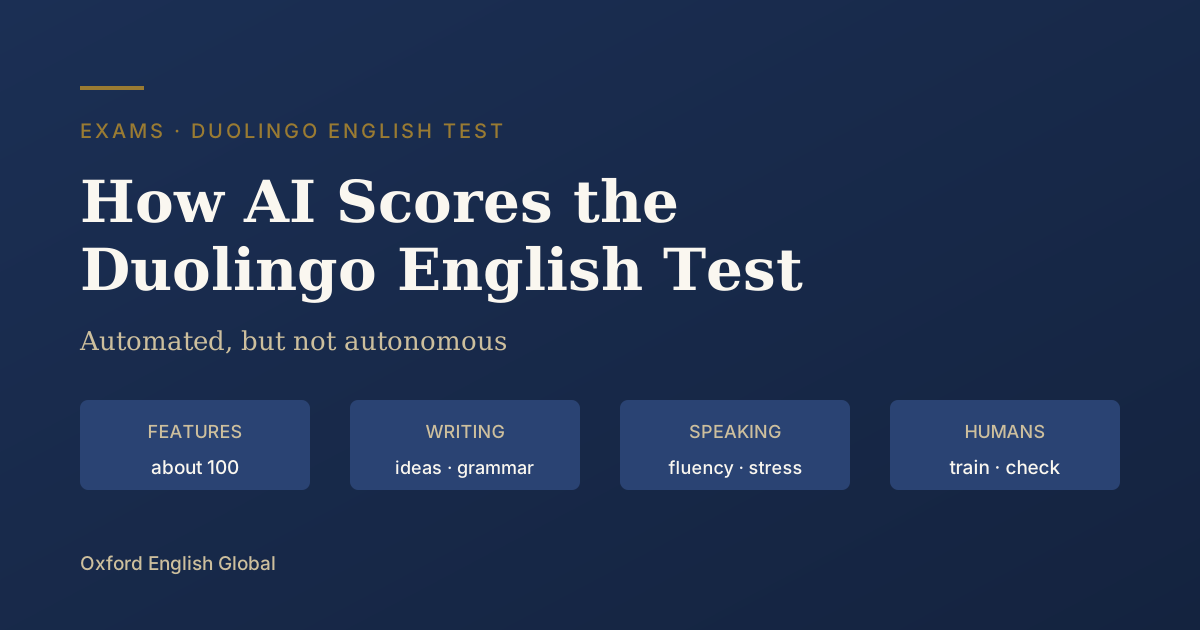
The Duolingo English Test (DET) scores speaking and writing with specialised machine-learning models, not with ChatGPT or any general chatbot. According to the test maker's November 2026 explanation, the models combine about 100 features chosen by assessment experts, such as idea development, coherence, vocabulary, more than 50 types of grammar error, fluency, pronunciation, pausing, stress and intonation. Humans design, train, validate and monitor the system, and human proctors review every test session for rule-breaking before scores are released, but they do not re-score your answers. For test takers, the practical lesson is simple: the scoring rewards clear, relevant, well-developed English, not length, memorised templates or a particular accent. This guide explains what the scoring looks at, where humans are involved and how to prepare with that in mind.
Sources and date. Written on 20 November 2026. The main source is the DET blog post "How Does the Duolingo English Test Use AI for Scoring?" by Nitin Madnani, co-lead of the DET Test Scoring team (published 17 November 2026), and the technical report it links to, "Scoring Writing & Speaking on the Duolingo English Test" (Duolingo Research Report DRR-26-09, 22 September 2026). We read both on 20 November 2026. The preparation advice is our own, based on what these sources say the scoring measures.
The short answer: how AI scores the DET
The DET is an online, computer-adaptive English test used mainly for university admissions. For the open-ended speaking and writing tasks, a computer, not a human examiner, gives the score. Duolingo's explanation makes five key points:
- It is not ChatGPT. The DET uses specialised machine-learning models. Some individual features use large language models (LLMs), but "a general-purpose chatbot or an LLM never makes an overall judgment" about a response.
- About 100 features. Each feature measures one specific aspect of proficiency, and each contributes evidence to the score.
- Humans are in control. Assessment scientists decide what to measure; trained raters score real responses to create training and test data; researchers check accuracy and fairness; and experts approve every model update.
- Models are locked. Once approved, a model does not keep learning while it scores tests.
- Length alone does not win. Longer answers do not automatically score higher, and repeated or copied material is detected.
For background on the test itself, including price, format and score scale, see our Duolingo English Test guide.
What "automated scoring" actually means
Automated scoring means using a computer system to assign a score to a typed or spoken answer. The DET's technical report describes four broad types of system:
| Type of system | How it works | Main strength or weakness |
|---|---|---|
| Rule-based | Experts write explicit rules, such as "deduct a point if the response has fewer than 50 words" | Full control, but rules can only cover a small part of what good English is |
| Feature-based machine learning | Experts define measurable properties of a response; the model learns how to combine them | Experts control what is measured and can check what drives a score |
| Deep learning | The system learns its own internal representations directly from data | Powerful, but harder to verify what it is responding to |
| Hybrid | Combines two or more of the above | Depends on the design |
The report describes the DET's approach as "construct-driven and anchored in human expertise". A construct is the skill a test is trying to measure, for example "the capacity to speak clearly, fluently, and appropriately in English". Researchers break that skill into parts, linguists choose measurable features for each part, and machine-learning experts build models that combine those features, so that each part's contribution to the score can be measured. In short, the DET is closest to a feature-based machine-learning system, with some LLM-based features inside it.
What the writing score looks at
The DET report defines the writing skill as "the capacity to produce clear, well-organized, and appropriately complex written English across a range of purposes and audiences". According to Duolingo's November 2026 blog post, writing features examine:
- Content and development of ideas: does your answer address the question and develop points with reasons and examples?
- Coherence: are sentences and ideas logically connected? An LLM-based feature, trained against expert human ratings, helps evaluate this.
- Vocabulary: range and appropriate use of words.
- Grammar: accuracy and range, including more than 50 types of grammatical error.
Duolingo also says the models are designed so that no single area, such as vocabulary, dominates the final score. Using rare words in a disorganised answer will not rescue it.
What the speaking score looks at
The report defines speaking as "the capacity to speak clearly, fluently, and appropriately in English for academic and everyday situations". The blog lists features such as:
- Fluency: how smoothly you speak.
- Pronunciation: how clearly sounds and words are produced.
- Pausing: where and how often you pause.
- Stress and intonation: which words you emphasise and how your voice rises and falls.
- Content, grammar and vocabulary, as in writing.
An important detail for learners: the report says the speaking measurement focuses on fluency, grammar and vocabulary, logical structure and intelligibility, "rather than on having a native-like or standard English accent". You do not need to sound British or American. You need to be easy to understand.
Where humans are involved
Duolingo describes DET scoring as "automated, but it isn't autonomous". The table shows who does what, based on the November 2026 blog post.
| Stage | Who | What they do |
|---|---|---|
| Defining the skill | Assessment scientists | Decide which aspects of speaking and writing to measure and which features capture them |
| Creating reference data | Trained human raters | Rate real test-taker responses; these ratings are used to train and evaluate the models |
| Approving models | Researchers and experts | Check accuracy and fairness before any model or update is used |
| Monitoring | Scoring team | Continuously evaluate live performance and investigate issues |
| Test security | Human proctors | Review every test session before scores are released to confirm rules were followed; they do not re-score answers |
That last row is worth repeating. If you are worried that "a human will read my essay", the answer is: a human proctor reviews your session for integrity, but your writing and speaking score comes from the approved model.
Is AI scoring fair to different accents and first languages?
This is the most common worry, and Duolingo addresses it directly. According to the blog post:
- The training datasets include about 100,000 real test sessions each for speaking and for writing.
- More than 100 first languages are represented, and the most common first language accounts for less than 17% of sessions.
- Gender representation is close to evenly balanced.
- Expert raters come from diverse national, geographic and linguistic backgrounds, including people familiar with different varieties of English.
- Before a feature or model is used, the team checks whether test takers of comparable proficiency get systematically different scores by first language, gender or region, and can revise or remove a feature if they do.
These are the test maker's own figures and descriptions. They show the checks Duolingo says it runs; they are not an independent audit. If fairness is important to your situation, the full technical report includes more detail on validity evidence, including how automated scores compare with expert human ratings and with IELTS and TOEFL scores.
Five myths about DET AI scoring
| Myth | What Duolingo says |
|---|---|
| "ChatGPT marks your answers." | No. Specialised models combine about 100 features; no chatbot or LLM makes an overall judgment. |
| "Write more words and you score more." | No. Length gives some information because developing ideas matters, but repeated, copied or padded language does not count as the same evidence. |
| "Big words guarantee a high score." | No. Models are designed so that no single area, such as vocabulary, dominates. |
| "You need a native accent." | No. Speaking scoring focuses on intelligibility, not a native-like or standard accent. |
| "The AI changes as it scores people." | No. Approved models are locked; updates go through training, evaluation, fairness testing and expert approval. |
How to prepare with AI scoring in mind
Because the scoring measures real communication across many features, the best preparation is the same as good English practice, with a few test-specific habits.
For writing
- Answer the actual question. Content features check relevance. Before you type, underline the key words of the prompt mentally and answer them in your first sentence.
- Develop, don't pad. Give a point, a reason and an example. Avoid repeating the question or filling space with generic phrases.
- Connect your ideas. Use linking words (however, as a result, for example) and make each sentence follow from the one before. Our guide to writing a strong opinion essay shows a simple structure.
- Cut common grammar errors. With over 50 error types checked, accuracy matters. Review our list of 20 common grammar mistakes and check articles, verb tenses and subject-verb agreement.
- Avoid memorised templates. Duolingo says it uses features that distinguish original content from repeated material.
For speaking
- Aim for clear, steady speech. Fluency and pausing are measured. Short, natural pauses between ideas are fine; long silences in the middle of a sentence are not.
- Work on stress and intonation. Practise stressing the important words in a sentence. Our free Speaking Lab shows your pitch and intonation as you speak.
- Use the preparation time to plan two or three points, then speak until you have developed them, rather than trying to fill the time with repetition.
- Record yourself and listen back. Check whether a listener could understand every word. See our guide on improving English pronunciation at home.
How this compares with IELTS and TOEFL
Different tests use different scoring methods, and this can affect which one suits you. IELTS Speaking is a face-to-face (or video) interview with a human examiner. TOEFL iBT and the DET both rely on automated scoring for at least part of the speaking and writing. If you strongly prefer talking to a person, that is a fair reason to choose IELTS; if you prefer a fully online test you can take at home, the DET may suit you better. Check the score your university or employer accepts before choosing. Our articles on the new TOEFL 1–6 score scale and at-home versus test-centre English tests explain the other options.
What this article cannot tell you
- The exact weighting of features. Duolingo publishes the types of features it uses, but not how much each one adds to your score.
- Independent verification. The fairness figures (100,000 sessions, more than 100 first languages, under 17% for the largest group) come from Duolingo itself. We have not seen an independent audit.
- Your individual score. No guide can predict your result. Duolingo's official practice test is the best way to estimate it.
- Future changes. Duolingo calls its technical report a "living document" and says models are periodically updated, so details may change after November 2026.
This page is independent guidance from Oxford English Global. We have no commercial relationship with Duolingo, and the page contains no affiliate or sponsored links. If you want structured preparation with human feedback, explore our English courses or start with our free lessons.
Frequently asked questions
Does the Duolingo English Test use ChatGPT to score answers?
No. Duolingo says it uses specialised machine-learning models that combine about 100 features. Some features use large language models, but no general chatbot or LLM makes an overall judgment about a response.
Do humans check Duolingo English Test speaking and writing?
Human experts design, train, validate and monitor the scoring models, and trained raters provide the reference ratings. Human proctors review every test session for rule-breaking before scores are released, but they do not re-score answers.
Do longer answers get higher DET scores?
Not automatically. Duolingo says length gives some information because developing ideas matters, but repeated words, copying the question or padding do not count as the same evidence of proficiency.
Does my accent affect my Duolingo English Test speaking score?
According to Duolingo's September 2026 technical report, speaking scoring focuses on fluency, grammar, vocabulary, structure and intelligibility rather than a native-like or standard accent.
Can the DET scoring AI change while it is scoring tests?
No. Duolingo says approved models are locked and do not keep learning while scoring. Updates go through training, evaluation, fairness testing and expert approval before use.