
Ireland Study Visa English Requirements: Accepted Tests, Minimum Scores and What to Aim For
Irish immigration accepts IELTS, TOEFL iBT, PTE Academic, the Duolingo English Test and several other tests for study visas, with minimums such as IELTS 5.0 for degree courses. Universities usually ask for far more. Here are the official visa scores, real university examples, and how to set your target and plan your test date.
- Two different English requirements: the visa and the college
- Official visa minimum scores for every accepted test
- If you are coming to Ireland for an English language course
- What Irish universities actually ask for
- Which score should you aim for?
- IELTS, TOEFL, PTE or Duolingo: choosing a test for Ireland
- How to plan your test date
- What this article cannot tell you
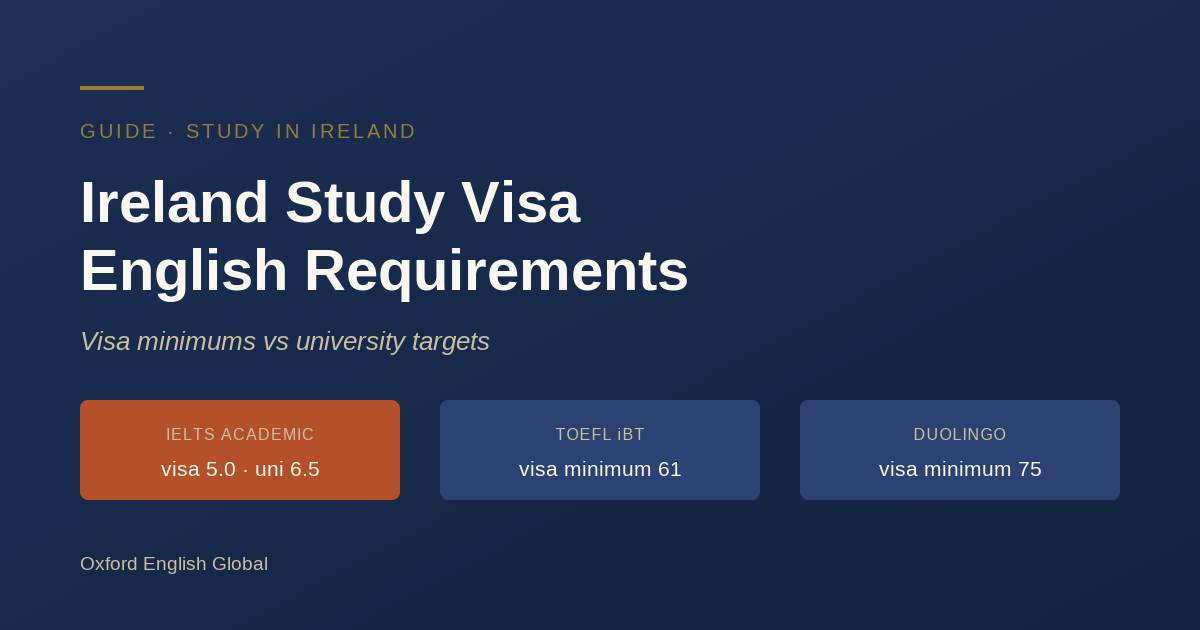
For an Irish study visa for a degree or other main course, Irish immigration asks for at least IELTS Academic 5.0, TOEFL iBT 61, PTE Academic 30 or a Duolingo English Test score of 75, and the result must have been issued within two years of your course start date. These are visa minimums only: most Irish universities ask for much more, typically IELTS 6.0 to 6.5 with 6.0 in every skill, and that university requirement is the score you should aim for. Students coming to Ireland for an English language course do not need a test result for the visa application, although a visa officer may ask for other evidence of basic English. This guide sets out the official visa minimums for every accepted test, compares them with real university entry requirements, and shows how to choose a target score and plan your test date.
Sources. Visa minimums come from the Irish Immigration Service Delivery page English language requirements for study visas, read on 28 November 2026 (the page itself shows a last-modified date of 16 September 2024). University examples come from University College Dublin and TU Dublin, read on the same day. Rules can change, so always confirm on the official pages before you book a test.
Two different English requirements: the visa and the college
Students often search for "the IELTS score for Ireland" as if there were one number. In fact there are two separate requirements, and you must meet both:
- The immigration (visa) minimum. Set by Irish immigration. It proves you have enough English to study in Ireland at all. Irish immigration says clearly that its table refers "to language requirements for immigration purposes only".
- The college or university requirement. Set by each institution, sometimes by each programme. It proves you can follow your course. It is almost always higher than the visa minimum.
In practice, the university requirement decides your target. You need an offer letter from the college to apply for the visa, and you only get that offer if you meet the college's English requirement. If you meet the university's level, you will normally be well above the visa minimum too.
Official visa minimum scores for every accepted test
Irish immigration has two columns. The lower one applies to second-level education (only in private, fee-paying schools), foundation courses (Level 5 on the National Framework of Qualifications) and preparatory English courses before a main course. The higher one applies to "all other courses", which includes degrees and postgraduate programmes.
| Test | Second level, foundation or preparatory English course | All other courses (for example degrees) |
|---|---|---|
| IELTS Academic | 4.0 | 5.0 |
| IELTS for UKVI | 4.0 | 5.0 |
| TOEFL iBT (including TOEFL iBT Home Edition) | 47 | 61 |
| PTE Academic | 30 | 30 |
| Duolingo English Test | 55 | 75 |
| Cambridge English | Pass in Preliminary (B1) | Pass in First (B2), Advanced (C1), Proficiency (C2) or Business English Certificate Vantage or Higher |
| Oxford Test of English | 81 | 100 |
| LanguageCert Academic | 40 | 60 |
| LanguageCert International ESOL | B1 | B2 |
| Trinity College London ISE | ISE I (B1) | ISE II (B2) |
| ETAPP, IELCA, Skills for English Four Facet | B1 | B2 |
Source: Irish Immigration Service Delivery, read 28 November 2026. Two details are easy to miss:
- Two-year validity. "The certificate of your English language standard must have been issued within 2 years of the expected start date of your course." A test taken in October 2025 is valid for a course starting by October 2027, but not later.
- PTE Academic is 30 in both columns. The page lists the same PTE minimum for both course types. That is unusual, so check it against your college's own PTE requirement, which will be higher.
The page also says that, because of problems accessing supervised tests during Covid-19, Irish immigration "will also accept the results of online tests from the Test Providers". This wording has not been updated since 2024, so if you plan to use an at-home version of a test, check with your college and, if needed, the visa office first. Our guide to at-home vs test centre English tests explains the practical differences.
If you are coming to Ireland for an English language course
Students who apply for a visa to study English at a language school in Ireland are in a different position. Irish immigration says: "English language course applicants are not required to provide evidence from a test provider when submitting their application. However, you may be asked by the Visa Officer to provide alternative evidence of a basic level of English before coming to Ireland."
In practice, "alternative evidence" could be a placement test result from your school or a certificate from a previous course, but the immigration page does not list what is acceptable. Keep any evidence of your current level ready in case you are asked.
Preparatory English before a degree
If you need to improve your English before starting a degree in Ireland, extra rules apply to the preparatory English course:
- it must not last more than 6 months;
- you must submit a detailed study plan with dates for both the English course and the main course;
- you must pay the fees in full for both the English course and the first year of the main course, with evidence of payment.
For this route, the visa minimum is the lower column (for example IELTS 4.0 or Duolingo 55). But you will still need to reach the university's level by the end of the English course, so plan realistically: moving from IELTS 4.0 to 6.5 in six months is a very large jump for most learners.
What Irish universities actually ask for
University requirements are the real target. Here are two official examples, read on 28 November 2026.
| Test | Irish visa minimum (degree) | University College Dublin minimum |
|---|---|---|
| IELTS Academic | 5.0 | 6.5 overall, at least 6.0 in each band |
| TOEFL iBT | 61 | 90, with at least 21 in Writing and 19 in each other section (or 4.5 overall and in each section on the new 1–6 scale for tests from January 2026) |
| PTE Academic | 30 | 63, with at least 59 in each communicative skill |
| Duolingo English Test | 75 | 120, with at least 110 in each subscore |
| Cambridge English | Pass in B2 First or higher | 176 on the Cambridge English Scale, no paper below 169 |
| Oxford Test of English | 100 | 140 overall, at least 125 in each skill |
Source: UCD Registry, Minimum English Language Requirements. UCD says these are minimums for all levels and "for some graduate courses the requirements may be higher".
TU Dublin, another large Irish university, states a minimum of IELTS Academic 6.0 with no less than 6 in each component, "unless otherwise stated", and notes that some programmes require more. Business schools often go higher still: UCD's Smurfit School lists IELTS 7.0 overall for taught master's programmes.
Rules that catch applicants out
- Single sitting. UCD assesses "the results of a single sitting only": you must reach the overall score and every component minimum in the same test. UCD's policy also excludes IELTS One Skill Retake results.
- Component minimums. An overall IELTS 6.5 is not enough if one skill is 5.5. Writing is the skill most often below the minimum.
- Two-year validity. UCD gives an example: for entry in September 2027, results must have been attained since 1 February 2025.
- New TOEFL scale. TOEFL iBT changed to a 1–6 score scale in January 2026. Our explainer on the TOEFL 1–6 score scale shows how the new bands compare with the old 0–120 scores.
Which score should you aim for?
Use this simple process to set a realistic target:
- Find your programme's exact requirement on the university's course page, not just the general admissions page. Programmes such as law, medicine, nursing or business often ask for more.
- Note the component minimums, not just the overall score.
- Add a safety margin. Scores vary from one sitting to the next. Aiming half an IELTS band (or the equivalent) above the minimum gives you room for a weaker day.
- Check the visa minimum last. If you meet the university level, you will almost always meet it, but check, especially for PTE, where requirements differ in an unusual way.
| Your plan | Typical target (IELTS Academic) | Why |
|---|---|---|
| English course at a language school | No test needed for the visa | Have evidence of basic English ready in case the visa officer asks |
| Foundation course or preparatory English before a degree | At least 4.0 for the visa; check the college's level | Lower visa column applies |
| Undergraduate degree | 6.0 to 6.5, with 6.0 in each skill | Common university minimums (TU Dublin 6.0; UCD 6.5) |
| Taught master's | 6.5, sometimes 7.0 | UCD minimum 6.5; some business programmes 7.0 |
If you are not sure where you are now, take a full practice test and convert your results with our IELTS score calculator. Our English level test guide explains how CEFR levels such as B2 and C1 relate to IELTS bands.
IELTS, TOEFL, PTE or Duolingo: choosing a test for Ireland
All four are accepted by Irish immigration for degree-level visas. The best choice depends on your university, your skills and your timeline.
| Test | Good choice if… | Watch out for… |
|---|---|---|
| IELTS Academic | You want the most widely accepted test; you prefer a face-to-face speaking test | Fees vary by country; see our guide to IELTS fees by country |
| TOEFL iBT | You also apply to US universities | The 2026 score scale change; check which scale your university quotes |
| PTE Academic | You are comfortable with fully computer-based tests and fast results | University minimums (UCD: 63) are far above the visa figure of 30 |
| Duolingo English Test | You want an online test you can take at home | Not every programme accepts it; UCD asks for 120 with 110 in each subscore. See our Duolingo English Test guide |
Before you pay for any test, confirm that your specific programme accepts it. A test that is valid for the visa but not for your university is wasted money.
How to plan your test date
Work backwards from your course start date. Irish universities usually ask for test results before they issue an unconditional offer, and you need the offer to apply for the visa.
| Step | When (for a September intake) |
|---|---|
| Check programme requirements and accepted tests | 9 to 12 months before |
| Take a diagnostic practice test; start preparation | 8 to 10 months before |
| First official test attempt | 6 to 8 months before |
| Possible second attempt if a component is below the minimum | 4 to 6 months before |
| Send results, receive offer, apply for the visa | 3 to 4 months before or earlier |
This timeline is our planning suggestion, not an official rule. It leaves time for a second attempt, which many applicants need, especially when one skill is below the component minimum. Remember the two-year validity rule: do not take your test so early that it expires before your course begins.
Use the time between attempts to target your weakest skill. Our guides to improving your English listening and writing an opinion essay cover two areas that often hold scores back. If you are still choosing between countries, compare these rules with our guides to UK SELT-approved tests and Australian visa English test requirements, or explore our study-abroad university matcher.
What this article cannot tell you
- Your programme's exact requirement. We give examples from two universities. Requirements vary by institution and programme, and change from year to year.
- Future rule changes. The Irish immigration page we used was last modified in September 2024. Check it again before you apply.
- Exemptions. Some universities accept a previous degree taught in English, or school-leaving results, instead of a test. Only the university can confirm whether you qualify.
- Visa decisions. English is only one part of an Irish study visa application. Finances, course fees, study history and other documents also matter. This page is not immigration advice.
- Test fees and dates in your country. These are set locally; check the test provider's official site.
This page is independent guidance from Oxford English Global. We have no commercial relationship with any test provider or Irish university mentioned, and the page contains no affiliate or sponsored links. If you want structured preparation for IELTS or another exam, see our exam preparation courses.
Frequently asked questions
What IELTS score do I need for an Irish study visa?
Irish immigration's minimum is IELTS Academic 5.0 for degree and most other courses, and 4.0 for second-level, foundation or preparatory English courses. Universities usually ask for more, typically 6.0 to 6.5 with 6.0 in each skill.
Does Ireland accept the Duolingo English Test for a study visa?
Yes. Irish immigration lists a minimum Duolingo English Test score of 75 for degree and other main courses, and 55 for second-level, foundation or preparatory English courses. Check that your university also accepts it; UCD, for example, asks for 120.
Do I need IELTS to study English at a language school in Ireland?
No. Irish immigration says English language course applicants do not need test results for the visa application, but the visa officer may ask for other evidence of a basic level of English.
How long is an English test result valid for an Irish study visa?
The certificate must have been issued within 2 years of the expected start date of your course.
Is the visa minimum enough to get into an Irish university?
Usually not. The visa minimum is for immigration purposes only. University College Dublin, for example, asks for IELTS 6.5 with 6.0 in each band, while the visa minimum is 5.0.