
100 Essential English Sentence Structures (Free PDF Download)
One hundred core English sentence patterns, from SUBJECT + VERB + OBJECT to the structures fluent speakers use — each with the formula, a plain usage note, natural examples, and a practice tip. Free to download as a PDF, and built to fix the 'I know words but can't build sentences' problem.

You know hundreds of English words, you understand the grammar when you read it, and yet the moment you have to build a sentence yourself it comes out slow, broken, or simply does not come at all. That gap is not a vocabulary problem and it is not really a grammar problem — it is a pattern problem. 100 Essential English Sentence Structures fixes it by handing you the reusable templates that fluent speakers run on, and you can download the full book as a free PDF below.
The core idea is simple and a little liberating: a sentence structure is a reusable pattern. Own the pattern, and you can pour thousands of different words into it correctly. This page tells you exactly what is inside, who the book is for, and how to use a patterns PDF so it actually changes the sentences that come out of your mouth.
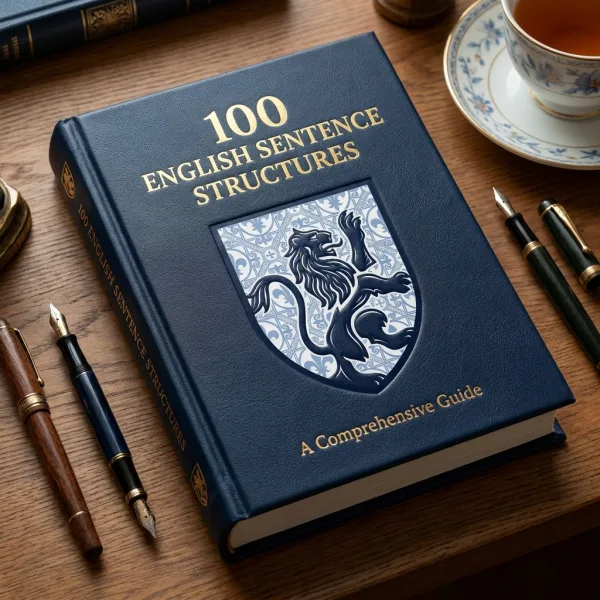
100 Essential English Sentence Structures
↓ Download the free PDFNo email required. Free for personal study and classroom use.
- One hundred core English sentence patterns, ordered from the simplest building blocks to the structures fluent speakers and skilled writers use.
- Every pattern in the same four-part rhythm — PATTERN (the formula), USE (a plain usage note), EXAMPLES (natural sentences with green ✓ checks), and a PRACTICE tip.
- Formulas you fill with your own words, so each pattern generates not one sentence but thousands.
- A path that runs from SUBJECT + VERB + OBJECT all the way to advanced structures — 61 pages, CEFR A2–C1.
- Free to download and free to photocopy for personal study and the classroom.
What this book covers
The book is one hundred patterns, and they are arranged the way sentences actually grow — the simplest building blocks first, each new structure resting on the ones before it. Every single pattern is laid out in the same four parts so you always know where to look:
- PATTERN — the formula written in symbols (SUBJECT + VERB + OBJECT, and so on) that you fill with any words you like.
- USE — a plain-language note on what the pattern does and when to reach for it.
- EXAMPLES — natural example sentences, marked with a green check (✓) so you can hear how the pattern sounds in real English.
- PRACTICE — a short, practical tip that turns the pattern from something you read into something you can produce.
The hundred structures climb steadily in difficulty. The early ones are the foundations every sentence is built from — subject, verb, object, and the simple ways to extend them. The middle stretch adds the joins and shapes that let you say more in one breath: linking clauses, asking questions cleanly, describing and comparing. The later patterns are the advanced structures used by fluent speakers and confident writers — the ones that make English sound polished rather than merely correct. Because the patterns build in order, an A2 learner can start at number one and an advanced learner can skim to the structures they do not yet own.
What you will not find is a list of sentences to memorise. Each entry is a formula with empty slots, and the empty slots are the whole point: the same pattern that produces "She wants a coffee" will, with different words, produce "My students need a break" and "The report explains the results." Learn the formula once and you have not learned one sentence — you have unlocked every sentence that shares its shape. That is why a 61-page book can carry you so far: a hundred patterns multiply into far more usable English than a hundred memorised lines ever could.
Who it's for
The book is written for two audiences at once. For learners from A2 to C1, it is the missing link between knowing words and building sentences — a single place to collect the patterns that generate fluent English instead of memorising example sentences one by one and forgetting them. For teachers and tutors, the consistent PATTERN / USE / EXAMPLES / PRACTICE layout makes each structure a ready-made mini-lesson, and you are explicitly encouraged to photocopy the patterns for class drills and writing tasks.
If you are around A2–B1, work through the patterns roughly in order; the first dozen alone will steady almost everything you try to say. If you are B2–C1 and stuck on a plateau where your English is correct but flat, do not start at page one — scan the contents and hunt for the advanced structures you recognise but never actually use. Those are the patterns that move you from understood to impressive.
How to use a patterns PDF so it works
Here is the honest part. A patterns PDF is a brilliant map and a poor coach — if you only read it. Reading the formula SUBJECT + VERB + OBJECT is not the same as producing fifteen of your own sentences in it without hesitating. The book gives you the pattern; you have to supply the words, the repetition, and the speaking.
A pattern you have read is a pattern you recognise. A pattern you have filled twenty times, out loud, is a pattern you own. Recognition lives in your notes; ownership lives in your mouth.
So use it actively. For each structure, take the formula and fill it with five sentences about your real life — your job, your morning, the person across the table — not the textbook's. Then say them aloud, because the goal is speech, not a tidy notebook. Before you move on, cover the examples and try to generate a fresh sentence from the formula alone; that retrieval is what burns the pattern into long-term memory. Collect the patterns, not the sentences: stop trying to memorise English phrase by phrase and start collecting the structures that generate them. We expand on this method in our guide to learning from English PDFs the right way.
Learners who "know a lot of words" but freeze when speaking almost always have the same hidden gap: they are assembling each sentence from scratch, word by word, in real time — which no one can do quickly. The freeze eases noticeably once they stop translating words and start reaching for a known pattern and pouring words into it. The shift from word-by-word to pattern-first is usually the moment speaking speeds up.
Based on instructor intake notes. Directional observation, not a controlled study.
What makes this book different
Most resources teach you grammar rules or hand you sentences to memorise. This book teaches you the layer in between — the generative patterns themselves. One reusable structure replaces a hundred memorised sentences, because once you hold the formula you can build any sentence that fits it. That is the single fastest route from "I know words" to "I can build sentences," and it is why the book is patterns rather than phrases: you are not collecting fish, you are learning to fish in English. The four-part rhythm reinforces it on every page — you never just see a structure, you see what it is for, hear it in a real example, and get a nudge to produce your own — so the patterns leave the page and become sentences you can actually reach for under pressure.
Pair it with these free PDFs
Patterns give your sentences a frame. Three other free books in our library fill that frame with correct, natural, confident English:
- Want the rules behind the patterns? English Grammar: A Complete Guide explains the grammar system these structures are built on, beginner to advanced.
- Patterns get the shape right; word partnerships make it sound native — English Collocations in Use teaches the words that naturally go together inside your sentences.
- Ready to take the patterns from the page to your mouth? Speak English Fluently turns correct structures into smooth, confident speech.
All three sit in the same free library — see the full set on our free English learning PDFs page.
Download 100 Essential English Sentence Structures
Grab the PDF, pick one pattern, and fill it with five sentences about your own day before you close it. Do that with one pattern a day and your speaking will change faster than another month of collecting vocabulary ever could.
100 Essential English Sentence Structures
↓ Download the free PDFNo email required. Free for personal study and classroom use.
Want the patterns and your own sentences corrected? Our free English track adds the one thing a PDF cannot — feedback on the sentences you actually build.
Prefer an app to a book? See our pick for The best language learning app 2026.
Frequently asked questions
Is 100 Essential English Sentence Structures really free to download?
Yes. The full 61-page PDF is free to download from this page, with no email sign-up and no paywall. It was written and produced by Oxford English Global, and you are free to use it for personal study and to photocopy the patterns for the classroom.
What level is this sentence patterns book for?
It runs from CEFR A2 to C1. The patterns are ordered from the simplest building blocks (SUBJECT + VERB + OBJECT) up to the advanced structures fluent speakers and skilled writers rely on, so A2 learners start at number one while B2–C1 learners can jump straight to the structures they don't yet use.
How is each of the 100 structures laid out?
Every pattern follows the same four-part rhythm: PATTERN (the formula in symbols you fill with any words), USE (a plain-language note on when to use it), EXAMPLES (natural sentences with green ✓ checks), and a PRACTICE tip. The idea is that once you own the pattern, you can pour thousands of different words into it correctly.
Can I learn to build sentences from a PDF alone?
A PDF shows you the patterns but cannot react to the sentences you build from them. Use it actively — fill each pattern with words from your own life and say them aloud — and pair it with a source of feedback. Our free English track is built to add exactly that correction layer.