
Australia's Genuine Student Test and Financial Requirements Consultation: What May Change
Home Affairs is asking for views on revising Ministerial Direction 106 and on new financial capacity rules, including holding funds in an Australian bank account before you apply. Nothing has been decided. This guide explains the options, the interim proposal for Evidence Level 3 countries and what students should do now.

- What the consultation is and why it is happening
- The Genuine Student requirement: what could change
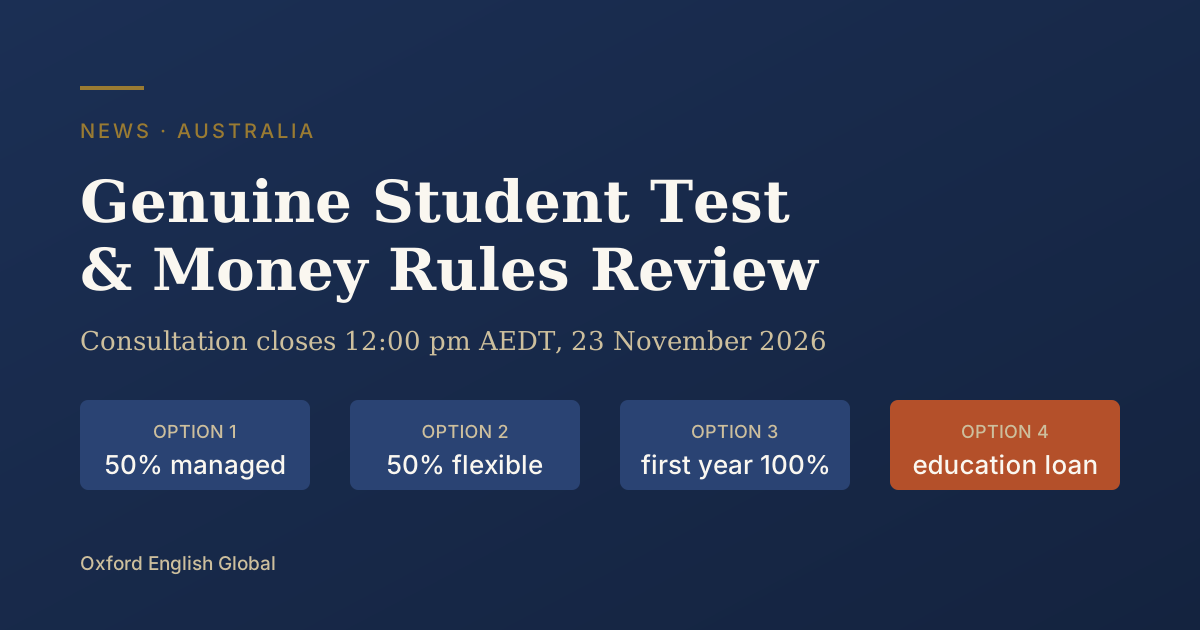
- The four financial capacity options
- The possible interim rule for Evidence Level 3 countries
- What does not change, at least for now
- What it means for English (ELICOS) students
- What prospective students should do now
- What this article cannot tell you
Australia's Department of Home Affairs is consulting on two possible changes to the Student visa (subclass 500): a revised Ministerial Direction 106, which guides how officers decide whether you are a "Genuine Student", and a tougher financial capacity framework that could require students to hold money in an Australian bank account before they apply. No decisions have been made. Submissions close at 12:00 pm AEDT on Monday 23 November 2026, and the current rules still apply to every application lodged today. The options on the table range from showing 100% of first-year costs to holding 50% of the cost of your whole course in an Australian account for one to three months before you lodge. Home Affairs is also considering an interim rule for applicants from Evidence Level 3 countries, with six months of bank history. This guide explains what may change, what will not, and what international students, including English (ELICOS) students, should do now.
Checked on 12 November 2026 against the Home Affairs page Consultation on proposed reforms to the Genuine Student requirement and financial capacity framework and its consultation paper, plus ICEF Monitor reporting (5 November 2026). These are proposals, not law. Oxford English Global is an English school, not a registered migration agent.
What the consultation is and why it is happening
On 30 October 2026, at the Australian International Education Conference, Assistant Minister Julian Hill outlined the Government's work on Student visa integrity. Home Affairs then opened a consultation on two connected areas:
- The Genuine Student requirement: possible updates to Ministerial Direction 106 (MD106), the instruction that tells officers how to assess whether study is the main reason for your visa application.
- Financial capacity: ways to strengthen the rules on how much money you must show and what evidence counts, currently set out in a legislative instrument.
The consultation paper says the aim is settings "that can be easily understood by applicants and education providers", that "improve the quality and completeness of applications" and that "reduce reliance on unreliable or poorly verifiable financial arrangements". It states plainly: "No decisions have been made on these proposals."
The background is a difficult year for the sector. ICEF Monitor reported that the past year saw unprecedented numbers of Student visa refusals, and quoted Mr Hill as saying new overseas student commencements at public universities were projected to end the year down by around 18%. He also said that refusal rates were "actively deterring the very students we most want to come to Australia". At the same time, the Government says it "will not compromise on integrity", following the 2 October 2026 rules that ended most onshore "visa hopping" (see our guide to Australia's October 2026 student visa changes).
The Genuine Student requirement: what could change
The Genuine Student (GS) requirement asks whether you really intend to come to Australia temporarily to study. Today, applicants answer GS questions in English in the online form. The paper proposes keeping a "holistic, individual assessment" but organising it differently:
| Issue | Current approach (MD106) | Proposed direction |
|---|---|---|
| Structure | One common set of factors for all applicants | Separate focus for students starting a new study pathway and students continuing or returning to study |
| New students | Home and Australian circumstances, value of the course, immigration history | Focus on whether the study plan is credible and achievable: reasons, preparedness, course and provider choice, costs and intended outcomes |
| Continuing students | Closer scrutiny of previous Student visa holders | More weight on conduct in Australia, progress, results, course changes, gaps, work and financial patterns |
| Transnational education | Not specifically rewarded | Positive weighting for study with an Australian provider offshore, where there is evidence of good progress (not a guarantee of a visa) |
| Work | Officers may consider incentives to come for reasons other than study | Clearly separate finances from expected earnings in Australia; consider whether your plan is sustainable with no guarantee of work |
| Application questions | GS statements in the online form | Revised questions and evidence, removing reliance on "formulaic Genuine Student statements" and making reasons for decisions clearer |
Source: Home Affairs consultation paper, "What could change under a revised MD106", read 12 November 2026.
For English learners, the most relevant change is the move away from "formulaic" statements. If the new questions focus on the credibility of your study pathway, an applicant who can explain clearly, in their own words, why they chose a course and how it fits their plans will be in a stronger position than one who submits a template answer.
The four financial capacity options
The biggest practical change could be how you prove you can pay. Under the first three options, applicants would have to hold funds in an eligible Australian bank account in their own name. The fourth option allows recognised education finance instead.
| Option | Amount | Account and access | Home Affairs' own assessment |
|---|---|---|---|
| 1. Managed 50% model | 50% of total tuition and living costs for the whole course or package | Australian account in your name, funded for at least 1 month before lodging; money released on a set schedule | Highest assurance; biggest design and implementation impacts |
| 2. Flexible 50% model | 50% of total tuition and living costs for the whole course or package | Australian account, funded for at least 3 months; no set release schedule | High assurance with more flexibility |
| 3. First-year assurance | 100% of tuition and living costs for the first 12 months (or the rest of the course if shorter) | Australian account, funded for at least 3 months before lodging; managed release possible for some groups | Stronger baseline with lower liquidity impact than the 50% models |
| 4. Recognised education finance | Costs met through recognised financial institutions, personal funds or both | Transfer to an Australian account preferred; direct reliance allowed in limited cases | Wider access; needs approved providers and safeguards |
Source: Home Affairs consultation paper, "Illustrative financial capacity options". The paper says the models "are illustrative and are not settled Departmental positions".
All four options would require financial evidence at lodgement, check where the money comes from and whether it is really available, exclude future earnings from work in Australia, and still recognise genuine scholarships, government support and approved education loans. Verified overseas accounts could be used as a transitional arrangement before any Australian account model starts.
The options have already drawn criticism. ICEF Monitor reported that the Association of Australian Education Representatives in India (AAERI) called the first two options "impractical", arguing that moving money to Australia before knowing whether a visa will be granted exposes families to exchange-rate risk, transfer costs and the trouble of bringing the money back after a refusal. The Student visa application fee (from AUD 2,500 for the main applicant when we checked on 11 November 2026) is not refunded if you are refused.
The possible interim rule for Evidence Level 3 countries
An Australian account system would take time to build, so Home Affairs is also asking about a quicker, interim measure for primary applicants from Evidence Level 3 countries. Evidence Levels are risk ratings for each country and education provider that decide whether you must provide certain evidence with your application.
| Measure | Now | Possible interim rule |
|---|---|---|
| Who shows evidence at lodgement | Depends on combined country and provider Evidence Level | All primary applicants from Evidence Level 3 countries, whatever the provider's level |
| Amount | Existing prescribed amounts | Same amounts at first; the change is about evidence quality |
| Account history | No uniform minimum | At least 6 months of transaction history, longer in higher-risk cases |
| Who can support you | Not uniformly limited | Generally you, your spouse, your parents or another prescribed supporter |
| Loans | Loans from financial institutions or governments may be accepted | Unsecured personal loans and non-disbursed loans generally not accepted |
Source: Home Affairs consultation paper, "Possible interim strengthening for Evidence Level 3 applicants". The paper says this would be "a separate, earlier measure".
What does not change, at least for now
- Today's rules apply. Applications are assessed under the current MD106 and financial requirements until any change is made law.
- The English test requirement is not part of this consultation. The scores you need are unchanged; see the table in our guide to Australia's October 2026 changes.
- Financial capacity and the GS assessment stay separate legal requirements. The paper says that, with stronger financial rules, the GS assessment could focus less on money and more on whether your study plan is credible.
- The 2 October 2026 changes stay in place: most Student visa applications must be lodged outside Australia, and most students can no longer include family members.
What it means for English (ELICOS) students
ELICOS means English Language Intensive Courses for Overseas Students. If you plan to study English in Australia, alone or before a degree, three points stand out:
- Your study pathway must make sense. A revised MD106 would look closely at the "educational rationale" and "preparedness" of commencing students. Be ready to explain why you need English study, how long, and what comes next.
- Short English courses may look different under a 50% model. Under options 1 and 2 the amount is based on the whole course or package, so a short standalone English course would need less than a long ELICOS-plus-degree package. Under option 3, it is the first 12 months or the remaining course if shorter. This is our reading of the paper; detailed rules have not been written.
- Write your own answers. GS questions are answered in English. If future questions are less formulaic, clear, honest English will matter more. Practise explaining your plans aloud and in writing.
What prospective students should do now
- Do not delay a ready application. If you meet today's rules, waiting for new rules that may be stricter has no benefit.
- Keep clean, traceable finances. Whatever option is chosen, the direction is clear: funds that are genuine, accessible, in the right person's name and supported by transaction history. Avoid sudden unexplained deposits.
- Prefer recognised loans. If you rely on a loan, a secured, government-backed or recognised education loan is more likely to be accepted than an informal or unsecured personal loan.
- Plan your whole study pathway before you apply. Decide on your English course length and any packaged course now.
- Have your say if you want to. Individuals as well as organisations can make written submissions. Email student.visa.consultation@homeaffairs.gov.au with the subject "Student Visa Consultation – sector/organisation" before 12:00 pm AEDT on 23 November 2026. Home Affairs says it will not publish submissions.
- Get your English to the level you need. Our exam preparation courses and free lessons cover B1 to C1, and the IELTS score calculator shows how band scores combine.
Comparing destinations? See our guides to New Zealand's tougher English checks and the IDP survey on how visa policy shapes students' choices.
What this article cannot tell you
- The final rules. Feedback "will inform advice to Government on whether reforms should proceed and, if so, their scope, sequencing and detailed design". Any option could be changed or dropped.
- Dates. No start date has been announced for any reform, including the interim measure.
- Which countries are Evidence Level 3. Evidence Levels change; check the Home Affairs document checklist tool for your country and provider.
- Exact amounts under each option. These would depend on your course fees and prescribed living costs, which the paper does not set out per course.
- Your individual case. For advice on your application, use a registered migration agent or lawyer.
This page is independent guidance from Oxford English Global. It contains no affiliate or sponsored links.
Frequently asked questions
Has Australia changed the Genuine Student requirement?
Not yet. Home Affairs is consulting on possible changes to Ministerial Direction 106 and the financial capacity framework, and says no decisions have been made. Current rules apply to applications lodged now.
Will I need an Australian bank account to apply for a Student visa?
Possibly, in future. Three of the four illustrative options would require funds in an Australian account in your name before lodging. The fourth would allow recognised education finance. None has been adopted.
When does the consultation close?
Written submissions close at 12:00 pm AEDT on Monday 23 November 2026, by email to student.visa.consultation@homeaffairs.gov.au.
What is the interim measure for Evidence Level 3 countries?
Home Affairs is considering requiring all primary applicants from Evidence Level 3 countries to provide financial evidence at lodgement, supported by at least six months of transaction history, with tighter rules on supporters and loans.
Does the consultation change English test scores for the Student visa?
No. English language requirements are not part of this consultation.