
Which Top US Colleges Require an English Test? TOEFL, IELTS and Duolingo Rules for 2026–27 Applicants
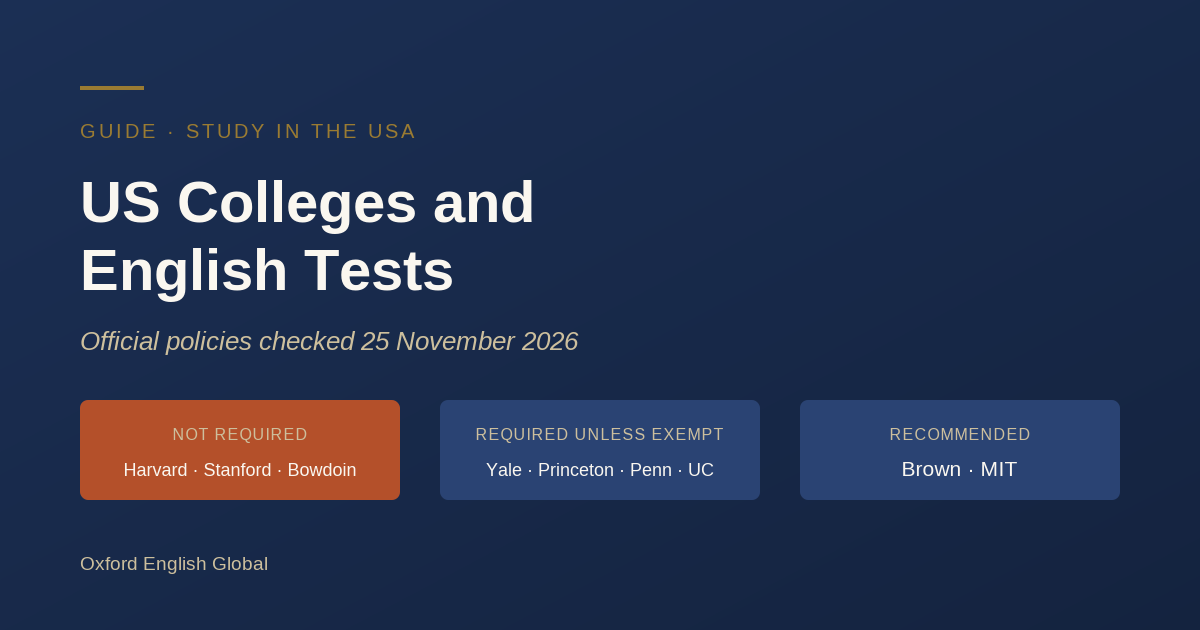
Harvard, Stanford and Bowdoin do not require an English test, but Yale, Princeton, Penn, Cornell, Dartmouth and the University of California do unless you are exempt, and Brown and MIT strongly recommend one. Here are the rules, exemptions, accepted tests and published scores from each college's official page.
- The quick answer: required, recommended or optional
- Why Harvard, Stanford and Bowdoin require no English test
- Colleges that require a test unless you are exempt
- Colleges that strongly recommend a test
- Published scores, test by test
- How exemptions really work
- The new TOEFL 1–6 scale and why scores do not line up
- Which test should you take for US colleges?
- How to prepare if you need a C1-level score
- What this article cannot tell you
Most highly selective US colleges ask non-native English speakers for an English proficiency test, but not all of them. Of the eleven colleges and university systems we checked on their official admissions pages on 25 November 2026, Harvard, Stanford and Bowdoin do not require one; Yale, Princeton, Penn, Cornell, Dartmouth and the University of California require a TOEFL, IELTS, Duolingo English Test or similar score unless you qualify for an exemption; and Brown and MIT strongly recommend one. Exemptions usually depend on whether English is your first language or how many years you have studied in English-medium schools, not on your passport. This guide sets out each college's rule, the tests it accepts, the scores it publishes, and what a "not required" policy really means for an international applicant.
Sources and date. Every college policy below was read on the college's own admissions website on 25 November 2026 and is linked in the text. We started from a summary by GradPilot (published 30 October 2026) and re-checked each claim we use against the official page. We could not open Columbia's English proficiency page (it blocked our automated reader), so Columbia is not in the tables. TOEFL score-scale details come from ETS. Policies apply to first-year undergraduate applicants for entry in 2027 unless stated otherwise, and they can change at any time.
The quick answer: required, recommended or optional
US colleges fall into three groups. Some require an English test from non-native speakers who do not meet an exemption. Some recommend one, which in practice means a missing score can weaken an application from a student whose English is not otherwise obvious. And a few treat the test as fully optional.
| College | English test policy | Main exemption | Published scores |
|---|---|---|---|
| Harvard | Not required; you may submit scores | Not applicable | None |
| Stanford | Not required; you may self-report scores | Not applicable | None |
| Bowdoin | Optional | Not applicable | No minimum |
| Yale | Required for non-native speakers | 2+ years of English-medium secondary school | None on the page |
| Princeton | Required for non-native speakers | Native English, or 3+ years at an English-medium secondary school | None on the page |
| Penn | Required for non-native speakers | Native English, or 3+ years taught in English by enrolment | Typical competitive scores |
| Cornell | Required for non-native speakers | Examples: US citizens, native English, 4+ years at an English-medium school | Minimum and recommended scores |
| Dartmouth | Required unless exempt | English first language, or 2+ years of English-medium curriculum | No minimum; typical scores |
| University of California | Required if all secondary school was in a non-English-medium country | Any secondary schooling in English, or other routes (AP, IB, ACT, SAT section) | System minimums |
| Brown | Highly recommended | English as first language, home language or language of instruction | Scores "expected in most cases" |
| MIT | Strongly recommended | Using English for five years or more, at home or school | Minimum and recommended scores |
Two points before the detail. First, "not required" does not mean "English does not matter"; it means the college will judge your English from the rest of the application. Second, an English test never replaces the SAT or ACT at colleges that require those, such as Harvard, Stanford, Yale and MIT.
Why Harvard, Stanford and Bowdoin require no English test
These three colleges do not ask for TOEFL, IELTS or Duolingo scores, but each still expects excellent English. Their reasons are worth reading closely, because they explain how your English will be judged instead.
Harvard
Harvard's international applicants page says: "Although you are not required to take an English proficiency exam (such as the TOEFL, IELTS, etc.), you may submit scores if you wish to do so." It adds that these scores "cannot be used to meet the standardized testing requirement", so you still need the SAT or ACT. The same page states that "a strong knowledge of English is essential for successful study at Harvard" and that the admissions process is the same for all applicants regardless of nationality or citizenship.
Stanford
Stanford's international applicants page (updated 2 November 2026) answers the question directly: "No, we do not require any English proficiency exams", adding that "you may feel your fluency will be clear in other aspects of your application." Applicants can self-report scores from any English proficiency exam, and the page notes there are "no courses or minimum scores required to secure admission". It also warns that "fluency in English is a prerequisite for admission to Stanford."
Bowdoin
Bowdoin, a liberal arts college in Maine, says on its international students page: "It is optional to submit English proficiency test scores." It accepts TOEFL, IELTS, the Duolingo English Test and Cambridge English, and also lists recorded interviews from InitialView and Vericant. Bowdoin "does not have a minimum qualifying EPT score". It is also frank about the stakes: it does not offer English as a Second Language courses, and all incoming students are expected to be highly proficient. Note that submitted scores cannot be removed later.
What "not required" means in practice
At these colleges, admissions officers judge your English from your essays, teacher recommendations, school record, SAT or ACT results and, where offered, interviews. That has two consequences:
- If your English is strong and visible elsewhere (for example, you studied in English or your SAT Reading and Writing score is high), a test adds little.
- If your schooling was entirely in another language, a strong optional score can give the reader independent evidence. Submit it only if it helps; at Bowdoin, it cannot be withdrawn.
Colleges that require a test unless you are exempt
Yale
Yale's international applicants page says: "Non-native English-speakers who have not taken at least two years of secondary education where English is the medium of instruction are required to submit results" of an English test. It accepts TOEFL, IELTS, Cambridge English Qualifications, the Duolingo English Test and InitialView. English tests "will not fulfill Yale's testing requirement", which is a separate SAT or ACT requirement. We did not find minimum scores on the page.
Princeton
Princeton's international students page says a test is "not required… if English is your native language or if you have spent at least three years at a secondary school where English is the primary language of instruction." Accepted tests are TOEFL, IELTS Academic, the Duolingo English Test and PTE Academic. No minimums are published on that page.
University of Pennsylvania
Penn's international applicants page asks non-native speakers for TOEFL, IELTS Academic or the Duolingo English Test, and lists tests it does not accept: IELTS Indicator, IELTS One Skill Retake and TOEFL MyBest scores. Only tests taken on or after 1 April 2025 count. The exemption applies if English is your native language or if English has been your primary language of instruction for at least three years, in high school, college or both, "by the time you enroll". Penn gives typical scores rather than cut-offs: "Competitive applicants tend to have a composite score of 5 or above" on the new TOEFL scale (100 or above on the old scale), 7 or above on IELTS and 130 or above on the Duolingo English Test.
Cornell
Cornell's English proficiency page requires a test from applicants whose first language is not English or who did not attend a school where English is the main language of instruction. It gives US citizens, native English speakers and students with at least four years at an English-medium school as examples of who is exempt. Self-reported scores are fine for review; admitted students must send official scores.
Dartmouth
Dartmouth's admissions FAQ requires a test if your first language is not English and your curriculum has not been taught in English for at least two years. It accepts TOEFL (including Home Edition), IELTS (including IELTS Indicator), the Duolingo English Test and Cambridge, but not TOEFL MyBest or TOEFL Essentials. "Dartmouth does not have minimum required scores on English proficiency exams; however, most successful applicants score above a 7 on IELTS", above 135 on Duolingo and above 185 on Cambridge, and 5 or above on TOEFL tests taken from 21 January 2026.
University of California
The UC system's English language proficiency page applies to students who completed all of secondary school in a country where English is not the language of instruction. The test must be taken by December of the final year of school. UC sets system-wide minimums (see the score table below) and also accepts other evidence: AP English Language or Literature at 3 or above, IB English A at Standard Level 6–7 or Higher Level 5–7, ACT English Language Arts 24 or above, or the old SAT Writing and Language score of 31 or above. It does not accept the digital SAT Reading and Writing score, IELTS One Skill Retake or MyBest TOEFL scores. Importantly, "a UC campus may require a score higher than the minimum for admission selection."
Colleges that strongly recommend a test
Brown
Brown's English proficiency page says: "We highly recommend that international applicants for whom English is not a first language… submit the results of an English proficiency test", including students whose home language or language of instruction for all of secondary school is not English. It also says proficiency must be achieved before you are admitted. Brown accepts TOEFL (including Home Edition, but not MyBest), IELTS, the Duolingo English Test, PTE and Cambridge. Students enrolling in fall 2027 must send official score reports by May 2027.
MIT
MIT's tests and scores page says: "we strongly recommend providing the results of an English proficiency exam if you have been using English for fewer than five years" or do not speak it at home or at school. MIT accepts Cambridge C1 or C2, the Duolingo English Test, IELTS, PTE Academic and TOEFL, and uses your best section scores across sittings. Unusually for a "recommended" test, MIT publishes both minimum and recommended scores, so if you submit a score, aim for the recommended column.
Published scores, test by test
Only some colleges publish numbers, and they describe them differently: a minimum, a recommended score, or the score most admitted students reach. The table shows each college's own wording and numbers. Do not convert scores between scales yourself (see the TOEFL section below).
| College (type of figure) | TOEFL iBT, new 1–6 scale | TOEFL iBT, old 0–120 | IELTS | Duolingo | Other |
|---|---|---|---|---|---|
| Penn (typical competitive) | 5+ | 100+ | 7+ | 130+ | Not listed |
| Cornell (published scores) | 5.0 minimum, 5.5 recommended | 100 | 7.5 | 130 | Cambridge C1/C2: 191 |
| Dartmouth (most successful applicants) | 5+ | Above 100 | Above 7 | Above 135 | Cambridge: above 185 |
| Brown (expected in most cases) | 5.5 | 105 | 8.0 | 130 | PTE 75; Cambridge C1/C2: 191 |
| MIT (minimum / recommended) | 5 / 5.5 | 90 / 100 | 7 / 7.5 | 120 / 125 | PTE 65 / 70; Cambridge 185 / 190 |
| University of California (system minimum) | 4.5 | 80 | 6.5 | 115 | AP, IB, ACT and SAT routes |
Two patterns stand out. Top private colleges cluster around IELTS 7 to 8 and Duolingo 120 to 135, which corresponds roughly to a strong C1 level. And the UC minimums are a floor, not a target; individual campuses can ask for more.
If you are not sure where you stand, our IELTS score calculator shows how section scores turn into an overall band, and our Duolingo English Test guide explains its 10–160 scale.
How exemptions really work
Many applicants assume a passport from an English-speaking country exempts them. On the official pages we checked, that is rarely how it works. Exemptions are mostly about your language history:
| Exemption route | Colleges that use it (from pages checked) |
|---|---|
| English is your native or first language | Princeton, Penn, Cornell, Dartmouth |
| 2 years of English-medium secondary schooling | Yale, Dartmouth |
| 3 years taught in English | Princeton (secondary school); Penn (high school and/or college, counted to enrolment) |
| 4 years at an English-medium school | Cornell (given as an example) |
| Any secondary schooling in English | University of California (you must test only if all secondary school was in a non-English-medium country) |
| US citizenship | Cornell (given as an example) |
| Other exam results (AP, IB, ACT, SAT section) | University of California |
If you are close to a boundary, for example two and a half years at an international school, read the exact wording on the college's page and ask the admissions office in writing. "Medium of instruction" normally means the language your subjects were taught in, not an English class.
The new TOEFL 1–6 scale and why scores do not line up
ETS changed TOEFL iBT score reporting on 21 January 2026. According to ETS, "TOEFL iBT score reports feature a new 1 – 6 scale, in half point increments", aligned with CEFR levels, and for two years reports also show a comparable score on the old 0–120 scale. ETS itself sets no pass mark: "There are no passing or failing scores set by the TOEFL Program or ETS."
Colleges have translated their old requirements into the new scale in different ways. Brown pairs an old 105 with 5.5; Cornell and Penn pair 100 with 5; UC pairs 80 with 4.5. ETS's own comparison table puts 5.5 at 107 or above and 5 at 95 or above, so these pairings are each college's choice, not an exact conversion. The safe rule: meet the number each college publishes for the scale your test was reported on, and check which test dates each college accepts. For a full explanation, see our guide to the new TOEFL 1–6 score scale.
Which test should you take for US colleges?
Based on the pages we checked, TOEFL, IELTS and the Duolingo English Test are accepted by every college that asks for a test, so any of the three is a safe choice for this group. The differences are practical:
| Question | What to check |
|---|---|
| Do all my colleges accept it? | Check each college's list, especially for PTE and Cambridge, which some lists omit. |
| Does the variant count? | Several colleges reject IELTS One Skill Retake and TOEFL MyBest; Dartmouth also rejects TOEFL Essentials. Penn rejects IELTS Indicator, while Dartmouth accepts it. |
| Is my test date accepted? | Penn accepts only tests from 1 April 2025; UC needs the test by December of your final school year. |
| Which format suits me? | Home and test-centre versions feel different; see our comparison of at-home vs test-centre English tests. |
| How many attempts can I afford? | MIT uses your best section scores across sittings; other colleges may not. |
If you are also applying to universities in the UK, check their lists separately: Oxford, for example, stopped accepting TOEFL tests taken from 21 January 2026, as we explain in which English test to take for top UK universities.
How to prepare if you need a C1-level score
The scores above (IELTS 7 to 8, Duolingo 120 to 135, TOEFL 5 to 5.5) all sit around the C1 level. Reaching them is less about test tricks and more about academic English. A practical plan for the 6 to 12 months before your deadline:
- Find your level first. Take a free diagnostic such as our English level test, then one official practice test for your chosen exam.
- Work on the weakest skill. For most applicants it is writing or speaking. Write two timed essays a week and get feedback on organisation and range, not only grammar.
- Read academic texts daily. Twenty minutes of long-form articles or textbook chapters builds the vocabulary that also helps your SAT and college essays.
- Practise speaking for two minutes without stopping. Every major test includes an extended speaking task. Record yourself and listen back.
- Book early. Leave time for a retake before your earliest deadline.
If you want structured help, our English courses include exam preparation, and our study-abroad university matcher can help you shortlist universities.
What this article cannot tell you
- Colleges we did not check. We read eleven official pages; Columbia's blocked our reader, and we did not check Duke, Northwestern, the University of Chicago, NYU, Johns Hopkins, USC or Rice. Do not assume their rules match any college here.
- Graduate and transfer rules. This page covers first-year undergraduate admission. Graduate schools and transfer applications often have different, stricter requirements.
- Your individual case. Exemption wording can be interpreted differently for unusual school histories. Only the admissions office can confirm whether you are exempt.
- Admission chances. A test score is one part of a holistic review. Meeting a published score does not guarantee admission, and missing it does not always rule you out.
- Later changes. Colleges update these pages each cycle. Everything here was checked on 25 November 2026.
This page is independent guidance from Oxford English Global. We have no commercial relationship with any college, test provider or website cited, and the page contains no affiliate links.
Frequently asked questions
Does Harvard require TOEFL or IELTS?
No. Harvard's international applicants page says you are not required to take an English proficiency exam such as TOEFL or IELTS, but you may submit scores if you wish. These scores cannot replace the SAT or ACT, which Harvard requires.
Does Stanford require an English proficiency test?
No. Stanford's international admissions page, updated on 2 November 2026, says it does not require any English proficiency exam and has no minimum scores. You may self-report a score, and Stanford says fluency in English is a prerequisite for admission.
Which US colleges require an English test from international students?
Among the colleges we checked on 25 November 2026, Yale, Princeton, Penn, Cornell, Dartmouth and the University of California require a test from non-native speakers who do not meet an exemption. Brown and MIT strongly recommend one, and Bowdoin makes it optional.
Am I exempt if I studied at an English-medium school?
Often, but the number of years differs. Yale and Dartmouth exempt students with two years of English-medium schooling, Princeton and Penn three years, and Cornell gives four years as an example. The UC system requires a test only if all your secondary schooling was in a non-English-medium country.
Is the Duolingo English Test accepted by top US colleges?
Yes, by every college in this guide that asks for a test. Published Duolingo figures range from 115 (UC minimum) to around 130 to 135 at Penn, Cornell, Brown and Dartmouth.