
Oxford Stops Accepting the New TOEFL: Which English Test to Take for Top UK Universities
Oxford has paused acceptance of the redesigned TOEFL iBT while it reviews the new format, and Cambridge does not list the TOEFL for undergraduates. Here is what changed, which tests and scores Oxford, Cambridge and other leading UK universities accept, and how to choose and prepare.

- What changed: the new TOEFL and Oxford's review
- Cambridge's stance: TOEFL is not on the list
- Why the change matters for applicants
- Which tests other top UK universities accept
- Which English test should you take now?
- How to prepare for a 7.5 IELTS or a C1–C2 exam
- A simple timeline for 2027 entry
- What this article cannot tell you
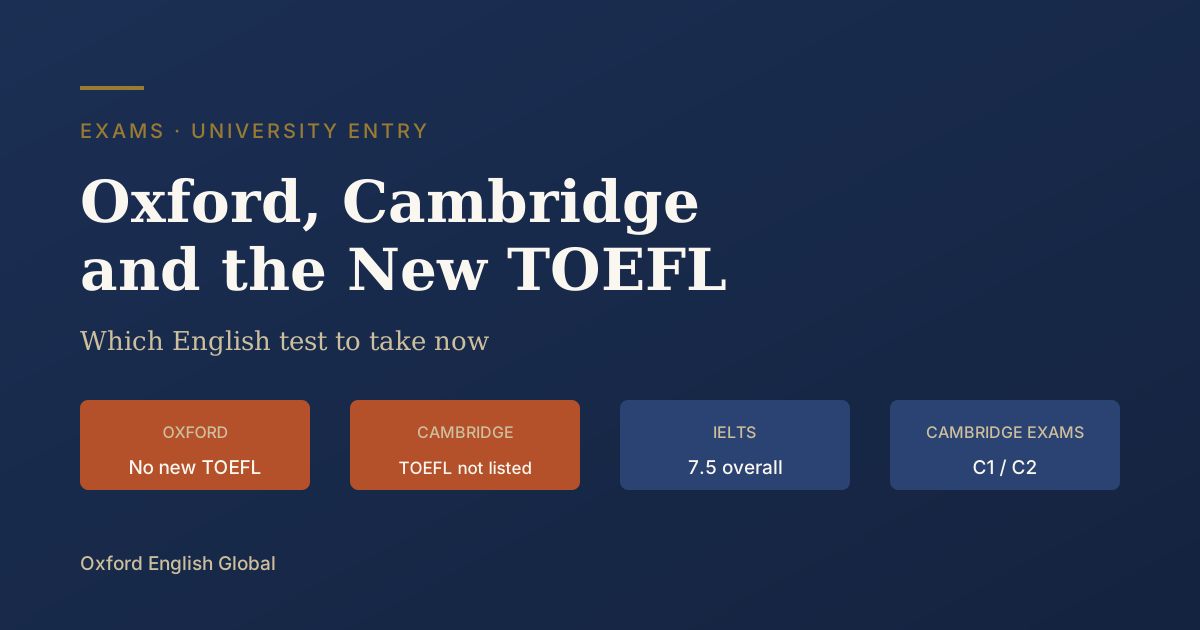
If you are applying to the University of Oxford or the University of Cambridge for undergraduate study, do not plan on the new TOEFL iBT. Oxford says TOEFL iBT tests taken on or after 21 January 2026, the day the redesigned test launched, are not accepted while the University reviews the new format, and Cambridge's undergraduate admissions page does not list the TOEFL at all. For both universities, the safest choices today are IELTS Academic (Cambridge asks for 7.5 overall, usually with 7.0 in each element) or a Cambridge English exam such as C1 Advanced or C2 Proficiency. This guide explains what changed, why it matters, which tests count at Oxford, Cambridge and other leading UK universities, and how to choose and prepare.
Sources and date. Checked on 21 November 2026. Cambridge facts come directly from the University of Cambridge undergraduate entry requirements page, read today. Oxford's undergraduate English language requirements page blocked automated access when we tried to read it today, so Oxford details are confirmed from Oxford's own graduate English requirements page as shown in search results ("the University will only accept tests taken before 21 January 2026") and from independent admissions advisers who quote the undergraduate page, including LHE Consultancy (14 November 2026). Always confirm on the university's own website before you book a test.
What changed: the new TOEFL and Oxford's review
The TOEFL iBT is an English test made by ETS and used by universities around the world. On 21 January 2026 ETS launched a redesigned version. It is shorter, it is reported on a new 1 to 6 band scale instead of the old 0 to 120 total, and its Writing section was rebuilt around short tasks (building sentences, writing an email and posting in an academic discussion) instead of a longer essay. Our article on the new TOEFL 1–6 score scale explains the scoring in detail.
The University of Oxford responded by pausing acceptance of the new test. Its graduate admissions page states that, "following changes made to the test, the University will only accept tests taken before 21 January 2026." Advisers quoting the undergraduate page report the same position: tests taken up to and including 20 January 2026 are accepted, while tests taken from 21 January 2026 are "currently under review by the University" and do not meet the English language condition until that review ends.
| TOEFL iBT test date | Oxford (undergraduate) | What to do |
|---|---|---|
| Up to and including 20 January 2026 (old 0–120 scale) | Accepted if it meets Oxford's score and validity rules (reported as 110 overall) | Check the score is still valid when your course starts |
| On or after 21 January 2026 (new 1–6 scale) | Not accepted while Oxford reviews the new test | Take IELTS Academic or a Cambridge English exam instead |
Oxford has not said when its review will finish. Until it publishes a new decision, treat a new-format TOEFL as unusable for an Oxford offer.
Cambridge's stance: TOEFL is not on the list
The University of Cambridge takes a different route to a similar result. Its undergraduate page does not single out the TOEFL; it simply does not include it among the qualifications it lists. As of 21 November 2026, Cambridge's "minimum English language requirements" for undergraduates are:
- IELTS Academic: "normally a minimum overall grade of 7.5, usually with 7.0 or above in each element".
- School-leaving qualifications that show English at C1 level or above, for example the German Abitur, Romanian Baccalaureate, French Baccalauréat with appropriate English options, Swiss Maturité or Hong Kong Diploma of Secondary Education.
- Cambridge English C2 Proficiency: a minimum overall score of 200, with no element lower than 185.
- Cambridge English C1 Advanced: a minimum overall score of 193, with no element lower than 185, "alongside other evidence of competence in English".
Cambridge adds that, as a guide, students should reach "a good C1 standard" on the CEFR in all four skills by the time they start, and recommends an English level of at least IELTS Academic 6.5 overall, with no element below 6.0, at the point of application so that you can take part in the interview. The College that makes the offer sets the exact English condition.
What about Cambridge postgraduate courses? Advisers report that Cambridge's postgraduate admissions still list the TOEFL but ask applicants with a TOEFL taken after 21 January 2026 to complete an additional English assessment. We could not verify this on Cambridge's postgraduate pages today, so check your course page directly if you are applying for a master's or PhD.
Why the change matters for applicants
Neither university has published a detailed explanation, so be careful with claims about their reasons. What we can say from public information is:
- The test content changed. The new TOEFL Writing section no longer includes a long essay. Oxford and Cambridge teaching relies heavily on extended reading, analytical writing and discussion, so a university may want time to check whether the new test still predicts success on its courses.
- The score scale changed. Universities set their English conditions on the old 0–120 scale. Converting those conditions to the new 1–6 bands requires its own review.
- Your test choice now affects every application. A UK applicant can apply to up to five courses through UCAS. If Oxford or Cambridge is one of them, a single IELTS Academic or Cambridge English result will normally work for all five, while a new TOEFL may not.
Which tests other top UK universities accept
Most other leading UK universities do accept the new TOEFL. The table below summarises undergraduate requirements as reported by LHE Consultancy from each university's website in November 2026. Requirements vary by course, so treat these as a starting point and always check your course page.
| University | IELTS Academic | New TOEFL (from 21 January 2026) |
|---|---|---|
| Oxford | Reported: 7.5 overall, minimum 7.0 in each section | Not accepted while under review |
| Cambridge | 7.5 overall, usually 7.0 in each element (verified) | Not listed |
| LSE | Reported: 7.0, minimum 7.0 in each section | Reported: 5.5, minimum 5.0 in each |
| King's College London | Reported: 6.5 to 7.0 depending on course band | Reported: 4.5 to 5.0 depending on band |
| UCL | Reported: from 6.5 to 8.0 depending on course | Reported: 4.5 to 5.5 depending on course |
| Imperial | Reported: 6.5 standard, 7.0 higher | Reported: 4.5 standard, 5.0 higher |
| Warwick | Reported: 6.0 to 7.0 depending on course | Reported: 4.5 to 5.0 |
Two details catch many applicants. First, section minimums: a strong overall score does not help if one skill is below the minimum. Second, single sittings: Cambridge says component scores "should normally be achieved in a single sitting of the test", so you usually cannot combine your best Reading from one test with your best Speaking from another.
Which English test should you take now?
Use your list of universities to decide.
| Your situation | Best test choice | Why |
|---|---|---|
| Oxford or Cambridge is one of your choices | IELTS Academic at a test centre, or Cambridge C1 Advanced / C2 Proficiency | Accepted by both, and by almost all other UK universities |
| Only other UK universities (LSE, King's, UCL, Imperial, Warwick and so on) | IELTS Academic or the new TOEFL | Both widely accepted; choose the format that suits you |
| You already have an old-format TOEFL (taken by 20 January 2026) | Keep it, but check its validity | Many universities, including Oxford, still accept old-format results within the validity period |
| You also need a UK Student visa | Check whether your university will assess your English itself | Cambridge notes that, as a higher education provider, it can accept qualifications other than a UKVI SELT when sponsoring a student visa |
One more practical point: advisers report that Oxford does not accept IELTS Online, the version taken at home. Book IELTS Academic at a test centre if Oxford is on your list. For the trade-offs between home and centre testing in general, see our guide to at-home vs test-centre English tests.
IELTS Academic or a Cambridge English exam?
IELTS Academic is the most flexible choice: it is accepted almost everywhere, results arrive quickly, and you can practise with free official materials. C1 Advanced and C2 Proficiency are longer exams that never expire as certificates, although universities usually set their own time limits. Cambridge accepts C1 Advanced only "alongside other evidence of competence in English", so C2 Proficiency or IELTS gives you a cleaner case if Cambridge is your first choice. If you are unsure of your level, start with our free English level test.
How to prepare for a 7.5 IELTS or a C1–C2 exam
An IELTS 7.5 with 7.0 in every skill is a high bar, roughly a strong C1. Most applicants need focused preparation, especially in Writing and Speaking.
- Find your weakest skill first. Take a full practice test and work out your band in each section with our free IELTS score calculator. Raising your lowest score to 7.0 matters more than pushing a strong one higher.
- Write a full essay every week. IELTS Writing Task 2 still asks for an extended argument. Our guide to writing a strong opinion essay covers structure, paragraphing and linking language.
- Read academic texts daily. Long articles in your subject build the reading speed and vocabulary that Oxford and Cambridge courses demand, and they help in the interview too.
- Practise speaking about ideas, not just yourself. IELTS Speaking Part 3 and Oxbridge interviews both ask you to explain and defend opinions. Record yourself and listen back.
- Plan your test date backwards. Leave time for a second attempt before your offer deadline. If you need a re-mark, IELTS allows an Enquiry on Results within six weeks of the test date.
A simple timeline for 2027 entry
Oxford and Cambridge offers are usually conditional, and the English condition must be met by the date in your offer. A typical plan for applicants who need to prove their English looks like this:
- Now to early 2027: decide on IELTS Academic or a Cambridge English exam, take a diagnostic test and start targeted preparation.
- Spring 2027: sit your first attempt, leaving time for a retake.
- Before your offer deadline: send your results as your College or the university instructs, and check that they will still be valid on the first day of your course, as Cambridge requires.
If you already took a new-format TOEFL this year, do not panic: it may still be accepted by your other UCAS choices. You only need an additional test for Oxford, and in practice for Cambridge.
What this article cannot tell you
- Oxford's exact current wording. Oxford's undergraduate page blocked automated access on 21 November 2026. We confirmed the 21 January 2026 cut-off from Oxford's graduate page and from advisers quoting the undergraduate page, but Oxford's IELTS and old-TOEFL minimums above are reported, not read directly by us.
- When Oxford's review will end. Oxford has not published a date. Its decision could change after this article was written.
- Course-specific rules. Some courses and Colleges set higher or different English conditions. Your offer letter is the final word.
- Other universities' figures. The scores for LSE, King's, UCL, Imperial and Warwick come from a secondary summary and vary by course.
This page is independent guidance from Oxford English Global. Despite the similar name, we are not connected to the University of Oxford, and we have no commercial relationship with ETS, IELTS, Cambridge University Press & Assessment or the advisers cited. If you want structured help reaching IELTS 7.5 or C1, see our English courses.
Frequently asked questions
Does Oxford accept the new TOEFL?
No. Oxford says TOEFL iBT tests taken on or after 21 January 2026, when the redesigned test launched, are not accepted while the University reviews the new format. Tests taken up to and including 20 January 2026 can still be used if they meet Oxford's score and validity rules.
Does Cambridge accept the TOEFL for undergraduates?
Cambridge's undergraduate entry requirements page does not list the TOEFL. It lists IELTS Academic (normally 7.5 overall, usually with 7.0 in each element), C1-level school-leaving qualifications, and Cambridge English C2 Proficiency or C1 Advanced.
Which English test should I take if I am applying to Oxford or Cambridge?
Take IELTS Academic at a test centre or a Cambridge English exam such as C2 Proficiency. These are accepted by both universities and by almost all other UK universities, so one result can cover all your UCAS choices.
Can I still use a TOEFL I took in 2025?
Possibly. Oxford and many other universities still accept old-format TOEFL iBT results taken before 21 January 2026, provided they meet the required score and are still valid when your course starts. Check each university's validity rules.
Do other UK universities accept the new TOEFL?
Most do. Universities such as LSE, King's College London, UCL, Imperial and Warwick are reported to accept the new 1 to 6 TOEFL scale, with minimum bands that vary by course. Always check your course page.