
How to Give a Short Presentation in English With Confidence: Structure, Phrases and Practice
A short presentation is easier when you use a fixed structure and prepared phrases. This guide gives you a five-minute plan, signposting language for every part, a complete example talk, a rehearsal routine, and tips for nerves, body language and questions.

- Why short presentations are harder than they look
- A simple structure for a five-minute presentation
- Useful phrases for every part of your presentation
- A complete example: a two-minute presentation
- How to prepare in seven steps
- A rehearsal routine that builds confidence
- How to manage nerves
- Voice and body language basics
- Common mistakes to avoid
- What this article cannot tell you
To give a confident short presentation in English, use a simple three-part structure (introduction, two or three main points, conclusion), learn a small set of signposting phrases for each part, speak from short notes rather than a script, and rehearse out loud at least three times with a timer. For a five-minute talk, plan roughly 30 to 45 seconds for the introduction, about a minute for each main point and 30 to 45 seconds for the conclusion, leaving time for questions. This guide gives you a ready-to-use structure, more than 50 useful phrases, a timing plan, a way to handle nerves and questions, and a practice routine that works for adult learners at B1 level and above.
The one-sentence test: before you plan any slides, write your main message in one sentence, for example "Our team should move the weekly meeting online to save two hours of travel." If you cannot say it in one sentence, your audience will not remember it either.
Why short presentations are harder than they look
A short presentation is any talk of about two to ten minutes: a project update at work, a class presentation, a "tell us about yourself" introduction, a five-minute pitch, or a speaking task in an exam or interview. Short talks are common because they are efficient, but they leave little room for mistakes. You cannot spend two minutes warming up, and the audience notices quickly if you lose your place.
For English learners, there are two extra challenges. First, you are thinking about the language and the content at the same time, which uses a lot of mental energy. Second, nerves make it harder to find words you normally know. The solution to both is the same: a fixed structure and prepared phrases, so that your brain only has to work on the content.
A simple structure for a five-minute presentation
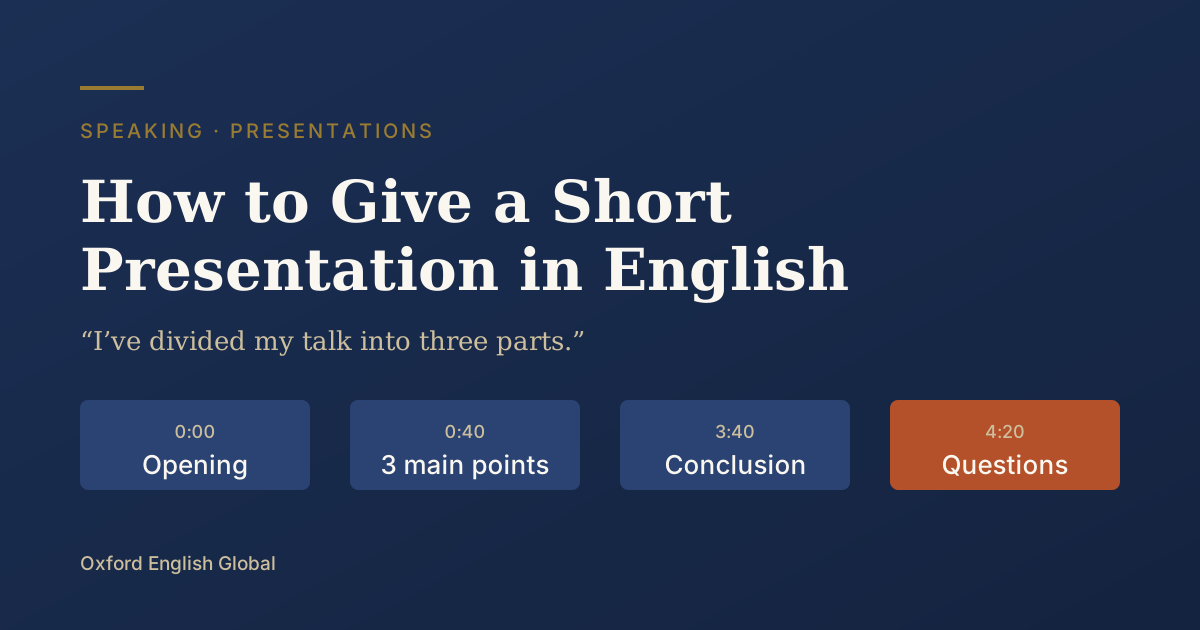
Almost every successful short talk follows the same pattern: tell them what you will say, say it, then tell them what you said. Here is a practical version with suggested timings for five minutes.
| Part | What to do | Suggested time (5-minute talk) |
|---|---|---|
| 1. Opening | Greet, introduce yourself if needed, get attention with a question, fact or short story | 15–20 seconds |
| 2. Purpose and outline | Say your main message and the two or three points you will cover | 20–25 seconds |
| 3. Main point 1 | Point, reason, example | About 1 minute |
| 4. Main point 2 | Point, reason, example | About 1 minute |
| 5. Main point 3 (optional) | Point, reason, example | About 1 minute |
| 6. Conclusion | Summarise, repeat the main message, say what you want the audience to do | 30–40 seconds |
| 7. Questions | Invite and answer questions | Remaining time |
For a two-minute talk, use two main points of about 30 seconds each. For a ten-minute talk, keep three main points but add more examples, not more points. Audiences remember three ideas much better than seven.
The PRE pattern for each main point
Inside each main point, use Point, Reason, Example:
- Point: First, an online meeting saves time.
- Reason: Most of us spend about an hour travelling to the office on Monday mornings.
- Example: Last month, for example, three people were late because of the train strike.
This keeps each section short, clear and self-contained, and it gives you something to say if your mind goes blank: just move to the next letter.
Useful phrases for every part of your presentation
These phrases are called signposting language, because they show the audience where you are in the talk, like signs on a road. Choose two or three phrases for each part and learn them well; you do not need them all.
Opening and greeting
- Good morning, everyone. Thank you for coming.
- Hi everyone, I'm Lina, and I work in the marketing team.
- Let me start with a question: how many of you...?
- Did you know that...?
- I'd like to begin with a short story.
Purpose and outline
- Today I'm going to talk about...
- The purpose of this presentation is to...
- I've divided my talk into three parts.
- First, I'll look at... Then I'll... Finally, I'll...
- It should take about five minutes, and there will be time for questions at the end.
Moving between points
- Let's start with...
- That brings me to my second point.
- Now let's move on to...
- Next, I'd like to look at...
- Finally, ...
Giving examples and reasons
- For example, ... / For instance, ...
- A good example of this is...
- The main reason is that...
- This is important because...
- In other words, ...
Talking about slides, charts and numbers
- As you can see on this slide, ...
- This chart shows...
- Sales went up / rose / increased by 10%.
- Costs went down / fell / decreased slightly.
- The figure stayed the same / remained stable.
- I'd like to draw your attention to...
Concluding
- To sum up, ... / In summary, ...
- So, the key message is...
- Let me finish by saying...
- What I'd like you to do is...
- Thank you for listening.
Inviting and handling questions
- I'm happy to take any questions.
- That's a great question. Thank you.
- Sorry, could you repeat the question, please?
- If I understand correctly, you're asking about... Is that right?
- I'm not sure about that, but I'll find out and get back to you.
- Does that answer your question?
If your English needs to be more formal or business-focused, our guide to business English and the free Complete Business English Handbook include more meeting and presentation language.
A complete example: a two-minute presentation
Here is a short example using the structure and phrases above. Read it aloud and time yourself; at a calm pace it takes roughly two minutes.
Good morning, everyone. Let me start with a question: how much time did you spend travelling to last Monday's meeting?
Today I'd like to suggest that we move our weekly team meeting online. I'll cover two points: time and participation.
Let's start with time. Most of us travel about an hour to reach the office on Mondays, and the meeting only lasts forty minutes. For example, last month three people arrived late because of the train strike. Online, we would all start on time.
That brings me to my second point: participation. In online meetings, people can use the chat to ask questions, which is easier for quieter colleagues. A good example is the client call last week, where we got twelve questions in the chat.
So, to sum up: an online meeting saves travel time and helps more people take part. What I'd like us to do is try it for one month and then review it. Thank you for listening. I'm happy to take any questions.
Notice what the speaker does: one clear message, two points, one example each, a clear request at the end, and simple sentences. Simple English is not a weakness in a presentation; it is easier for everyone to follow, including native speakers.
How to prepare in seven steps
- Know your audience and goal. Who will listen, what do they already know, and what should they think or do after your talk?
- Write your one-sentence message. Everything else should support it.
- Choose two or three main points. Cut everything else, even if it is interesting.
- Write short notes, not a script. Use keywords and the signposting phrases. Reading a full script makes you sound flat and stops eye contact.
- Prepare simple slides (if any). One idea per slide, few words, large text. Slides support you; they are not your notes.
- Check difficult words. Look up the pronunciation of key words and names, and mark word stress, for example deVELopment, PHOtograph, phoTOgraphy. Our guide to improving pronunciation at home explains how.
- Prepare for three likely questions. Write short answers in advance.
A rehearsal routine that builds confidence
Confidence comes mostly from preparation and repetition. Rehearse out loud, not in your head; speaking and thinking are different skills. A practical routine:
| Rehearsal | Focus | How |
|---|---|---|
| 1 | Content and order | Say the whole talk out loud with your notes. Do not stop for mistakes. |
| 2 | Timing | Use a timer. Cut content if you are over time; do not just speak faster. |
| 3 | Language | Record yourself on your phone. Listen for unclear words and fix two or three. |
| 4 | Delivery | Stand up, look up from your notes, pause after each main point. |
| 5 (if possible) | Real audience | Present to a friend, colleague or teacher and ask for one strength and one thing to improve. |
Learn your first three sentences and your last two sentences almost by heart. A strong start calms your nerves, and a strong ending is what people remember. For more timed speaking practice, the free PDF The Fluency Stopwatch (written for teachers) has activities you can adapt for yourself.
How to manage nerves
Feeling nervous before speaking in public is very common, for native speakers too. You cannot remove nerves completely, but you can reduce their effect:
- Breathe slowly before you start. A few slow breaths, with a longer breath out than in, help many people feel calmer.
- Slow down. Nervous speakers speak fast. Aim to speak a little more slowly than feels natural, and pause between sections.
- Use pauses instead of fillers. A short silence sounds confident; "erm, erm" does not. Use a phrase such as Let me think about that for a moment if you need time.
- Find friendly faces. Look at people who are nodding or smiling.
- Accept small mistakes. If you make a grammar mistake, keep going. The audience is listening to your ideas, not marking your grammar.
- If you lose your place, look at your notes and say So, where was I? Yes, ... It is completely normal.
If speaking anxiety is a big issue for you, read how to speak English confidently when you are shy, and for a longer guide to public speaking, download our free PDF Command the Room.
Voice and body language basics
- Stand or sit up straight, with both feet on the floor.
- Make eye contact with different parts of the room, or look at the camera in an online presentation.
- Use your hands naturally to show numbers or contrasts ("on the one hand... on the other hand").
- Stress key words. Say important words a little louder and more slowly: We can save two hours every week.
- Use falling intonation at the end of statements so you sound sure, not like you are asking a question. You can check your rising and falling tone with our free Speaking Lab.
Common mistakes to avoid
- Too much content. Five minutes is not enough for seven points. Choose three.
- Reading slides aloud. The audience can read faster than you speak. Say something the slide does not.
- Memorising a full script. If you forget one word, you may lose everything. Memorise the structure and key phrases instead.
- Complex sentences. Long sentences are hard to say and hard to follow. Use short ones.
- No clear ending. Do not finish with "So... that's it." Summarise and thank the audience.
- Apologising for your English. Do not start with "Sorry, my English is not good." It lowers the audience's expectations and your confidence.
What this article cannot tell you
- The rules of your specific situation. Exam speaking tasks, university assessments and company presentations may have their own time limits, criteria and formats. Check them first.
- Exact timings for every speaker. Our timings are a practical guide, not a rule. Speaking speed varies a lot between people; time your own rehearsal.
- Clinical advice on anxiety. The nerves tips here are general. If anxiety stops you from speaking at work or study, consider talking to a qualified professional.
- Feedback on your delivery. Reading cannot show you how you sound. Record yourself, or get feedback from a teacher: our courses include speaking practice with feedback, and our free lessons are a good place to start. To check where you are, take our English level test; the CEFR global scale describes what speakers can do at each level.
Frequently asked questions
How do I structure a five-minute presentation?
Use an opening, a one-sentence purpose with an outline, two or three main points of about a minute each, and a short conclusion with a summary and a clear request, then take questions.
What phrases can I use to start a presentation in English?
Try Good morning, everyone. Today I'm going to talk about... I've divided my talk into three parts. First, I'll... Then I'll... Finally, I'll...
Should I memorise my presentation?
Memorise the structure, your first three sentences and your last two sentences, but speak from short notes rather than a full script.
How can I stop feeling nervous?
Rehearse out loud several times, breathe slowly before you start, speak a little slower than feels natural, use pauses instead of fillers and keep going after small mistakes.
What if I don't understand a question?
Say Sorry, could you repeat the question, please? or check by rephrasing: If I understand correctly, you're asking about... Is that right?