
ESAT-J Explained: Tokyo's English Speaking Test for High School Entrance and How to Practise at Home
ESAT-J is the tablet-based English speaking test that Tokyo's public junior high school students take in their third year. This guide explains the four parts, how grades A to F become up to 20 entrance points, the 2026 test dates and results, and practical ways for families and tutors to practise speaking at home.

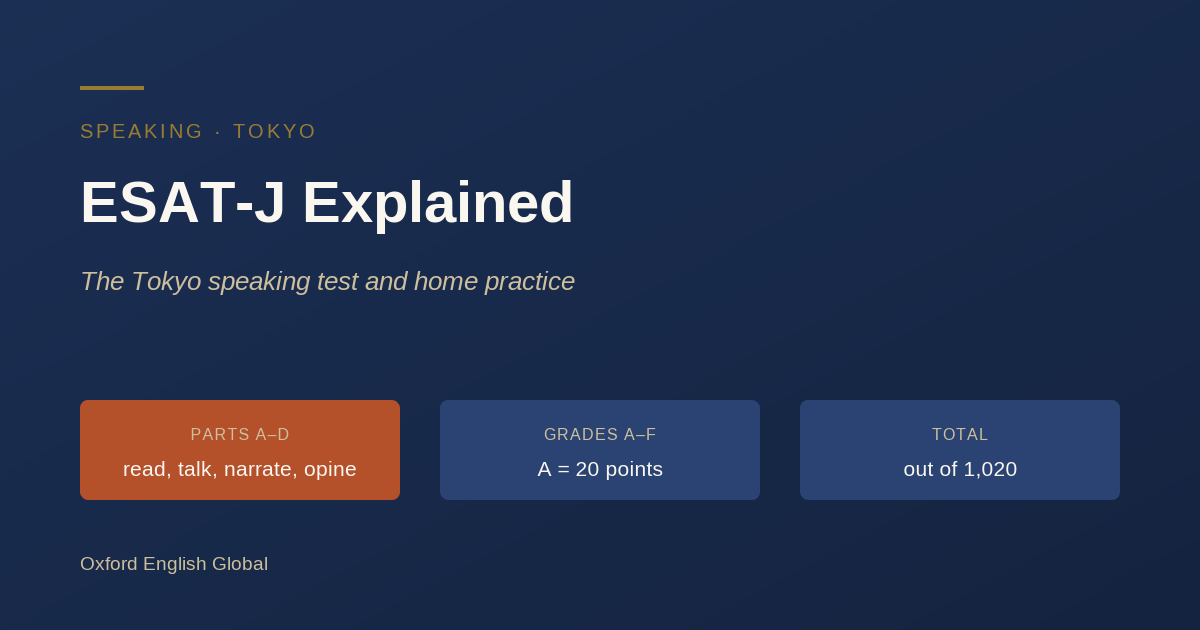
ESAT-J (English Speaking Achievement Test for Junior High School Students) is the English speaking test run by the Tokyo Metropolitan Board of Education for students at Tokyo's public junior high schools. In the third-year test (ESAT-J YEAR 3), students record answers on a tablet in four parts: reading aloud, short conversation questions, telling a story from pictures and giving an opinion. They receive a grade from A to F, and for Tokyo metropolitan high school entrance this grade is worth up to 20 points (A = 20, F = 0), added to the 1,000 points from the written exams and school report for a total of 1,020. The 2026 test took place on 22 November 2026, with a make-up date on 13 December; results go online from 6 January 2027. This guide explains the format, how scores feed into admissions and how families, tutors and teachers can help students practise speaking at home.
Sources and who this page is for. ESAT-J is run by the Tokyo Metropolitan Board of Education, which publishes the official rules (実施要項), sample tests and scoring criteria in Japanese. Its pages did not load for our automated check on 27 November 2026, so the details below come from two Japanese sources that summarise those official documents and were read that day: the education news site ReseMom (24 November 2026), reporting the Board's announcement of the 2026 test, and the preparation site Edtools (updated 29 October 2026), which cites the Board's 2026 rules and the 2027 high school admissions guidelines. Edtools states that it is not connected with the Board. Always confirm dates and rules with the Board and your school. Oxford English Global teaches adults; we wrote this for parents, tutors and teachers who support students taking the test.
What ESAT-J is
ESAT-J is an achievement test of spoken English for public junior high school students in Tokyo. Its purpose, according to the Board's description reported by ReseMom, is to assess objectively the speaking ability students have built through junior high school English lessons and to encourage them to improve their speaking. The third-year test, ESAT-J YEAR 3, matters most, because its result is used as evaluation material in Tokyo metropolitan (都立) high school entrance.
Students at national, private or out-of-prefecture junior high schools who plan to apply to a Tokyo metropolitan high school can also apply to take it, through their school and a parent's online account.
The 2026 test in numbers
| Item | 2026 (Reiwa 8) ESAT-J YEAR 3 |
|---|---|
| Main test date | Sunday 22 November 2026 |
| Make-up / re-test date | Sunday 13 December 2026 |
| Applicants | About 74,000 |
| Students who took the test on 22 November | About 67,000 (both figures about 1,000 lower than in 2025) |
| Venues | 226: 185 metropolitan schools and 41 private venues |
| Results online | From Wednesday 6 January 2027 (make-up test: from 22 January) |
| Paper report sent to schools | 18 January 2027 (make-up test: 28 January) |
Source: ReseMom, 24 November 2026, for dates, numbers and venues; Edtools for result dates. ReseMom also reported that one venue finished about 30 minutes late because checking the room set-up took longer than planned.
ESAT-J YEAR 3 format: Parts A to D
Questions appear on a tablet, and students speak after a recording tone. Students are split into two groups, and each session takes about 65 minutes including preparation and instructions. There are nine questions in four parts:
| Part | Task | Questions | Preparation | Answer time |
|---|---|---|---|---|
| A: Reading aloud | Read a short English text aloud so that a listener can understand it | 2 | 30 seconds each | 30 seconds each |
| B: Conversation | Look at a picture such as a map or flyer and answer questions; answer questions about yourself; ask a question | 5 | None for questions 1–4; 10 seconds for question 5 | Up to 15 seconds each |
| C: Narration | Tell a story from four pictures in order, starting with a given phrase | 1 | 30 seconds | Up to 40 seconds |
| D: Giving an opinion | Listen to a teacher's explanation, then give your opinion on a theme with reasons (you may use one of three hints) | 1 | 60 seconds | Up to 40 seconds |
Source: Edtools, based on the Board's 2026 sample test. Questions in Part B (1–4) and the teacher's explanation in Part D are heard as audio only; the Part B question 5 prompt and the Part D theme and hints are shown on screen.
Notice how short the answer times are. A student who pauses for five seconds before starting has lost a third of a 15-second answer. Much of the practice below is about starting quickly.
How ESAT-J is scored
Answers are rated against criteria for each part. According to Edtools' summary of the Board's criteria, the test looks at three aspects: communication (did the answer achieve the task?), language use (grammar and vocabulary) and pronunciation. Scores are processed statistically using item response theory (IRT) and reported as a score from 0 to 100 and one of six grades.
| Grade | Score | Points in Tokyo metropolitan high school entrance | Share of students in 2025 |
|---|---|---|---|
| A | 80–100 | 20 | 47.2% |
| B | 65–79 | 16 | 29.0% |
| C | 50–64 | 12 | 13.4% |
| D | 35–49 | 8 | 5.9% |
| E | 1–34 | 4 | 4.0% |
| F | 0 | 0 | 0.5% |
Source: Edtools, citing the Board's February 2026 press release for the 2025 (Reiwa 7) score ranges and percentages, and the Board's document on using ESAT-J results in metropolitan high school entrance for the points. The average score in 2025 was 74.9.
What each part rewards, in brief:
- Part A: pronunciation and stress, and reading speed and pausing that make the meaning clear.
- Part B: whether each answer fits the situation. A short answer such as "The zoo." or "Four." can be appropriate if it answers the question.
- Part C: describing all four pictures in time order, covering the key points and linking ideas with words such as then and so.
- Part D: a clear opinion, supported by a reason and an example, connected with linking words.
The student's report shows the grade, the score, a reference CEFR-J level, "can do" statements for that grade and study advice. Parents can request access to the recording of their child's answers through the parent account.
How ESAT-J results feed into high school admissions
For the first-round and split first-period admissions to Tokyo metropolitan high schools, the junior high school writes the ESAT-J grade on the student's school report (調査書). The high school converts it to points: A = 20, B = 16, C = 12, D = 8, E = 4, F = 0. These points are added to the 1,000 points from the written entrance exams and the school report, for a total out of 1,020.
- Schools where it does not apply: Encourage Schools, Challenge Schools and schools that do not hold an English written exam.
- Recommendation-based and later rounds: students do not submit the result when applying for recommendation-based selection, the split second-period or the second round, but submit the report if they are admitted.
- Students who could not take it: students who missed the test for an unavoidable reason such as illness (with the school's procedure), and students at private or out-of-prefecture schools who did not take it, receive a provisional result calculated from the average ESAT-J results of applicants with similar English written exam scores. A student who is absent without a valid reason is treated as zero.
Twenty points out of 1,020 is about 2% of the total, but entrance decisions can be close, so the difference between grades B and A (four points) can matter.
How students can practise speaking at home
The most useful practice is short, timed and spoken aloud. Reading answers silently does not prepare a student to start speaking within a second of the tone. These routines take ten to fifteen minutes a day.
Part A: reading aloud for meaning
- Use a short paragraph from the school textbook. Spend 30 seconds marking where to pause (commas, full stops, after long subjects) and which words to stress (numbers, names, key nouns and verbs).
- Read it aloud in 30 seconds. Record it and listen: does it sound like someone telling information, or like a list of words?
- Shadowing helps: play the textbook audio and speak along with it, copying the rhythm. Our guide to connected speech explains why natural English links words together.
Part B: fast, relevant answers
- A parent or tutor asks quick questions about pictures (a map, a menu, a timetable) and about daily life: Where is the station? How many people are there? What do you usually do on Sundays?
- The student answers within three seconds. Short answers are fine if they fit; then practise adding one more sentence.
- For question 5, practise asking questions correctly: What time does it start? Where can I buy tickets? Check that the question word and the auxiliary (do, does, is) are both there.
Part C: telling a story from pictures
- Use any four-panel comic or draw four simple pictures. Tell the story in the past tense in 40 seconds, starting with a phrase such as Last Sunday…
- Use linking words for each step: First… Then… After that… So… In the end…
- Check that all four pictures are mentioned. Missing one is a common way to lose marks.
Part D: opinion, reason, example
Practise a four-step frame that fits comfortably into 40 seconds:
"I think students should do volunteer work. This is because they can learn about their local community. For example, they can help older people at a care home and hear about their lives. So I think volunteer work is a good experience for students."
Give a new theme each day: school uniforms, using smartphones at school, studying abroad, reading books versus watching videos. Use the full 60 seconds of planning time to choose one opinion and one example; do not try to say everything.
Start speaking straight away
The single most useful habit is to say a first sentence immediately, even a simple one, instead of waiting for a perfect idea. Practise with a timer and a "go" signal until it feels automatic. Our guide to practising speaking without a partner has more solo routines, and our free Speaking Lab shows pitch and rhythm as you speak, which helps with Part A.
Tips for parents and tutors
- You do not need perfect English to help. Holding the timer, asking the questions in Japanese or English, and listening to recordings together all help.
- Focus on completing the task. The criteria reward answers that fit the situation and cover the required points. A simple, complete answer is better than an ambitious, unfinished one.
- Use the official sample tests. The Board publishes past questions and model answers on its ESAT-J page. ReseMom reported that the 2026 questions and model answers were published after the test.
- Compare with the student's recording. After results come out, parents can request the answer audio and compare it with the model answers to decide what to practise next.
- Keep it short and regular. Ten minutes of daily speaking practice is more useful than one long session at the weekend.
Adults supporting learners at home may also find our guide to improving pronunciation at home useful for their own practice.
What this article cannot tell you
- Official confirmation. We could not load the Tokyo Metropolitan Board of Education's pages directly on 27 November 2026. The facts here come from ReseMom and Edtools summaries of the Board's documents. Check the Board's ESAT-J page and your school's notices for the official rules.
- Individual admissions outcomes. How much the ESAT-J grade affects a particular student's admission depends on their other scores and the school they apply to.
- Future years. Dates, the format and the way results are used may change. The details here describe the 2026 (Reiwa 8) test and 2027 admissions.
- Predicted grades. Practice tools, including AI scoring apps, give estimates only. They do not predict the official grade.
This page is independent guidance from Oxford English Global. We are not connected with the Tokyo Metropolitan Board of Education, ESAT-J's test administrator or the sites cited, and the page contains no affiliate links.
Frequently asked questions
What is ESAT-J?
ESAT-J (English Speaking Achievement Test for Junior High School Students) is a speaking test run by the Tokyo Metropolitan Board of Education for public junior high school students in Tokyo. The third-year result is used in Tokyo metropolitan high school entrance.
How many points is ESAT-J worth in Tokyo high school entrance?
Up to 20. Grade A counts as 20 points, B as 16, C as 12, D as 8, E as 4 and F as 0. These are added to 1,000 points from the written exams and school report, for a total of 1,020.
What are the four parts of ESAT-J?
Part A is reading aloud, Part B is short conversation questions including asking a question, Part C is telling a story from four pictures, and Part D is giving an opinion with reasons. Answers are recorded on a tablet.
When are the 2026 ESAT-J results released?
For the main test on 22 November 2026, results go online from 6 January 2027 and paper reports are sent to schools on 18 January 2027, according to summaries of the Board of Education rules.
What happens if a student misses ESAT-J?
A student who misses it for an unavoidable reason through the school procedure receives a provisional result based on applicants with similar English exam scores. An absence without a valid reason counts as zero.