
Duolingo Max Is Being Discontinued: What Video Call in Super Means for English Learners
Duolingo has stopped selling Max and is moving unlimited Video Call into Super Duolingo by the end of 2026. Here is what changes for free, Super and Max users, which AI features are actually free, and how English learners can use Video Call for real speaking practice.

- What Duolingo announced in November 2026
- What changes for free, Super and Max users
- Where each Max feature stands now
- Which AI speaking features are free?
- Video Call for English learners: availability and what a call is like
- A weekly Video Call speaking routine for English learners
- What Video Call cannot do that a teacher can
- Should you pay for Super to get Video Call?
- What this article cannot tell you
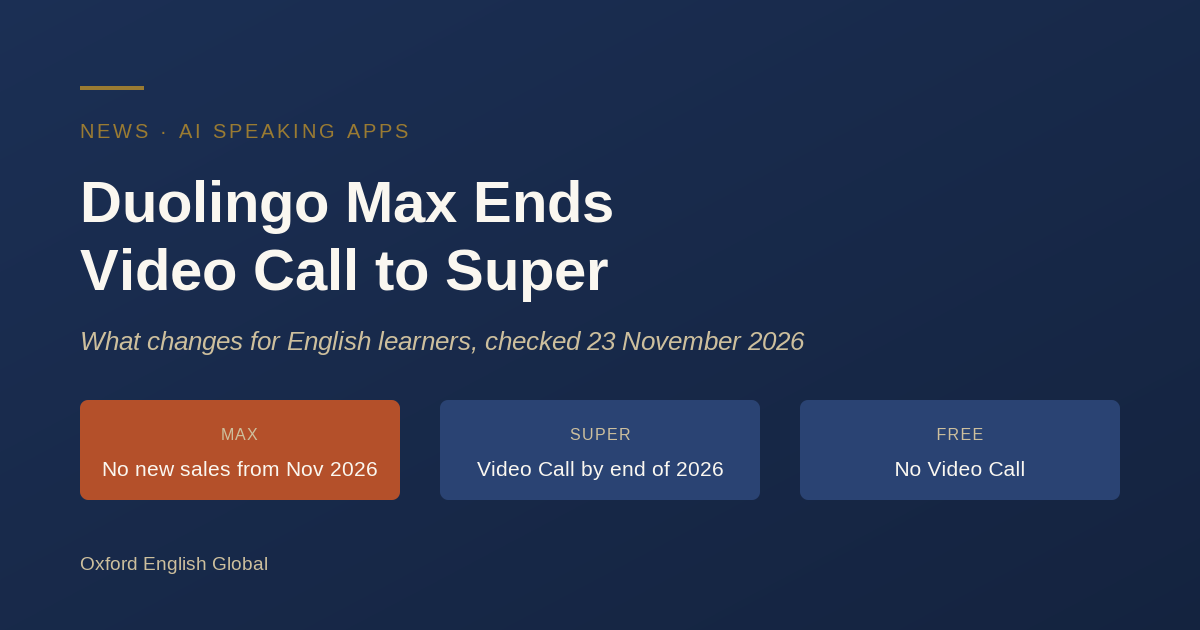
Yes, Duolingo is discontinuing Max. In its third-quarter 2026 shareholder letter, published on 3 November 2026, the company said it had "decided to sunset Duolingo Max", would stop selling new Max subscriptions in November 2026, and would move individual Max subscribers to a Super Family plan at the same price. Unlimited Video Call, the AI speaking feature that was the main reason to buy Max, is moving into Super Duolingo and is due to reach all Super subscribers by the end of 2026. Video Call is not becoming free. This guide explains what changes for free, Super and Max users, which AI features you can use without paying, and how an adult English learner can turn Video Call into real speaking practice, with a weekly routine and an honest look at what it cannot do.
Sources and date. Checked on 23 November 2026. The announcement is in Duolingo's Q3 2026 shareholder letter, filed with the US Securities and Exchange Commission. The SEC website blocked our automated reader, so we quote the letter as reported by Observer (11 November 2026) and other coverage that links to the filing. Executive comments come from the Q3 2026 earnings call transcript published by The Motley Fool. Feature and course details come from Duolingo's own blog posts on Video Call with Lily, Video Call with Falstaff, Duolingo Max and its Video Call research report, and from the Super Duolingo page. Where a claim comes only from a fan or review site, we say so.
What Duolingo announced in November 2026
Duolingo launched Max in March 2023 as a tier above Super, built around features that used large language models. In the Q3 2026 shareholder letter, the company wrote that "since unlimited Video Call will be part of Super, we've decided to sunset Duolingo Max, our highest subscription tier." According to the letter as quoted in coverage, Duolingo would, during November 2026:
- stop selling new Max subscriptions;
- move existing individual Max subscribers to a Super Family plan at the same price, "giving them the same feature set plus the added benefit of sharing their subscription with family or friends";
- keep considering options for legacy Max Family subscribers, with a decision to come in 2027.
On the earnings call on 3 November, chief executive Luis von Ahn explained why. When Video Call launched, he said, it cost "about $0.30 per call" in AI processing; Duolingo has since cut that "to well under $0.01 per call", mainly by moving to open-source or open-weight models. That made it affordable to put Video Call in Super, which he said reaches "about 10x as many users" because Super has far more subscribers than Max. Chief financial officer Gillian Munson said Max had become a single-digit share of both paid subscribers and bookings.
One small wording difference is worth knowing. The letter says "same price"; on the call, Munson said individual Max subscribers would move to Super Family "at a similar price". Check your own bill after the switch.
What changes for free, Super and Max users
Here is the position as of 23 November 2026, based on Duolingo's statements.
| Your plan | What Duolingo says happens | When |
|---|---|---|
| Free | No change to the free plan was announced. Video Call is not added to the free tier. | Not applicable |
| Super (new subscriber) | Unlimited Video Call included. Coverage of the letter says this began for new Super subscribers during Q3 2026. | Already in place |
| Super (existing subscriber) | Unlimited Video Call being rolled out; the letter says Duolingo is on track to reach all Super subscribers by the end of the year. | By end of 2026 |
| Max individual | Moved to Super Family at the same price, with the same features plus sharing. Duolingo's Super page says Super Family covers up to 6 accounts. | From November 2026 |
| Max Family | Stays on the legacy plan for now; options to be addressed in 2027. | 2027 |
| Thinking of buying Max | No longer possible. Super is now the plan that includes Video Call. | From November 2026 |
What about prices? Duolingo's Super page showed no prices when we checked on 23 November 2026, only a one-week free trial, and the shareholder letter does not publish a price list. Prices vary by country, platform and offer, so the figure on your own in-app paywall is the one that applies. When we checked, the Super page also did not yet list Video Call among Super's features, which fits a rollout that is still in progress.
Where each Max feature stands now
Max was originally sold on three AI features. Each has followed a different path.
| Feature | What it does | Status on 23 November 2026 | Source quality |
|---|---|---|---|
| Video Call | A spoken, real-time conversation with an animated character (Lily, or Falstaff for guided calls) | Moving to Super; all Super subscribers by end of 2026 | Official (shareholder letter, earnings call) |
| Explain My Answer | An AI explanation of why an answer was right or wrong | Reported free for all learners since 1 January 2026, in seven courses (Spanish, French, German, Japanese, Portuguese, Italian, Korean) | Secondary only: we could not load Duolingo's own announcement |
| Roleplay | Guided text-and-voice scenarios with AI feedback afterwards | Not addressed in the coverage of the letter or on the earnings call we read | Unconfirmed |
| Practice Hub | Mistakes review and skills practice | Reported free for all learners since February 2026 | Secondary only |
Two points matter for English learners. First, the seven Explain My Answer courses reported by DuoGuides, an independent fan site, are courses for learners of those languages; the English course is not on that list, so do not expect Explain My Answer in Duolingo's English course. Second, Duolingo's 2023 Max announcement listed Roleplay for "English speakers learning Spanish, French, German, Italian, and Portuguese". We found no official page confirming Roleplay in the English course, and no statement about Roleplay's future. If you rely on it, watch for Duolingo's own message.
Which AI speaking features are free?
The short, honest answer: Duolingo has not announced any AI conversation feature for free users. Video Call is moving from one paid tier (Max) to another paid tier (Super). It is not becoming free.
There is a hint about the future. On the earnings call, von Ahn said Duolingo would spend "single-digit millions" in 2027 on live AI costs for free users "because we do want to give some of these AI features to free users". He did not say which features. He also said the company is "working on a number of features, particularly practicing speaking that are not just Video Call". Neither statement promises free Video Call.
What you can do for free today: normal lessons still include speaking exercises, and the Practice Hub is reported (by secondary sources) to have been free since February 2026. Free trials are also relevant. Von Ahn said learners who try Video Call during the free trial are more likely to subscribe, which suggests the trial is one way to test it. Check in your own app whether Video Call appears during your trial, because availability can vary by account and course.
If you want regular AI conversation without paying, see our comparison of free vs paid AI language learning apps, which explains what free tiers usually cover and where they stop.
Video Call for English learners: availability and what a call is like
Video Call is available in Duolingo's English course, according to Duolingo's own blog:
- Video Call with Lily (open, "unguided" conversation) was announced on 24 September 2024 for learners of English, Spanish, French, German, Italian and Portuguese, with Japanese and Korean on iOS first. Calls appear on the course path and in the Practice Hub.
- Video Call with Falstaff ("guided" calls for less confident speakers) was announced on 14 January 2026 for learners of English and eight other languages, on iOS at launch, with a rollout across all levels planned by the end of 2026.
Both announcements were written when Video Call was a Max feature, so the plan names have changed but the descriptions of the calls still apply. Duolingo has not published a list of which English courses (for speakers of which first languages) include Video Call, and we did not find official details on web-browser access. If you learn on a computer, check the mobile app.
How Lily and Falstaff differ
| Lily (unguided) | Falstaff (guided) | |
|---|---|---|
| Style | Free-flowing chat; she starts, you can talk about anything | Coached; he asks questions at your level |
| Help | You can ask her to repeat or slow down | Suggests phrases and translations when you are stuck |
| Correction | Duolingo says "you won't hear her correct your grammar" | Gives "real-time feedback in your own language" |
| Length | About 1 minute early in a course, up to about 3 minutes later (2024 description) | Not stated |
| Best for | B1 and above who need fluency practice | A1 to A2, or anyone who freezes |
After a call, Duolingo's Max page says you can see a transcript of the conversation. That transcript is the most useful learning tool in the feature, and the routine below is built around it.
Does it work?
Duolingo's Efficacy Research Lab published a research report on 30 March 2026. One study looked at Japanese speakers learning intermediate English: those who used Video Call at least twice a day for a month improved more on a standardised speaking test than learners who only did regular lessons. This is company research, and the public summary does not give sample sizes or effect sizes. The fair reading is that short, frequent speaking practice beats no speaking practice, which matches what teachers see.
A weekly Video Call speaking routine for English learners
Video Call works best as a daily habit with a clear focus, not as a random chat. This routine takes about 15 minutes a day, including review. The prompts are our suggestions for things you can say or steer the conversation towards; they are illustrative, not Duolingo content, and Lily may take the conversation somewhere else.
| Day | Focus | Example things to say | After the call |
|---|---|---|---|
| Monday | Talking about routines | "On weekdays I usually…" / "What I like most about my job is…" | Find one sentence in the transcript you could make longer |
| Tuesday | Past events and stories | "Last weekend I ended up…" / "The funny thing was…" | Check your past tenses; rewrite two sentences correctly |
| Wednesday | Opinions and reasons | "I'd say… mainly because…" / "On the other hand…" | Note any answer that was only one word |
| Thursday | Plans and future | "I'm planning to…" / "If I have time, I'll probably…" | List two phrases you wanted but did not know |
| Friday | Repair strategies | "Sorry, could you say that again?" / "Do you mean…?" / "What I'm trying to say is…" | Count how often you used a repair phrase instead of stopping |
| Saturday | Repeat a weak topic | Use the phrases you listed on Thursday | Compare with Monday's transcript: longer answers? |
| Sunday | Rest or record yourself | Speak for 90 seconds on the week's best topic, without the app | Listen back once; note one pronunciation point |
Five rules that make the calls count
- Answer in two or three sentences, never one word. A one-minute call gives you very little speaking time; filling it is your job.
- Ask Lily questions back. Real conversation is two-way, and asking questions is a skill in itself. Our guide to small talk in English has useful question forms.
- Read the transcript every time. Lily does not correct your grammar during the call, so the transcript is where you catch mistakes.
- Keep a "phrases I needed" list. Look the phrases up, then use them in the next call. That loop turns chatting into learning.
- Do a second call when you can. The intermediate study above used at least two calls a day. Short, frequent practice suits most adults' schedules.
For more solo methods such as shadowing and self-recording, see how to practise English speaking without a partner, and for fluency techniques, how to improve English speaking.
What Video Call cannot do that a teacher can
Video Call is a good speaking warm-up. It is not a teacher. Here is a plain comparison.
| Need | Video Call | A good human teacher |
|---|---|---|
| Speaking practice at any hour | Yes, unlimited on Super | Only at booked times |
| Low-pressure mistakes | Yes, no penalty for errors | Depends on the teacher and class |
| Correction of grammar during speech | Lily: no. Falstaff: some feedback | Yes, and they choose which errors matter |
| Long turns (2 to 5 minutes) | Calls are short | Yes, essential for exams and presentations |
| Your own topics (job, exam, interview) | Partly; topics follow the course path | Yes, built around your goal |
| Pronunciation diagnosis | Not described by Duolingo | Yes, sound by sound if needed |
| Accountability and a plan | Streaks and reminders | A person who notices when you stall |
The most effective approach for most adults is both: Video Call for daily volume and confidence, and a teacher or structured course for direction, correction and longer speaking. Our article on AI vs human tutors explains how to divide the work.
Should you pay for Super to get Video Call?
That depends on what you need, not on the announcement.
- You already use Duolingo daily for English and rarely speak out loud. Super now includes the one feature that gives you regular conversation. Use the free trial, make sure Video Call appears in your English course, and do the routine above every day of the trial before deciding.
- You were a Max subscriber. Duolingo says you keep the same price and features and gain family sharing. Confirm the plan name and price after the switch.
- You use Duolingo a few times a week. The free plan may be enough; spend the money on something with more speaking time.
- You have an exam, interview or move abroad coming. Video Call alone is too short and too general. Add longer practice with feedback.
For an overall view of the app, read our Duolingo review. For how Duolingo's AI features compared with other apps before this change, see our earlier look at AI features in Duolingo Max, Babbel, Speak and ELSA Speak; note that it describes Max as it was in August 2026.
What this article cannot tell you
- Your exact switch date or price. Duolingo has not published a per-account timetable, and prices vary by country and platform.
- The full text of the letter. We could not open the SEC filing directly and rely on quotations in Observer and other coverage that link to it, plus the earnings call transcript.
- Roleplay's future. Duolingo has not said publicly, in the sources we read, what happens to Roleplay after Max ends.
- Max Family. Duolingo says it will address these subscribers in 2027.
- Explain My Answer. Its free status and course list come from secondary sources; we could not load Duolingo's own announcement.
- Later changes. Duolingo runs many A/B tests, so what you see may differ from this page. Everything here was checked on 23 November 2026.
This page is independent guidance from Oxford English Global. We have no commercial relationship with Duolingo or any news outlet or website cited, and the page contains no affiliate links. If you want longer speaking practice with feedback from a teacher, see our English courses, or start with our free lessons.
Frequently asked questions
Is Duolingo Max really being discontinued?
Yes. In its Q3 2026 shareholder letter, published on 3 November 2026, Duolingo said it had decided to sunset Max and would stop selling new Max subscriptions in November 2026. Individual Max subscribers are being moved to a Super Family plan at the same price, and Max Family subscribers will hear about their options in 2027.
Is Duolingo Video Call free now?
No. Video Call is moving from Max to Super Duolingo, which is a paid plan. Duolingo says unlimited Video Call is on track to reach all Super subscribers by the end of 2026. No AI conversation feature has been announced for the free plan, although the company says it plans to give some AI features to free users in 2027.
Can I use Duolingo Video Call to practise English?
Yes. Duolingo's blog lists English among the courses with Video Call with Lily, and Video Call with Falstaff launched for English learners on iOS in January 2026. Calls are short, so use them daily, answer in full sentences and review the transcript afterwards.
Does Lily correct my grammar during a Video Call?
Duolingo says you will not hear Lily correct your grammar, because the calls are designed as low-pressure conversation. Falstaff's guided calls give some real-time feedback in your own language. To catch your own mistakes, read the call transcript and rewrite the sentences that went wrong.
What happens to Roleplay when Max ends?
Duolingo has not said publicly what happens to Roleplay, in the sources we checked on 23 November 2026. Its 2023 Max announcement listed Roleplay for English speakers learning other languages, and we found no official confirmation that it is in the English course. Watch for an in-app message from Duolingo if you use it.