
Booking an English Course Abroad After the 2026 School Closures: What to Check Before You Pay
EC English Language Centres stopped trading in September 2026, and English UK has launched a review to protect students whose school closes. Here is what protection exists today, what the review may change and a checklist to use before you pay for a course abroad.

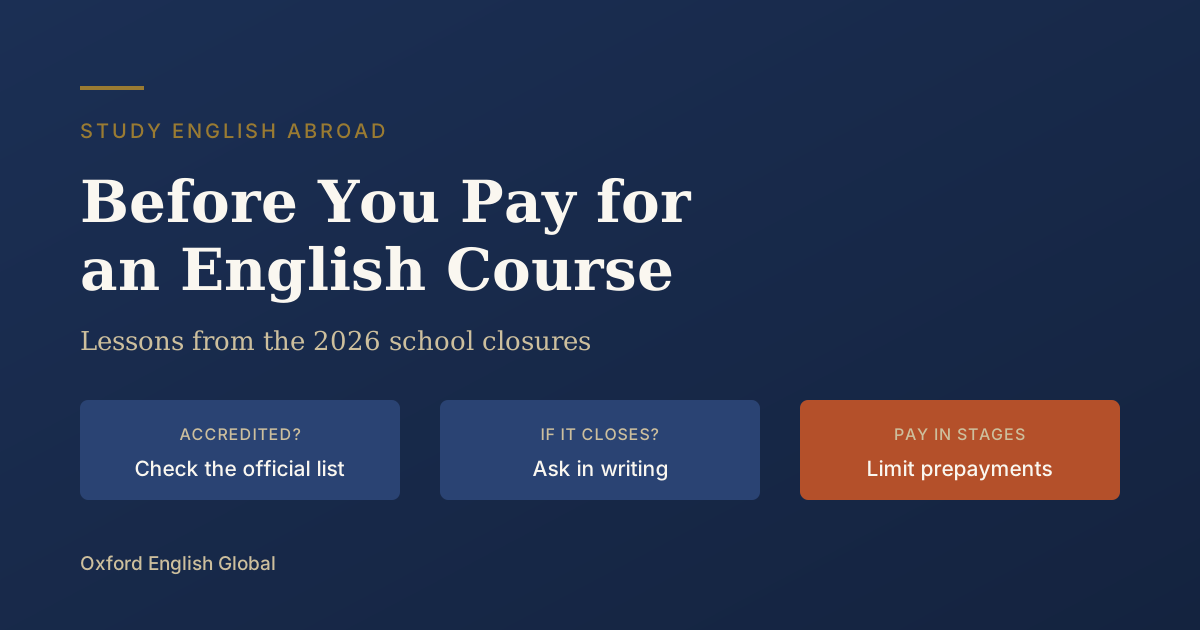
- What happened: English school closures in 2025 and 2026
- What protection exists in the UK today
- What English UK's review could change
- The checklist: what to check before you pay
- Questions to send the school, ready to copy
- Choosing the course itself: not only safety
- Example: two ways to book the same course
- What this article cannot tell you
Before you pay for an English course abroad, check five things: that the school is accredited (in the UK, on the British Council's Accreditation UK list), what happens to your money if it closes, which parts of your payment are protected, how much you are paying in advance, and the written refund terms. These checks matter more after 2026, a year in which EC English Language Centres stopped trading and English UK, the UK's national association for English language centres, launched a review to strengthen protection for students whose school closes. This guide explains what happened, what protection exists today and a practical checklist to use before you book.
Sources and date. Checked on 22 November 2026. The review and the gaps in current protection come from English UK's announcement English UK leads student protection review (28 October 2026). Figures on closures come from ICEF Monitor (3 November 2026). Accreditation information comes from the British Council's Accreditation UK pages. This is general guidance, not legal or financial advice.
What happened: English school closures in 2025 and 2026
ICEF Monitor, an international education trade publication, reports that there have been many language school closures in Ireland, the UK, Canada, the US, Australia and Malta in the past two years. Its examples:
| Event | What ICEF Monitor reported |
|---|---|
| UK language schools | More than 20 established schools have closed since 2025 |
| Languages Canada membership | Fell from 220 schools to 148 |
| EC English Language Centres | Ceased trading on 14 September 2026, affecting roughly 1,500 students in 24 schools across seven destinations |
| ILAC (Canada) | Filed for bankruptcy days later, displacing nearly 1,400 students in Toronto and Vancouver |
English UK's own announcement names "recent large-scale closures, including EC and BSC" as the events that "highlighted gaps" in the current UK protection scheme. Associations moved quickly to place affected students in other member schools, but students and agents could still lose money paid for accommodation and other parts of a package.
What protection exists in the UK today
The UK's current scheme is called Student Emergency Support (SES). According to English UK:
- SES helps displaced students find places at other accredited centres if their school closes;
- it does not protect prepaid accommodation or other elements of a student's package;
- it relies on receiving schools providing replacement tuition without payment.
In other words, the system today is mainly about continuing your lessons somewhere else. It is not a full refund guarantee. Jodie Gray, English UK's chief executive, said: "goodwill alone is not a sustainable system of protection."
What English UK's review could change
English UK announced the review on 28 October 2026. It ran an online consultation for providers, agents and students that closed on 11 November 2026; a task force will then recommend a model to English UK's Board of Trustees. ICEF Monitor reports that the aim is to agree an implementation strategy and timeline by the end of 2026. No final model has been chosen.
| Principle being consulted on | What it would mean for you |
|---|---|
| Protection for tuition paid for but not delivered | Lessons you paid for would be covered, not only "found" elsewhere |
| Protection before departure as well as after the course starts | You would be covered if the school closes before you travel |
| Protection whether you book directly or through an agent | Your booking route would not change your cover |
| An agreed level of protection for prepaid accommodation | Some of your housing payment could be protected |
| Possible cover for other prepaid items | Transport, activities, exam fees and course materials are under discussion |
| Protection compulsory for accredited providers | Every accredited school would have to take part |
The task force will look at ways to deliver protection, including insurance, funds or levies, escrow, guarantees, payment protection and hybrid models. Until a scheme is agreed and running, assume these protections do not yet exist and protect yourself.
The checklist: what to check before you pay
- Is the school accredited? In the UK, search the British Council's A to Z list of accredited centres, which also links to inspection reports. Check the exact school and city, not only the brand name. Accreditation UK is run by the British Council in partnership with English UK. In other countries, ask which national accreditation or association the school belongs to and check it on that body's own website.
- Is it a member of the national association? In the UK that is English UK. Membership matters because schemes such as SES work through member schools.
- Ask the school in writing: "What happens to my tuition and accommodation money if you close?" A good school will answer clearly. Ask which scheme covers you and whether accommodation is included.
- Check what is covered separately. Tuition, accommodation, airport transfers, exam fees and activities may each have different rules. Under the current UK scheme, accommodation is not protected.
- Limit how much you pay in advance. Ask whether you can pay in stages, for example for the first few weeks of a long course. A large prepayment for a year-long course is the biggest risk if a school closes.
- Read the refund and cancellation policy. Look for what happens if the school cancels, not only if you cancel. Keep a copy of every contract, invoice and email.
- If you use an agent, ask about their protection too. Ask whether your money is passed to the school straight away or held, and what the agent will do if the school closes.
- Check your payment method. Some card issuers and banks offer ways to dispute payments for services not delivered. The rules depend on your bank and country, so ask your bank before you pay.
- Look for warning signs. Very large discounts for paying a full year upfront, pressure to pay quickly, or reluctance to answer questions about protection are reasons to slow down.
Questions to send the school, ready to copy
You can send these in an email. Clear, polite questions in writing also give you a record. Our guide to writing a formal letter in English helps if you want a longer message.
Dear Admissions Team,
Before I confirm my booking, could you please tell me:
1. Which accreditation and association memberships does your school have for this centre?
2. If the school closes before or during my course, what happens to the tuition fees I have paid?
3. Is prepaid accommodation protected in that case, and how?
4. Can I pay in instalments rather than paying the full course fee in advance?
5. Could you send me your full refund and cancellation policy?
Thank you for your help.
Kind regards,
Choosing the course itself: not only safety
Protection is one part of the decision. The other is whether the course is right for you: your level, your goal, class size and how much speaking time you get. Our guide to choosing the right English language course covers those questions, and our free English level test helps you choose the right level before you book.
If you are planning a short course in the UK, check the entry rules for your nationality as well; our guide to the UK ETA for English course students explains one of them.
Example: two ways to book the same course
- Booking A: A student pays for 36 weeks of tuition and 36 weeks of homestay in one payment, through an agent, to an unaccredited school, after a "pay today" discount. If the school closes in week 6, most of that money is at risk.
- Booking B: A student chooses an accredited English UK member, pays the first 12 weeks of tuition and the first month of accommodation, keeps the written refund policy and has an email from the school explaining its closure procedure. If the school closes, far less money is exposed, and the student knows who to contact.
These are illustrative examples, not real cases.
What this article cannot tell you
- Whether a particular school is financially safe. Accreditation checks quality standards; it is not a guarantee that a business will not fail.
- The final English UK scheme. The review was still in progress on 22 November 2026. We will not know the final protections until English UK publishes its decision.
- Rules in every country. Protection schemes differ between the UK, Ireland, Canada, Malta, Australia, the US and elsewhere. Check the national body in the country you choose.
- Legal or financial advice. For a dispute about money already paid, contact your bank, a consumer advice service or a lawyer in the relevant country.
This page is independent guidance. Oxford English Global runs its own English courses, so we have a commercial interest in English teaching generally; we have no relationship with any school, agent or association named here, and the page contains no affiliate links.
Frequently asked questions
What happens if my English language school in the UK closes?
Under English UK's Student Emergency Support scheme, displaced students at accredited centres are helped to find places at other accredited centres. English UK says the scheme does not protect prepaid accommodation or other parts of a student's package.
What is English UK's student protection review?
Announced on 28 October 2026, it aims to create stronger protection for students whose accredited English school closes. Principles under consultation include protecting undelivered tuition, cover before departure, cover for agent bookings and some protection for prepaid accommodation. No final model had been chosen as of 22 November 2026.
How do I check if an English school in the UK is accredited?
Search the British Council's A to Z list of Accreditation UK centres, which includes inspection reports. Check the exact school and city, and ask whether the school is a member of English UK.
Should I pay for a full year of English classes in advance?
Paying a large amount upfront increases your risk if a school closes. Ask whether you can pay in instalments, keep the written refund policy and ask the school in writing what happens to your money if it closes.